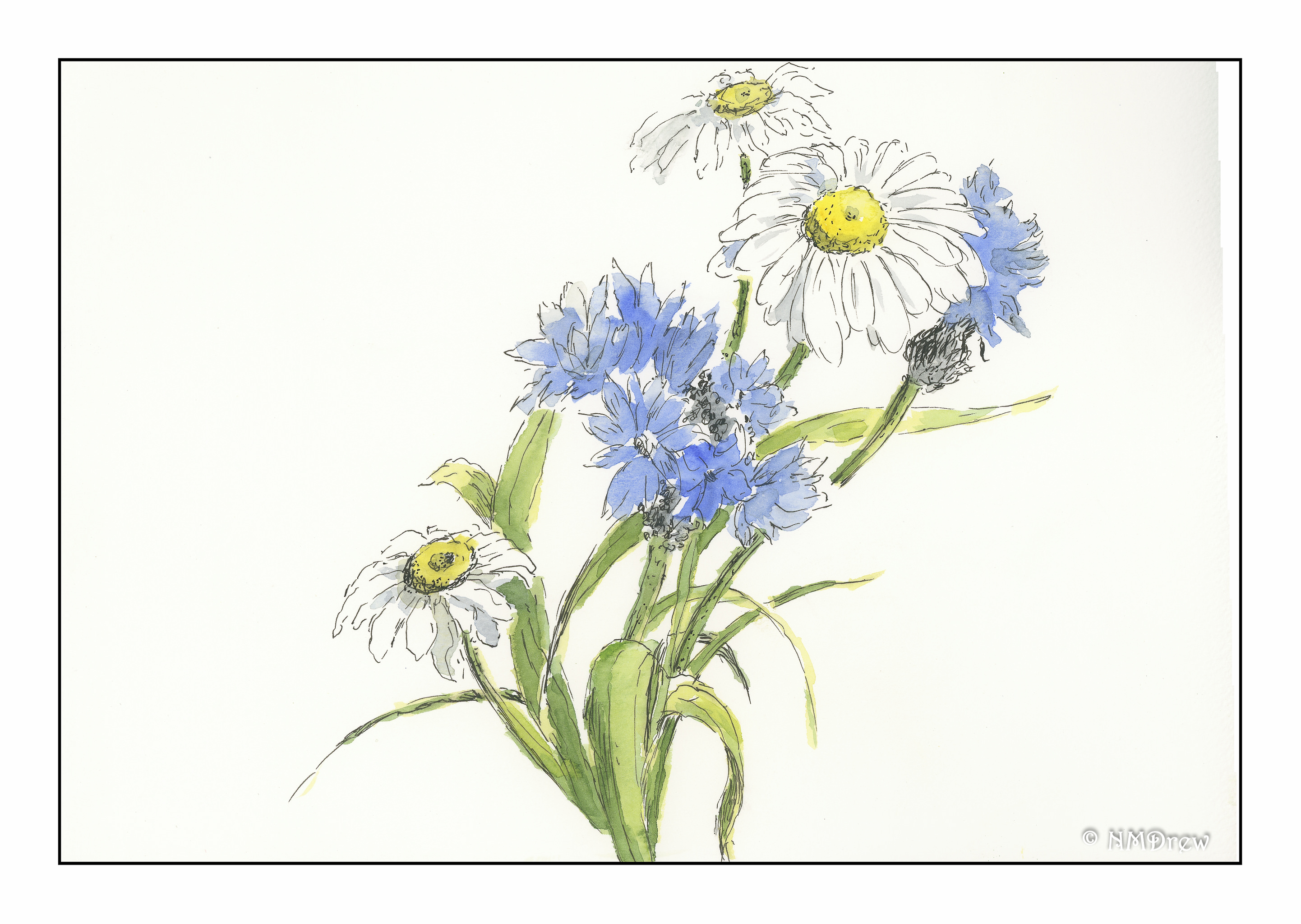
After a lot of watercoloring, picking up a pen and using ink to draw feels really relaxing. Adding watercolor to a pen drawing doesn’t need a lot of color, but it does require a bit of thought about light and shadow.
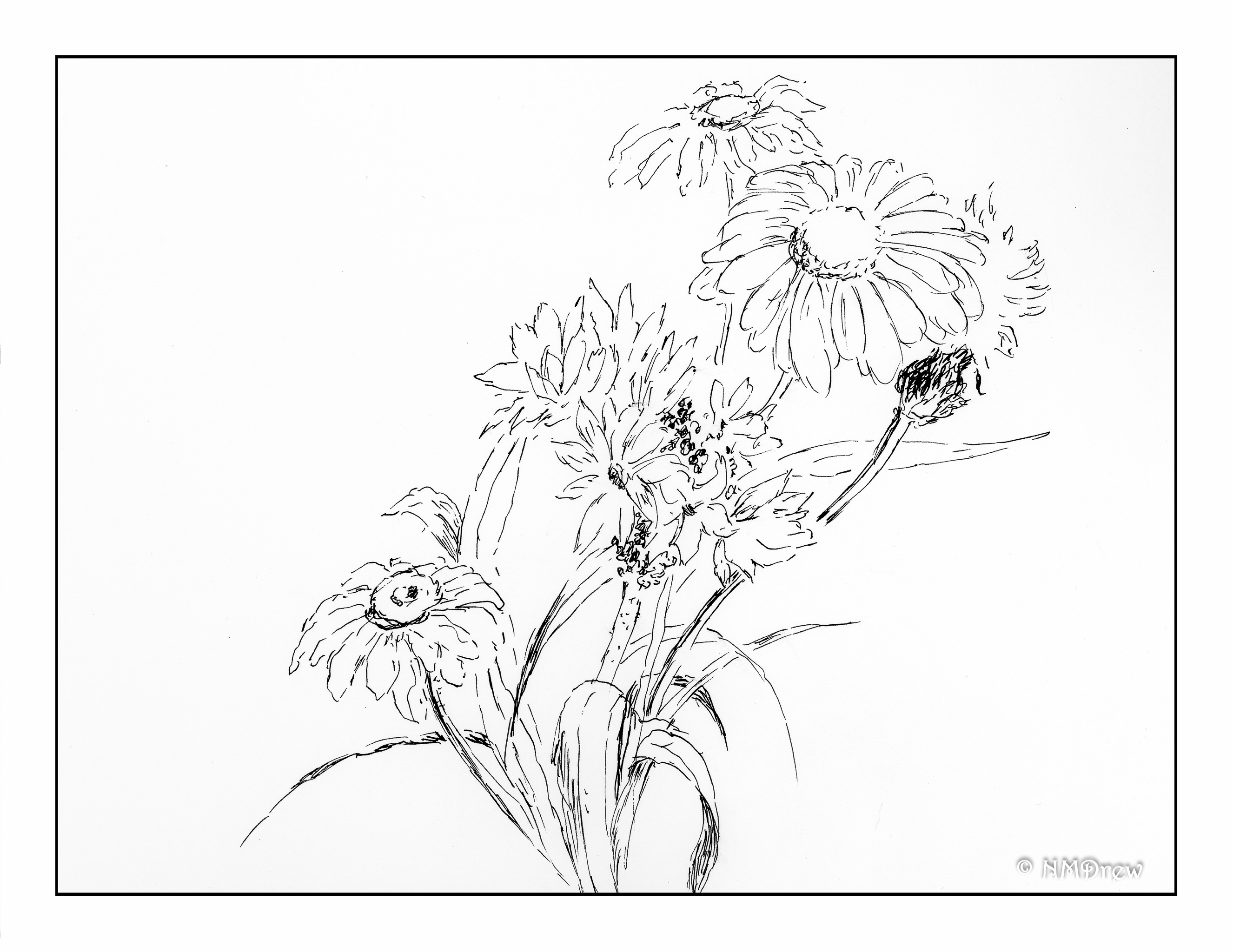
I thought about a daisy study of Peter Sheeler’s on YouTube – I remembered how very little color he added to his ink drawing of the daisy. With this in mind, I put in some greys and grey-blues. I tried to apply the same concept to the blue flowers (which I want to call cornflowers, but don’t think they are), and to the grasses and leaves. Below is my ink drawing, done freehand without a pencil sketch beforehand. I am rather pleased with both – my inking skills are improving, as, perhaps, are my watercoloring skills. Less is more has become more of motto than before!
One of the pleasures of hiking is taking in the little details along the trail, such as this small daisy-like flower with its cheerful purples and yellows.
Below is an image of a daisy taken awhile ago alongside our house. It’s rather bland. Below is the same image, with post-processing done in Photoscape. You can see that under the top daisy, the flower’s receptacle has become nearly pure black, like a puzzle piece. Even in the original picture, it is a bit dark, and consequently distracting to the eye.
Original PhotoDaisies with Post-Processing
Neither picture above is especially spectacular, but the post-processing certainly messed up the final image. Below are two more results, the first which is sharpened only from the original. The receptacle is a bit more defined, with its ridges a bit more clear, but not darker. The second one uses the “bloom” feature (which I don’t understand – I’m a novice in post-production photography software) in combination with the sharpening. I think the result is a little better. The whiteness of the petals is more apparent. I also used the mole removal feature to get rid of the black spot on the foreground daisy.
Daisies SharpenedDaisies Sharpened and Bloomed
One thing I have a very hard time with visually is contrast – adjacent areas and their shades of grey – when I work in color. Whenever possible, I try to take photos of any artwork I am doing to check out the contrast. High contrast has few shades of grey; low contrast has several. The degree of density in each, how dark or light, can determine the “pop” in a picture. In painting, this can cause items to retreat to the background, or move forward. This is what our mind uses to create depth and dimension in a photograph or a painting.
This next photo is the last one above, converted to greyscale. It is a soft photo, not especially dramatic. There are good areas of contrast, but the petals are lost.
Daisies in Greyscale after Sharpening and Blooming in Color
This next photo is the greyscale photo further sharpened, and the contrast increased. The petals are more apparent.
Greyscale Daisies with More Sharpening and Contrast
Finally, here are chorus lines of the photos in a row. It may be worthwhile to look at it, and thus decide which photo is ultimately the best. I set the lines up so they would span the same space, but in doing so, some of the image quality is degraded. What I am looking for is the contrast and clarity in the final image of the petals, the inside yellow part (stamens and pistils? I forget my flower sex!).
Ultimately, I am not sure about any of these photos. I think the viewer needs to determine it. Liking or disliking a photo is a personal thing. I do think, in general, the composition is rather nice, but in retrospect, I should have taken the photo from a more superior perspective, looking into the foremost daisy a bit more, but not by much. Also, to cut down on “busyness,” it would have been a good idea to remove the dropped petal on the most distant daisy, the one up against the wall. If I knew how to remove it with software, I would try it. There is some movement in the photo. The center of the daisy on the left may be a distraction, just as the receptacle on the upper daisy may be too dark.
Good, bad? I need to step back to reconsider! Too close, too much, a bit overwhelming. Later I can make a decision.
Whoopsie Daisies!
One thing which does help is turning one’s work upside down.The same can apply to a photo. Maybe I am more successful than I think, as I really like the movement in this upside down image. And, in reconsidering, I like the one of the colored daisies only sharpened a bit, with the black spot removed, the best.



 Ink, Yarn & Beer