Summer’s End

Somewhere I remember reading about a “rosy dawn,” but today’s rosy dawn is because of the fires burning in the San Gabriel area in Southern California. Yesterday as I drove home from Ventura, the billows of smoke from more than 80 miles away could be seen piling up in the sky, much like a volcano’s ash and smoke as it travels upward. This morning, the air is thick, and ash is falling on the streets in very fine particles.

The entire state of California is very vulnerable to these fires, which are part of the eco-system, and the fact that we have had a drought for several years, makes massive fires a very likely probability.

Where we live, we are in a valley surrounded by mountains. So far, we have not had anything major since moving here nearly five years ago, but I wouldn’t be surprised if our time will be soon. So many things can cause a fire, from a spark from electrical equipment to a bird on fire after hitting a power line (yes, it has happened), that you just don’t know where it will occur. You just need to be ready. Fires and earthquakes – a fact of life in California.

This week, our very good friend, Jerry, and his wife, Raka, have been here from Japan. They were married a year ago, and only now is their wedding reception being celebrated by their friends and family in the U.S. And, their first child is on the way! It is so good to see them, and wonderful to have the time to visit. They return to Japan tomorrow.

For me, the end of my all-too-brief summer holiday is winding to a close. I’ve had a few weeks off from students and school, but I still have had to deal with them even though I have tried to keep it to a minimum. We all begin again on 1 September.

I am also becoming a student again. Now that I have finished my teaching credential, the brain finally has time to pick up Japanese once again. I’ve tried different routes, but nothing seems to have been successful. I tried a community college class two nights a week while working on my credential. Beret Patt - First PageToo much work on all levels. Another time I tried a language class offered through a local adult school, but did not learn anything. Now I am trying to do it once more, this time through the Oxnard Japanese Language School. As the course meets state high school language standards, I expect it will be much be more to my liking. My class is for beginning adults; there are five adults, and seven kids, the youngest of whom is thirteen. Once we all settle in, I think it is going to be a lot of fun.

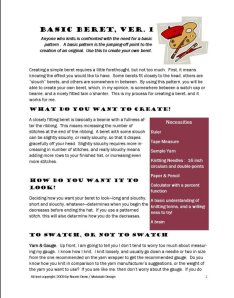
Finally, I’ve written down a very windy “how to” for making your own beret. Take a look at it. The purpose of this “Basic Beret” pattern is to help out the beginning knitter trying to design a hat. You can find the file on Ravelry, or here on the Pattern page, or under the heading of “Matataki Designs” to the right.

Yarns of the City – 27 August 2009

Village Spinning & Weaving

For the fiberholic on a road trip through the central coast area of California – north of Santa Barbara – the Village Spinning and Weaving shop is a must-do. This summer, John and Marsha, the proprietors, celebrated their eighteenth anniversary in the same place by being able to more than double the size of their store by expanding into the retail area next door. When Josh and I visited them in June, they had just broken through the connecting wall.

Some of our closest friends, Stephanie and Jay, were living in Solvang at the time Village Spinning opened. Stephanie is a full-time weaver, and I primarily a spinner/knitter – of course this was heaven for us! And Solvang is always good for a lazy day or a short trip if you live nearby, or need cookies or chocolate or cutlery, or you are on your way to the wine country. (I recommend the large cookie boxes at Mortensen’s Bakery, Ingeborg’s Chocolate, and Nordic Knives, if you need to satisfy some other vices.)

Anyhow!

As you walk in the main door – which will probably still be the only entrance to this fiber wonderland – you enter the current store, filled with yarn, fiber, weaving supplies, looms, spinning wheels, roving, bats, books, dyeing supplies, knitting needles, and on and on. You want it, they probably have it. (Notice, I did not say “need“!)

Getting extra space at Village Spinning & Weaving will benefit everyone. The new space has a lot of lighting, both natural and installed. All this will allow better display of looms and spinning wheels, which is really important if you want to check out how an item looks, or feel how a wheel spins. There will be room for knitters. Some lucky group will get to sit around the fireplace, but the sunny windows are not a bad place to be either. As you can see below, there is a lot to look forward to – at least there was in June. I hope they are all moved in and ready to go!

The service you get at Village Spinning & Weaving is wonderful. And they have a lot of stuff – dangerous! This is what they say on their “About Us” page:

Solvang’s Village Spinning & Weaving Shop was started in 1992 by John Novak and Marsha Mullaney-Novak. This shop grew out of our desire to simplify our lives and provide the best possible service and products — something we find lacking in much of today’s world.

Whether you are looking for a new loom or some cochineal for dyeing or maybe a new tatting book, check here or give us a call.

We carry much more than we can possibly list here, so… we have several different print catalogs – you can download a pdf file from this website for many of them. As things change, sometimes too quickly, prices in our printed catalog may not always be completely up to date.

John and Marsha are very knowledgeable about the products they sell. Inventory includes so many books you think you have died and gone to heaven, wheels to test drive, looms both large and small. John takes a lot with him when he does shows such as the Black Sheep Festival, Stitches, or Convergence. Many of you may have met them at one of these events.

For those unfamiliar with Solvang, it is a small town off the 154 and 101, about 30 miles north of Santa Barbara. The Sant Ynez valley is a beautiful place, and as you come over San Marcos Pass into the valley on the 154, the view is breathtaking. This valley, toward Santa Ynez, is where the movie “Sideways” was filmed.

I’m looking forward to my next trip to Village Spinning & Weaving, to see how the expansion is going, to finger fibers, play with wheels, peruse books I have never seen. My pocketbook may suffer a bit, but it sure is worth it!

See you there, and tell ’em I sent ya!

The Weng Collection and Chinese Garden at the Huntington Library

I have a fairly decent knowledge of different time periods in western art history, and some familiarity with many forms in which it is produced.  I’ve worked with oils, acrylics, watercolors, done etching, stone lithography, and other forms of printmaking.  Being familiar with techniques gives an appreciation of the process the artist goes through to create a work.  I’ve also studied art history a bit, and know what occurred in what time and place, understand the evolution of styles, and can recognize a fair number of renown western artists.

Studying Chinese painting is very different because there is not the cultural context of brush and ink, nor a sense of the symbology of many of the subjects.  To the western eye,  it has been written, much of the painting and ink art of Asia is not understood.  I’m inclined to agree, because although I love the elegance and simplicity of sumi ink painting, my cultural background and training can make the art of Japan and China at times difficult to appreciate.

The Weng Collection – “Treasures Through Six Generations – at the Huntington Library in San Marino, California, was eye-opening.  Spanning about 900 years in time, from the 1200s to present day, calligraphy and paintings, large (a 53′ scroll) and small, filled a couple of rooms.  There wasn’t so much that it was overwhelming, but enough to appreciate a sense of time and history in Chinese painting.   It was through this continuum of paintings that I got a sense of history and development, as well as an appreciation for the symbolism, the individuality expressed within traditional subject matter, and, I think, a sense of Chinese cultural time.  I was able to look at a painting and recognize how it was done – the movement of brush and ink, the addition of color.  Brushwork and style was recognizable, as both fine line and more spontaneous styles were shown.  The calligraphy was beautiful, ranging from “letters home” to loved ones, to a large, magnificant scroll of “hu” – tiger.

Newly completed in 2008, the Garden of Flowing Fragrance is nearby the exhibit.  After leaving the exhibit, we wandered down the hill, and into a grove of pine trees – so like the ones depicted in the scrolls in the exhibit, and so like the ones shown as samples in The Mustard Seed Garden Manual of Painting. From there, a setting of young black bamboo.

The grove leads to the ponds and streams which have numerous koi, trees (willows and native oak), pavilions, and bridges.  The eye is led here and there.  Details small and large wait to be noticed. Architecture, plants, and water create a living handscroll.

The Weng Collection, the Chinese garden, The Mustard Seed Garden Manual of Painting, and my monthly Chinese painting class have conjoined into a single experience.  Somehow, I understand the history of Chinese painting better – nearly a millenia of tradition has been seen (and who has touched these paintings?  who made them?  who unrolled them in lantern light to enjoy them?) – a garden of trees and flowers, an earthly aesthetic – a “how to” book that is about 500 years old, and still being printed – and finally, doing the brushwork myself, as generations have before.

The catalog which accompanies this exhibit is well worth the 25.00 price – I know I will continue to enjoy this exhibit long after it leaves the Huntington. It gives the history of the collection, and detailed information about the work displayed. These pictures will give a sense of the contents.

If you ever have the opportunity to see this exhibit, go! And if you are in the Los Angeles area, visit the Huntington Library. The grounds are incredible. The gardens are beautifully laid out, one leading to another. We went on a Friday, had a picnic on the lawn (you cannot bring food into the gardens), and wandered through galleries, gardens, and had a peaceful time. In four hours we could not see enough. We shall return!

Excursion: Treasures through Six Generations

Tomorrow I will be heading down to the Huntington Library with a friend.  This is a rather pleasant, serendipitous excursion because while in South Pasadena, at Gus’s, I saw a poster for this exhibit, Treasures through Six Generations:  Chinese Painting and Calligraphy from the Weng Collection. In the back of my mind I thought it would be worthwhile seeing, but not sure if I could organize my life enough to get to it.  The biggest intimidation factor is I just don’t like driving in L.A. traffic!  I’ll be meeting up with my excursion buddy in the valley, and as I am driving the first half, chauffering will be provided the rest of the way.

The Weng Collection has an interesting history behind it.   According to the press release of Feb.23, 2009 from Huntington:

The history of the Weng family and their art collection reads like an epic novel, mirroring the tumult of 19th- and 20th-century China and its ensuing diaspora. Assembled primarily in the second half of the 19th century, the collection is legendary not only for its superb selection—it contains masterpieces of brush and ink spanning 900 years—but also for the remarkable individuals who have been responsible for its formation and safe-keeping. The works of art have survived repeated dynastic changes, protracted warfare, and journeys across continents, remaining almost miraculously unscathed under the care of this family.

The Weng collection has been in the same family for six generations, beginning with Weng Xincun (1791–1862). Xincun’s son Weng Tonghe (1830–1904) and the collection’s current owner, Wan-go Weng (b. 1918), are particularly celebrated for their remarkable achievements.Weng Tonghe, the family patriarch who formed the nucleus of the collection,was a preeminent figure in late Qing China.He rose to prominence when he placed first in the 1856 metropolitan exams for the jinshi degree and became a zhuangyuan (“First Scholar of the Nation,” as Wan-go Weng likes to say). Weng went on to tutor two emperors, Tongzhi (r.1862–74) and Guangxu (r. 1875–1908). The latter studied with him for a total of 24 years and regarded him as his closest adviser. In addition, Weng also held some of the highest positions in the government. He is remembered in history as the leader of the pro-war faction during the Sino-Japanese war in 1894–1895 and, through his introduction of the radical reformer Kang Youwei (1858–1927) to Guangxu, for his early influence on the emperor’s Hundred Days’Reform in 1898.

Weng Tonghe’s collection was passed down to Wan-go Weng, who brought it to the United States in 1948. Wan-go Weng is himself a modern-day Renaissance man—filmmaker,poet, scholar and civic leader—whose English films and publications on Chinese history and art have been widely influential among both scholars and general readers. Under his leadership in the mid 1980s, the New York–based China Institute rebuilt its reputation as one of the leading centers for the promotion of Chinese culture in the United States . . . .

The gardens at the Huntington Library are renown.  There are themed gardens, such as a Chinese one which is a perfect parallel for the Weng exhibit, a Japanese garden, a desert garden, a Shakespeare garden, and more.  If you want to see what is in bloom, for instance, this month, you can click here.

I’ve lived in California most of my adult life, within close proximity of the Huntington – never more than 100 miles – but this is my first trip, and I’m as excited as a kid going to Disneyland!

Yarns of the City – 27 June 2009

Anacapa Fine Yarns

This weekend Anacapa Fine Yarns celebrates its 5th birthday.  And what a party it is!  On Saturday, Judy (my MIL) and I wandered over, planning on some damage occurring to the budgets.  We got in a bit later than the 10:00 a.m. opening – not much later, just 30 minutes – and the place was packed!

Lois started this store after working in a large accounting firm for years, and the years of “taking care of the books” certainly showed in her foresight.  Anacapa has been able to grow with the business. Lois is a cheerful, friendly person – sunny and funny – and greets many of her customers by name.

The store has a lot of floor space, natural light, good artificial light, and cosy feel.  In the front is most of the yarn, with plenty of room for new shipments, books, buttons, needles and notions. There are knitting bags, bits of fluffy wool for spinners, and yarns for all budgets and tastes. In the far corner are the books, with a small, circular table where you can sit, knit, chat, and look at patterns.  In the back is an even larger room, for classes, and more yarn (what else?).  Lois has had trunk shows, authors, teachers, as well as monthly and on-going classes.

As the years have gone by, more yarn has come in, wonderful employees, and a group of friendly fans make this a great place for knitters to congregate.  Customer service is always available, and I have never had a bad moment here – until I look at all the woolly seduction!  Then – well – you know how that is!  Choices!  And some – just some – self-control!!

And the sale? Well, you can see how crowded it was. The line was verrrry long! Judy and I each got sock yarn. Judy got some grey-green-blue Koigu, and I got some ocean-blue-green. Judy also got a lovely sock yarn that was creamy with other colors dispersed through it. I also picked up a nice ball of manly Tofutsies for the esposo, and some – finally! – Mini Mochi in greens.

Anacapa is a gem of a yarn store, and if you are up in Ventura, California, don’t forget to visit.  They are open 6 days a week – closed on Monday.  The newsletter is published regularly – take a look and see what’s happening and who is showing up.

Happy 5th, Anacapa!