
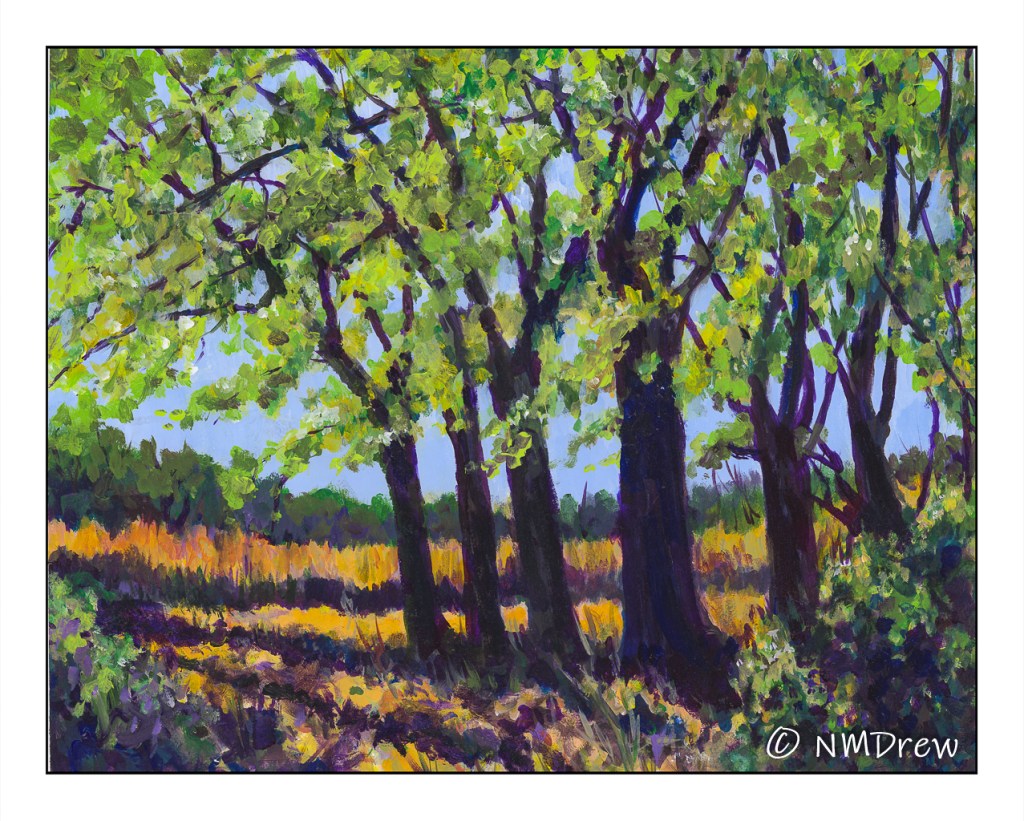
Trees, Late Afternoon

Third and last of a photo I took earlier this month in Independence, CA, before being driven back home because of Covid. I am not sure which of the three of these paintings I did of the same photo I like best (you can back track on this blog if you want to see them, or go to Instagram!), but this one, in acrylic, was by far the most time-consuming.

I used 16×20 Arches 140# CP paper and a variety of acrylic paints, but first I laid down a few layers of gesso to prep the surface of the paper. The first layer of gesso was thinned with water and brushed on quite firmly to work it into the paper itself. The paper warped as watercolor paper does, but I was really happy to see it flatten out with the second, thicker layer of gesso.

Most of my brushwork tends toward dabbing on dots, which is great for pointillism and impressionistic painting, so I worked at creating lines, as seen on the grasses in the background, along with using a flat brush and using its tip or sides to work paint in a more up / down, side-to-side manner. My next painting is going to include these types of brush strokes, just because. It never hurts to try things you don’t usually do.

Every type of media – watercolor, gouache, acrylics – has its own “language” – that is, the way you have to work with it. Acrylics are rather heavy on paper and I need to think ahead for what I want to do. I tried the slower drying acrylic paints, and just did not like them. As a result, the ones I use tend to dry rather quickly. Filling the palette with every color I think I might want to use is a waste of paint. Instead, I have to plan, not like a general, but certainly I need to anticipate what comes first, what comes next, and so on. I also have to think about brushes and brushwork. Painting can be spontaneous, but it also needs experience to allow for more success (however you want to define “success”) than failure.

One thing I considered for this painting, but did not do, was to lay down a glaze to unify it. Chicken! Maybe I will come back to it later. Now, two things are on my next painting agenda: buildings and no dabbing! And maybe a glaze . . .

Dry Land to the East

I was in the passenger side of the car, in the back seat. The land was barren and dry, filled with rugged rocks and sparse vegetation – beautiful and lonely.

I like to have my digital camera (here, X100V) set to a fast exposure and point and shoot, shoot, shoot, shoot out the car window. It is always surprising what you get and rather fun, too.

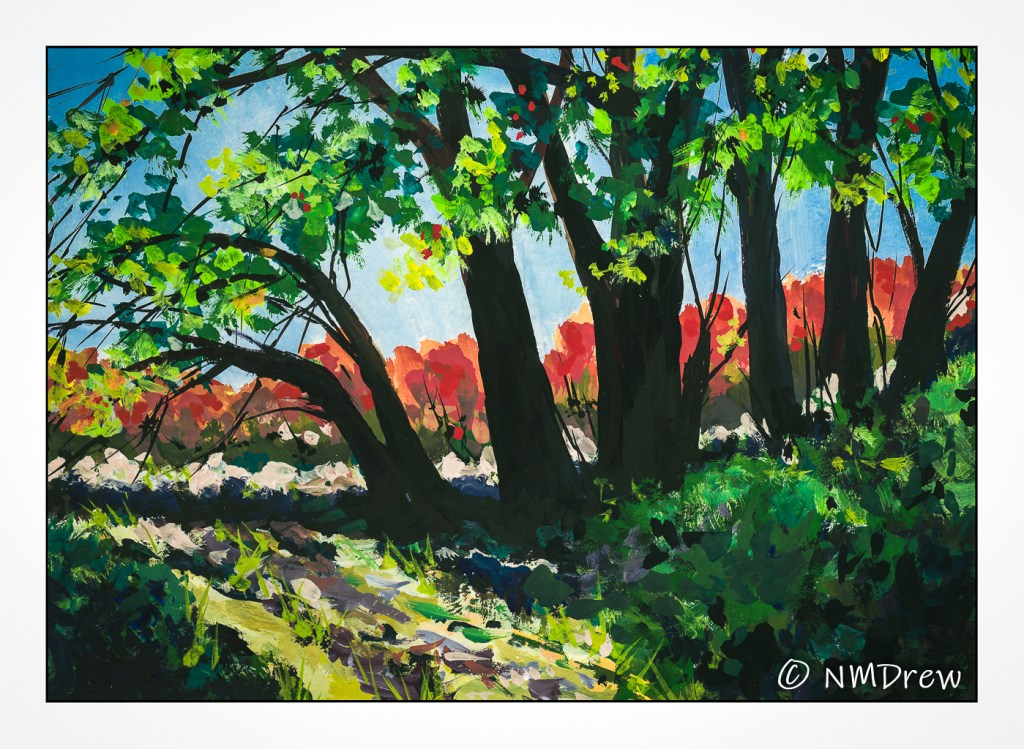
A Hint of Autumn

Independence, CA

Well . . . I got tired of pen, ink, watercolor. Watercolor just wasn’t in my head, so I dug out my gouache paints. They were rather fuzzy from mold – typical of gouache if you don’t use them often enough – so, I rinsed them off, and went to work. I really like the photo I took of these trees but did not like my earlier efforts.

I started out so klutzy – like, how do I use my colors? order or painting? All the usual stuff that goes with not doing something for awhile. The result is far better than I thought it would be!

Dry Wash

Dry Wash at Independence, CA, Botanical / Native Plant Garden

One of the nicest things about spending 2-3 nights at a place is that you get to explore. Independence, CA, is along Hwy 395 and is a town you would zip right by if your weren’t staying there. However, you really can miss a few things!

We stayed at the Winnedumah Hotel, in a room at the back. Out the door and down the road a few blocks is the local museum, and although it was closed the days we were there, we plan to go back. Outside the museum is a rather wonderful native plant garden. It faces west, so it is in the shadow of the Eastern Sierras. There is a creek running through it, complete with trickling water. Winter rains swell it and it obviously flows over its banks.

The sandy shore and rocky bottom depicted here create a dry wash. In canyon country these smooth areas are tempting for campers because the smooth soil makes pitching a tent and sleeping bag comfortable and easy, but if a rain happens upstream, a flash flood creates a swirling death trap. Even locally – where I live – people are drawn to these washes in the rainy season (if there still is one . . . ) and get washed away in the event. I had a wonderful friend who died in such a flash flood because the ground he was standing on probably got abruptly eroded from underneath. Even peaceful streams need to be treated with respect.

Mess Hall

This is a distance shot of one of the remaining mess halls / dining halls at Manzanar, the Japanese interment camp located in the Owens Valley of California. The Eastern Sierras butt up against with a sort of barren plain between the camp and the mountains. Over 110,000 Americans were forced here during WW2.

Not a lot remains here. Barracks were many, as were latrines, laundries, manufacturing, kitchens, and a cemetery. A hospital and schools and recreation areas kept this from being a dreadful place of extermination, but it did often exterminate self-worth and communities.