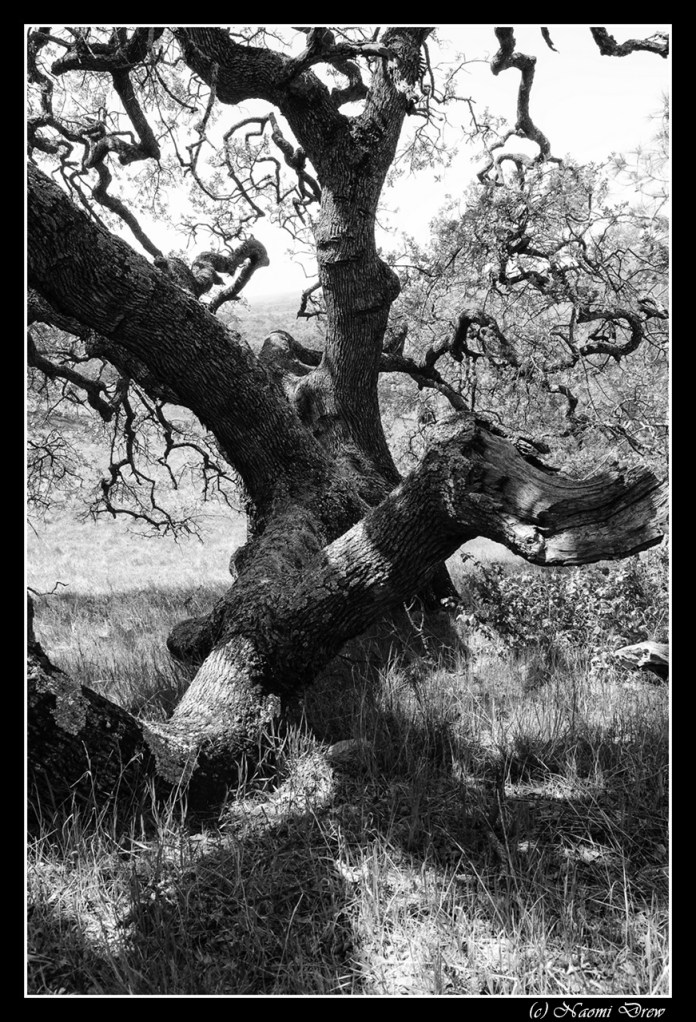
Old Oak


The other day I picked up a book on black and white photography, specifically John Batdorff’s Black and White: From Snapshot to Great Shot. He mentions using available light. With this in mind, and rather restless as I wait for the afternoon to pass before heading out to a swank party, I wandered around and came across my husband’s shoes on the table. He just polished them.
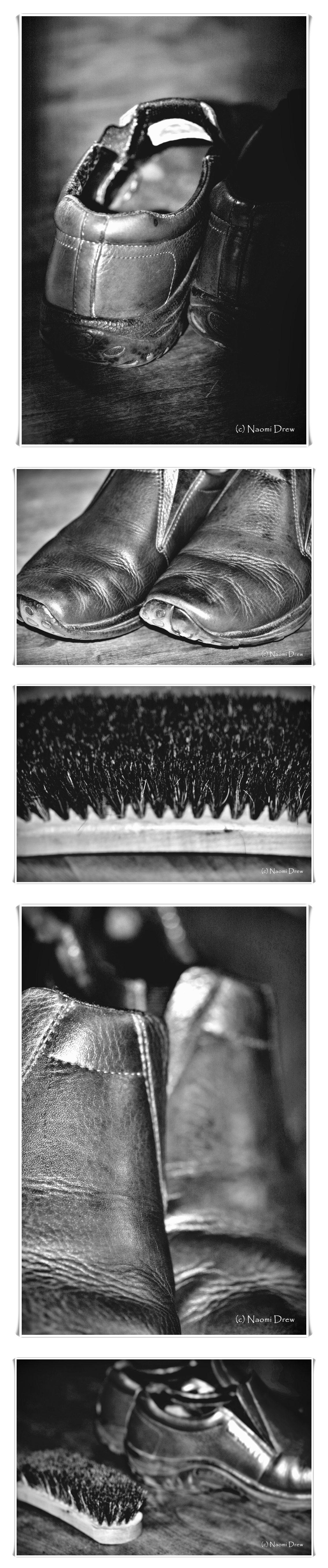
I used available light, and augmented a bit with some post-processing and on-camera pop-up flash for a few pictures.
As they say, work with what you got.
There are days, as anyone creative knows, when you “get it” and things come along perfectly. Everything you do feels right, you learn, and all the knowledge you have acquired throughout your lifetime pulls together and you create something you love, feels satisfying, and adds to your ongoing growth as an artist. And then, there are days where anything and everything you do is crap.
My walk around the neighborhood the other day was satisfying. The ants-in-the-pants restlessness was put into action. While I took some pictures I thought were pretty good, it wasn’t until I got home and started playing with some of them in black and white that I began to get a sense of composition in photos. Sure, I know the rule of thirds, etc., but I wasn’t really using it in a way I found meaningful. When I began the post-processing, I began to appreciate some of my photos a bit more, and with some cropping, rotating, contrast enhancement, or whatever, I ended up with a few I really liked.
 This picture was simply a quick shot into the tree above me. I like the shape of tree branches and leaves, the lines created against the sky. Turned into greyscale, the picture was too dark, and the texture of the bark was lost. I backlit it to the extreme, and it pushed the picture to this. A bit of contrast enhancement and playing with the histogram, and this is the result. It’s a rather edgy picture to me – not very serene – but there is something I also like about it, such as where the upper branch begins to get so bright it begins to disappear.
 I cropped this picture a lot – it is evidenced by the size of the signature in the corner! Anyway, this crop is of some tiny cactus flowers on a lovely plant with pointy needles. I decided to emphasize the pointiness, both on the spikes, and more generally on the shadows. The back-and-forth movement of light and dark is the idea behind this picture, both soft and sharp.
 I cropped this one to bring the focus onto the leaf itself. I pushed this, with contrast and edge sharpening. This is the underside of the leaf, which has a lot of linear texture. I also think this one has the potential to go further in subject matter – calla lily leaves are really lovely to look at through light because the veins in the leaf are so intricate.
 Finally, there is this one. I played with it a bit, and finally cropped it and rotated it so that the main branch of the leaf became horizontal and rested in the lower third of the photo. Again, the contrast was pushed, and the final image cropped.
You can see all these photos on Flickr, in B&W and in color.
Altogether, the post-processing was quite a satisfying experience. I thought about my compositions, and saw things in the original photos I liked, did not like, and I learned more about framing an image as I cropped and turned. I may not get great photos out and about, but I do think I will be looking at the entire image more carefully before snapping a picture (unless I am crawling in the mud!).
 Ink, Yarn & Beer