
More with HDR Express

One thing I find I like about HDR, if not pushed too far, is that it can create a good sense of the original light without a loss of detail. I still have 8 days left on my trial version of HDR Express, so that is the toy I chose to play with this morning. Yesterday’s picture shooting up into the tulip tree was the subject.

Manipulating images in other software, such as Photoscape or FastStone, allows me to lighten and darken them. I did this with the idea of merging multiple images in HDR Express, but HDR Express likes being boss, and reads the metadata from the same 3 images, and shuts its processes down – it realizes that you’ve got the same picture. That is a frustrating limitation. Removing all the metadata doesn’t change the situation. However! There is a work-around that is rather nice.

In Lightroom, open up the image you want, adjust the image so it is dark, and then right click on the image and export to HDR Express. It then pops open HDR Express, and HDR Express takes a few minutes, and creates 5 images, ranging from dark to light for your viewing pleasure. The differences are not immense, but if you watch the histogram on the upper right of the screen, you can see what the program is doing to your picture.

Below is a composite picture of the tulip tree out front. The top one is the original one I shot, which was dark to begin with, so I didn’t change it when I sent it to HDR Express via Lightroom. The middle one is my adjustment in Photoscape, which did a good job, but the intensity of the blue sky was a bit lacking. Finally, the bottom image is the one I exported to HDR Express, and it produced a rather pleasant image, with all the detail of the trunk, while retaining the colors of the leaves against that intensely blue sky I saw in my lens.
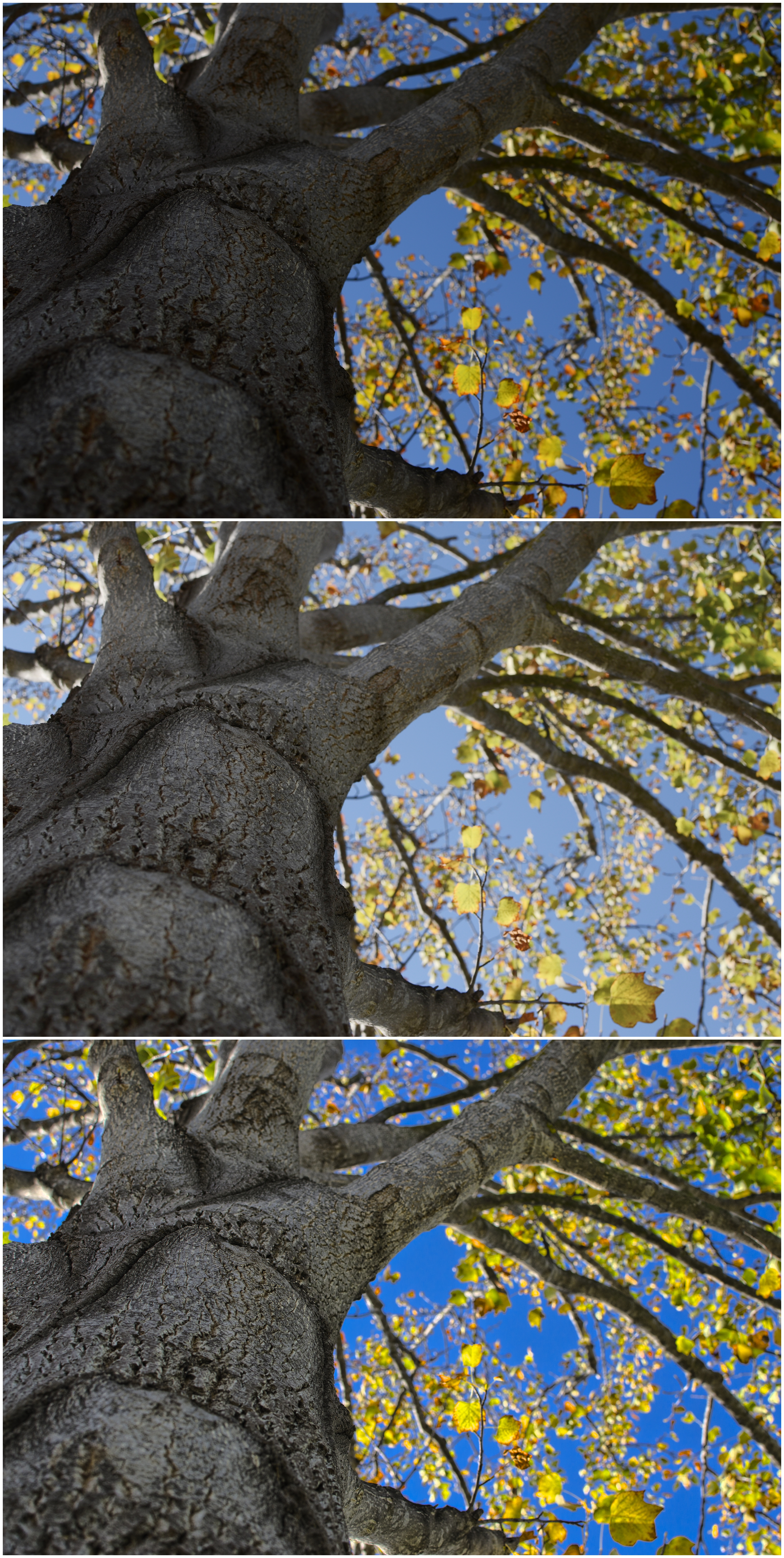
Top to Bottom - Original Picture - Lightened in Photoscape - HDR Express Image from Original

The Nikon Hit Man doesn’t like the idea of having to use lighting or post-processing to get the perfect image. I disagree.  Post-processing is often necessary, and has been done forever by artists in the darkroom – dodging and burning are forms of post-processing. The thing is, sitting at a computer putzing with software is pretty dull stuff, so for us restless souls, it’s something of a nuisance. In a darkroom, you are moving around, not sitting at a desk. Big difference. Modern technology has its points, but movement is not often one of them!

I am in agreement, though, with the Nikon Hit Man about the original image: it should be as perfect as possible. This means you think about it before hand (if you can) by choosing the right lens, exposure settings on your camera, and so on. Not always easy to do – or remember – because there are so many things you can forget as well! And that is why programs which allow image manipulation are assets to the photographer. Nonetheless, for people who like the physical realities of art, software is more challenging than trying out a new medium, and often far more frustrating.

Life isn’t perfect, but we adapt!

John Marshall: Works in Fabric, ii

My first contact with John Marshall came about when I discovered his book Make Your Own Japanese Clothes.

For anyone interested in traditional Japanese fabrics and clothing, this book is an incredible resource of information.  You learn how to construct Japanese clothing using traditional fabrics (which measure 13-14 inches wide), and how to sew them using traditional hand-sewing techniques.  Of course, you can also sew them by machine, but that just isn’t the same!

Garment construction is given for kimono, haori, hanten, various tops, vests, pants, obi, and tabi.  Not only do you learn how to make these, you also learn about the construction of sleeves, hems, collars, and the use of lining and padding.  All of these, combined with illustrations and photographs, give window to both traditional clothing, and a window into creating your own clothing with a modern cast.

I made the hanten, hand-stitched using traditional kasuri, and totally enjoyed the process.


John Marshall: Works in Fabric, i

John Marshall, of Covelo, California, is an incredible fabric artist who designs clothing using the traditional Japanese katazome and tsutsugaki techniques to color the fabrics he uses in clothing he designs and sews himself.

A bit about John, from his website:

John Marshall is an internationally known textile artist working with techniques of paste resist dyeing. He produces a wide range of sophisticated and colorful designs, many of which show the influence of his years of study in the Orient.

John grew up in the small town of Florin, just outside of Sacramento, California. Before wartime evacuations, Florin had been one of the largest Japanese-American communities in the United States; after the war many returned to reclaim lost years and property. These are the friends and neighbors John and his five brothers and sisters grew up among.

John’s Godmother, the late Mary Tsukamoto, was a great influence in his life: teaching him to read and write the Japanese language and sharing with him her great love of her cultural heritage.

At the age of seventeen, having worked and saved toward his goal for many years, John was off on his own to discover Japan. His eagerness to learn secured him private instruction under a variety of specialists in doll making, centered around the Yamato style. John was intent on studying the many facets of these shell-faced dolls, such as carving, weaving, dyeing, and sewing, to name just a few. His knowledge of the Japanese language proved to be of great benefit in understanding the subtleties of the culture.

The internationally published paper artist, Kunio Ekiguchi, took John under his wing and saw to it that he received the proper introductions so necessary in Japan. Mr. Ekiguchi arranged an apprenticeship for John with the late Matsuyo Hayashi, a master dyer in the bingata style of paste resist. Through her insight and careful instruction, John became truly fascinated with this ancient art form. Mme. Hayashi had long dreamed of sowing the seeds of her art abroad. Upon her death, John discovered she had willed much of her lifetime collection of work, supplies and equipment to him. John was determined to fulfill her wishes by bringing her techniques to the West.

Continuing his research into ancient cultures and dye techniques, John aims to interpret the sensibilities and aesthetics of the ancient and ethnic world through the Japanese paste resist process, using the actual plants and insects employed in making the original dyes. John’s research so far has taken him to Japan, Thailand, Italy, Indonesia, and the Yucatan. Through the generosity of collectors, he has had the opportunity to view first hand a wide range of ancient and ethnic textiles and artifacts which have served to influence his fabric designs.

Today John is in the midst of renovating an old flour mill in the Old West town of Covelo, nestled in the remote mountains of Mendocino County of Northern California. A generous 12,000 square feet, the new studio is used to display the full range of his work intermixed with art pieces collected at home and abroad. Situated on an acre of land complimented with over 300 wisteria vines gracefully covering a redwood arbor, this sun-filled space is also used to host lectures and as a classroom for teaching a wide range of Japanese crafts: dyeing, bookbinding, doll making, paper crafts, sewing, color theory and production, and textile history.

John has also taught programs for the past twenty five years for a wide range of institutions including a number of years at the Pacific Basin School of Textile Arts in Berkeley, and through UC Berkeley Extension Services, as well as lecturing extensively to large groups through museums, guilds, embassies, and universities internationally. He is currently working on a project to teach his design concepts to Japanese students of kimono design in Tokyo.

Specializing in one-of-a-kind works of art, John takes on commissions and new challenges. He produces primarily large interior hangings and luxurious clothing. All of John’s work is designed, dyed, and constructed for actual use. All hues are colorfast to repeated washings and to light. Personally executing all stages going into the creation of each piece is one of his great joys.

John Marshall’s work is collected internationally. He has done commission work with traditional kimono in Japan and also produces pieces for stockbrokers, professors, art collectors, and many international figures including European royalty. He travels regularly, showing to his private clients throughout North America and Asia. His work was also carried by leading galleries throughout North America.

John is writing a series of instructional books. The first was published by Kodansha International, 1988, on the subject of Japanese sewing techniques and design concepts for use in the western world. The title is Make Your Own Japanese Clothes: Patterns and Ideas for Modern Wear. This will be followed by a number of other books, including one on his unique dye techniques. His video, Japanese Textile Dyeing: Introduction to Paste-Resist Techniques, released through A/zo Productions, covers the basics of using natural dyes with Japanese Paste resist methods.

John is eager to share information and ideas, with the hope of helping the seedlings of Japanese dyeing and crafts to grow and enrich all our lives.

I have had the privilege to take dyeing and katazome classes from John, and appreciate his warm, friendly personality and the structure and organization of his workshops and classes.  I hope to continue learning from John in the future.