I cannot believe it has been over 3 weeks since I last posted here! Suffice it to say I have been busy with learning how to handle oil paints and some drawing, and really not in the mood to look at the computer much.
That said, today a trip down to Pasadena’s Blick store was a fun morning’s journey and got my mojo going again. I didn’t spend too much, but did pick up some colors in oil and watercolor from brands not available locally (and that is not to say we don’t have a fantastic store nearby), and just had fun wandering around a well-stocked art store. The esposo did the driving as I am not a big fan of driving in L.A., even on a Sunday morning.
Anyhoo! I am trying a more subtle approach to my watercolors – perhaps less bright, more delicate? As well, trying to convey depth better along with leading the eye of the viewer where I want to go. Not too sure if it is working, but the process is fun.
“I am afraid you do not like your pen. Let me mend it for you. I mend pens remarkably well.”
“Thank you – but I always mend my own.”
Austen is discussing the quill pen in particular – a pen made from the feather of a bird, usually a goose, and cut with a pen knife. The ink is most likely iron gall ink, made at home or sold in penny jars. Pre-cut quill pens could also be bought, perhaps well made or not, but certainly could be customized to one’s own liking. It is from this particular section of Pride & Prejudice that I decided I could “mend my pen” to my liking as it got worn with use.
First, let us consider what writing with a quill pen entails. It means getting a feather, preferably a long feather from a goose’s wing, a first or second pinion about 14-16 inches long. From there, the feather is aged before cutting – reportedly a year – or cured with heat, or “clarified” after soaking overnight in water that might have alum added to it. Then it is trimmed with all feathery parts are removed. The end of the feather that attached to the bird is the part which becomes the nib. It’s a complex process to learn, but easy enough once you get your mind around the steps and shape you need. As always, practice makes perfect – but even an imperfectly cut quill pen can write quite well. I speak from experience.
To cut a quill, you need to soak it in water and then heat treat it to “clarify” it – making it hard enough to handle the cutting process. This video shows you this step:
YouTube, of course, has a number of videos about it. Some are good and some are absolutely ridiculous. Here is a good one – he has already clarified his feather:
And this is basically what you do all over again when you “mend your pen”!
Why mend? Why re-trim and shape a feather quill pen? For one thing, quill pens are like anything – some you really like! I have one that fits perfectly in my hand and is a daily writer. Others are not as comfortable, some quills are narrower in diameter and less comfortable; wider in diameter and uncomfortable for lack of familiarity. All can write beautifully and I, the user, simply adapt to each one. However, quills do become a bit messy if used regularly and a good mending can refresh them. As well, quill pens require rotation – the nib becomes soggy from the ink, and need to dry out. My inkwell from the early 1800s has 4 holes in it, to hold 4 pens, so I can cycle through them (not that I do!).
When I choose to mend a pen, I follow a protocol that seems to work for me. Here are the steps.
Test the pen by using it. What is the problem?
Soggy pen? Too wide? I usually begin by re-cutting the very end of the pen off to create a new writing surface. Test the pen. Problem solved? Go no further.
If the pen is still not writing with a clarity of your liking, sometimes you just need to shave off a bit of the top and bottom of the nib as done in the video. This can help sharpen a nib. Test again.
After the above trimming, you may want to make your nib a bit more narrow, so shape the sides of the pen. I do this a little at a time, carefully, and test the pen until it is to my liking.
Does the pen fail to carry ink beyond a few words? It could be the slit in the pen nib needs to be re-cut. When this occurs, I usually have trimmed the nib using the above steps before re-cutting the slit. The slit is important for ink flow; without it your ink can blob out all at once and that is not a nice thing to have on your paper!
Is your pen, after trimming, writing rough? If so, I find that 3M 2000 grit wet sand paper helps. Write on the sand paper, practicing the marks you make when using cursive.
The tools I use for making and mending my pens are a few. They include
Toenail trimmer
Quill knife – a pen knife as seen in the 2nd video
Xacto knife
Self-healing mat
3M 2000 grit sand paper
Small tool to clean out inside of quill
Here is a good video about tools used to cut a quill, as well as cutting the quill itself:
You don’t need all these things – the differences of quill cutting varies, as you can see, from the above videos.
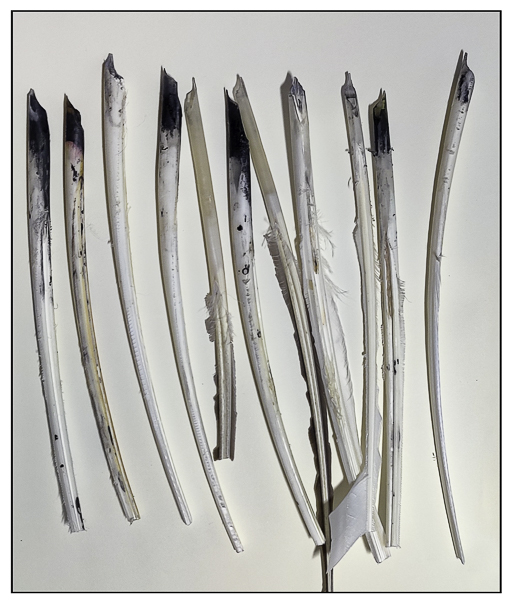
So, today I mended about 7 pens and cut 5 more, two of which were failures. I threw an old quill pen out as it was done in, and my mending attempts only made it worse. I saved my favorite pen and fixed a bunch and made some new ones. Not a bad few hours spent in the sunny patio! I now have 11 usable quills for my daily jottings.
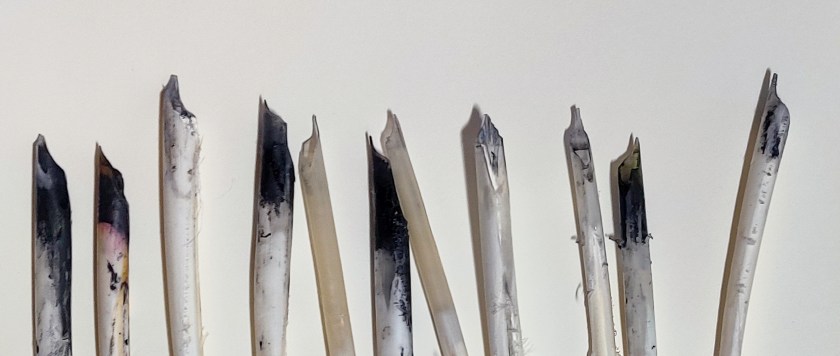
And a close up of the nibs – some are quite inky!
Hope this helps you realize that your old feather quill pen can still be used with a bit of TLC! If they did it in the Regency period, you can still do it in the 21st century.
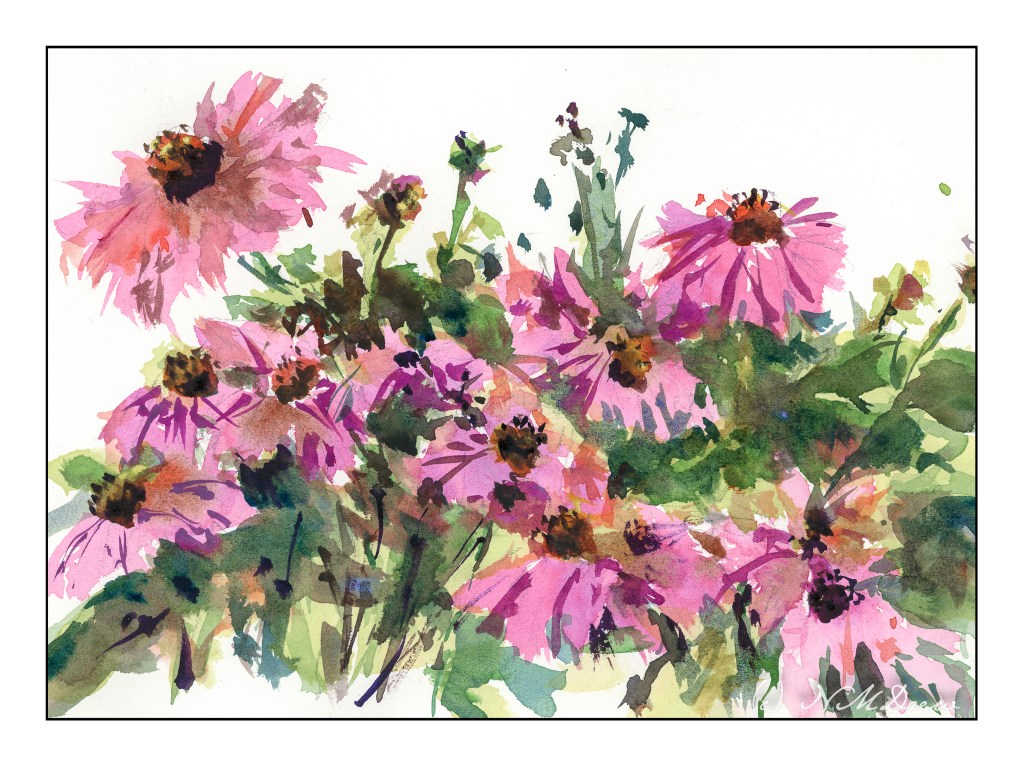
I think this is the first original flower study I am happy with. The reason is that it has the looseness of style I have been trying to get, a brightness of color, and decent contrast.
I began by wetting my paper on both sides after drawing in the basic flower shapes, some stems, and leaves. All of the pencil lines are simply guides, but it did help. From there, I did the flowers with a wet wash, more water than pigment, to suggest the basic flower petals. From there, leaves in a light yellow green with the plan to paint darker colors over petals and leaves. Once I had those general shapes in, I placed the flower center in, allowing it to bleed into the leaves and petals as it would. Then I dried it with the hair dryer.
More washes came along using more pigment and less water, but still wet. I tried to suggest leaves and shapes, painting around the flower to create indents where the petals fell over the leaves in an attempt to create some depth. Again the hair dryer, probably multiple times. Finally details with a fairly dry brush, thicker pigment slightly dampened with water. This was done for some of the stems, the flower centers, and a bit here and there.
I am using my new palette, but I don’t think I really like the alizarin crimson that much. It is the “permanent” variety and seems rather dull to my eye. I tried to liven it up with other colors, like some blue and red and orange in different areas, but it is not as vibrant a red violet I would like. I will need to do a bit of research here.
So, at last, a sense of being able to paint flowers in a manner pleasing to my sense of what a floral watercolor should look like.
I am very sad to hear that Queen Elizabeth II is no longer amongst us. In our turbulent world she has been a steady hand. No life is perfect and hers has had its share of upheaval and craziness, but in face of it all, she has remained dignified and human despite the responsibility of her role. I admire her a great deal, as a woman, as a leader. In today’s world, I only wish there were more like her with vision beyond their own immediate agendas.
When you find an artist whose work you like, and who is also a good teacher, an online class can teach you a lot! The nice thing with videos is that you can watch them over and over, catching little things with each viewing.
Shari Blaukopf is a painter that I admire. Her watercolors are clean and fresh. She also has a really nice online personality, whether it is on her blog or in her recorded classes. I’ve made comments on her blog and she replies; I have uploaded a painting or two, and she is always gracious. One day it would be nice to take a class with her in person.
Anyway, I have / am taking two of her courses on flowers. One is painting wet-in-wet flowers, and the other is painting fresh cut flowers.
The above one is from the wet-in-wet flowers class. The paper is wet on both sides after the initial pencil sketch is done. The paper is then blotted. And from there, you go to town! It was really fun to see how the paper and paints all worked together. Not a great rendition, but the experience is the most important part as that is how you learn. My contrast issues are not too bad.
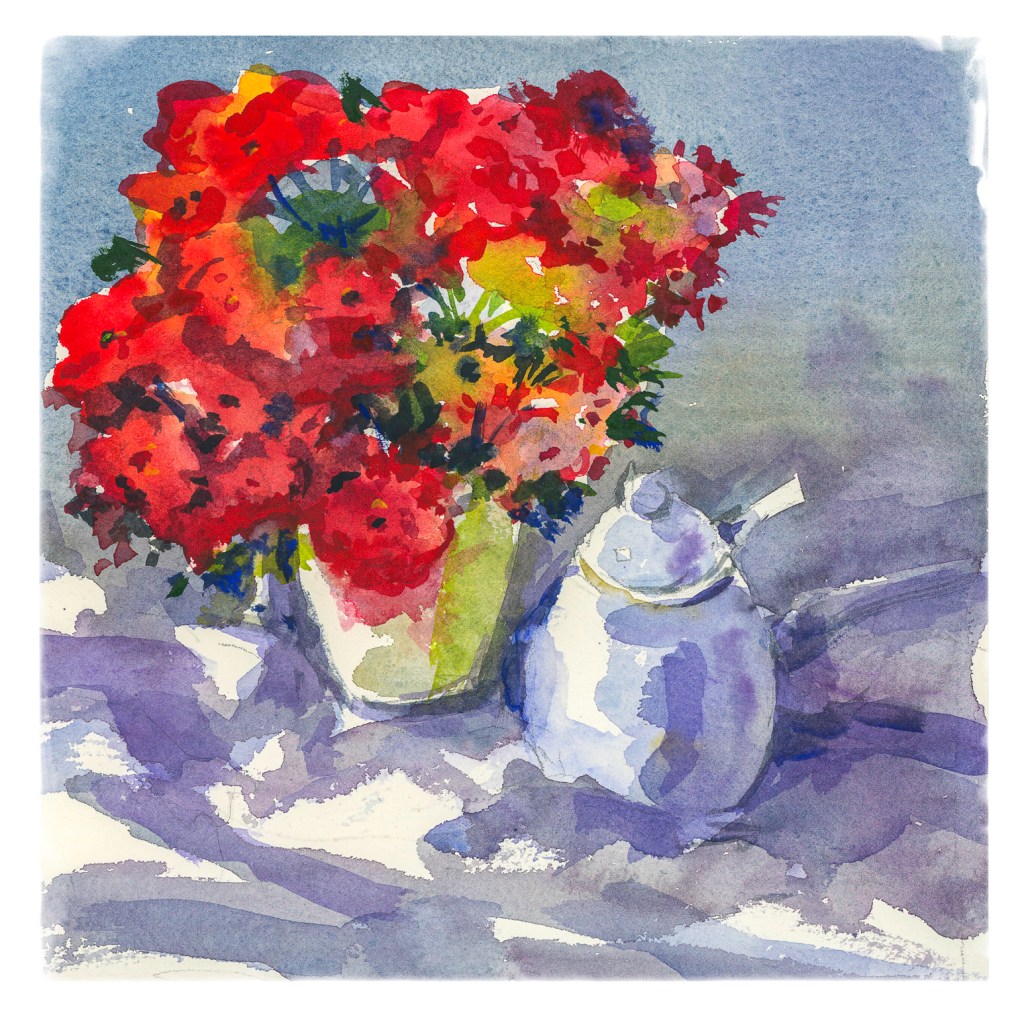
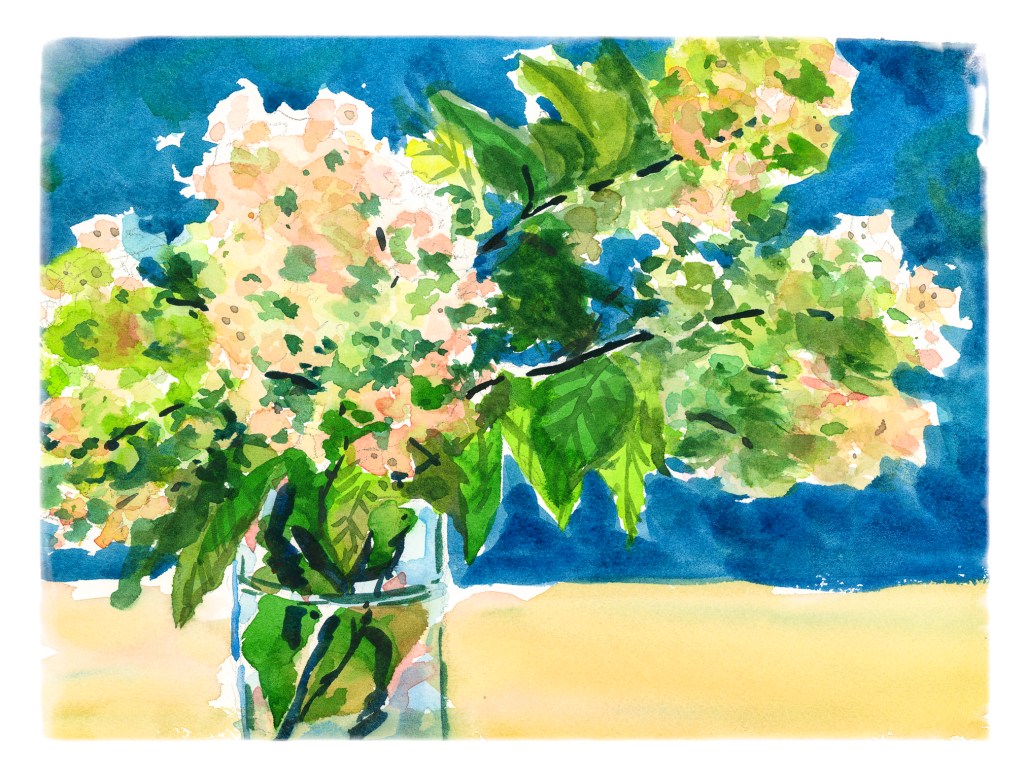
The hydrangeas are from Blaukopf’s course on fresh flowers. She does three different flowers – a blue salvia, then echinacea and black-eyed Susans, and finally the hydrangeas. I’ve done the salvia, but have yet to do the second one. I wanted to do the hydrangeas especially because of the delicacy of colors involved, as well as work on the contrast and negative painting, the latter which is just as much as a challenge for me as good contrast! Having been very frustrated with my colors always being too intense, this was also a good challenge for me with pigment and water control.
The past few days have been spent practicing free-motion quilting for a class this morning, so it was really a treat to wade back into painting. I love flowers, so painting them is the challenge, especially as I prefer a looser rather than more precise rendering of them. I think precision can be a lot easier than abstraction.



 Ink, Yarn & Beer