Knitting gauge is individual. Persnicketiness is too.
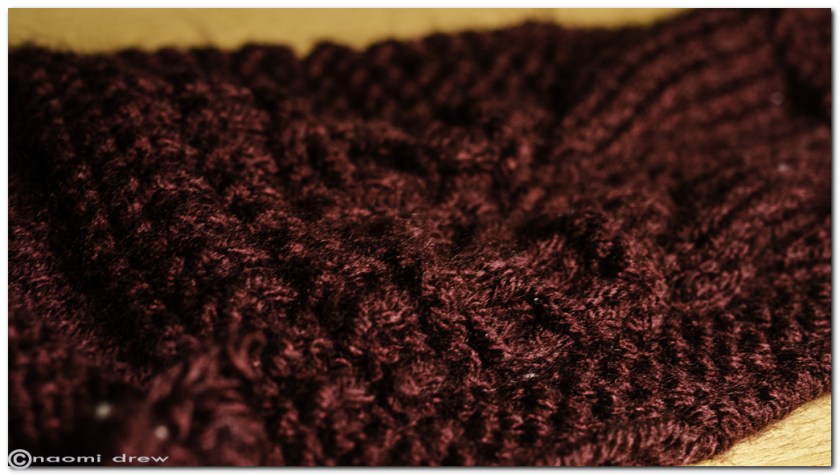
Admittedly, I am a sloppy knitter because I do not get myself in a tizzy over my knitting. Dropped a stitch? Oh, well. I’ll either latch it up or not with a crochet hook. Missing a stitch? I’ll look for the offender and tie it off if it is way too far down, and add another if necessary. I don’t swatch because I know how I knit. However, for the sweater for Josh, I did swatch, but not for gauge, but for the patterns. How do they look in Brava and how do they look in this color?
A sweater is a big project, and a bit of understanding of a pattern’s texture is more important to me than my gauge. The gauge takes care of itself. What do I mean by that? I mean I have been knitting long enough to know that I knit 4.5 sts / inch with worsted weight yarn on US size 7 needles. I know that massive cables will bring in a big project about 15-20%. I figure about 5% for a lot of stranded knitting. And, because I do not follow patterns except for ideas, I also know that I can change things as I go along – or rip the whole danged thing!
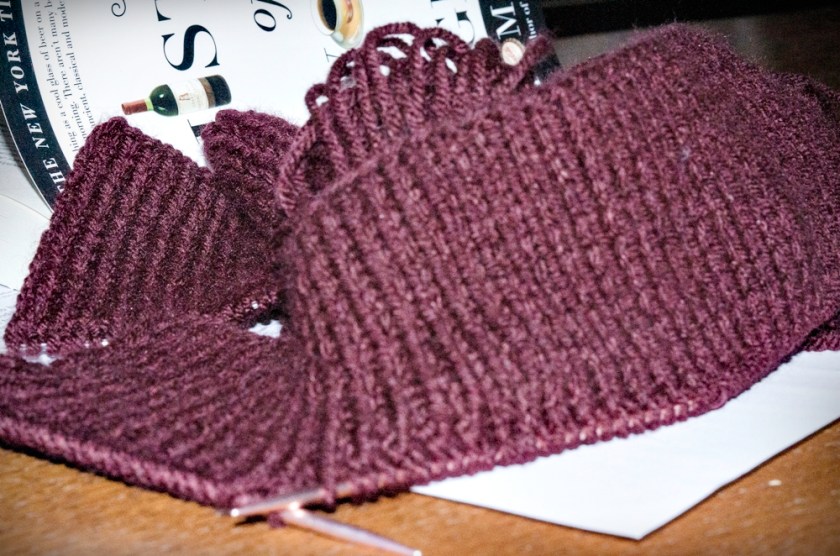
In writing up patterns, I always assume a gauge to be an approximation. For some patterns, it is really important, as in fancy cable work on sweaters and jackets. If you design your own, then you are the one in control. If you follow a pattern, you are also the one in control. Take the time out to see if something might work for you – or not. Everyone who knits has their own style, their own tensions, and hence, their own gauges. Comments about how hats have turned out “too large” make me wonder if the knitter is willing to analyze their own knitting style, or is caught up with following directions and assuming all will be well. I have seen knitters who do beautiful work, but fail to consider (or take responsibility for) if their knitting is going to work with a given pattern, and then blame the pattern, not themselves.
Designing anything does require a bit of forethought, as well as a bit of risk. I mentioned in one post about photography that I’d gone to a workshop where the photographer said that no work of art was unplanned. I think that is true – sure, some things are spontaneous and successful, but not all are. Experience, experimentation, frustration, imagination, intention, repetition are all the things which lead to success in any field. Even with all the best intentions, failures can occur; however, I always think that my failure may be a success in someone else’s eye.
Knitting is an activity like any other – running, kayaking, sewing, cooking, painting, writing. It requires some focus, and can give way to that pleasurable automation of the well-trained hand. A quality of “oneness” occurs that is soothing and calming – very zen! The art of knitting is very different from the act of knitting. When it becomes an art, all your knowledge comes into play, at whatever level you are doing it. Granted, the art may be highly pragmatic in results, but it is no less an art, whatever the utilitarian need being met.
So, to swatch or not to swatch? That is up to the individual. For me, I’ll leave it alone unless I need it. I’ll dive in and adapt a bit if I need to because it suits my personality far better. However, to create a pattern with texture – that is akin to painting. How do the colors respond to this or that? How shall I use this new brush? Then I swatch, because until I see the result, I will never know. Small scraps of paper, small textured swatches. Life goes on.



 Ink, Yarn & Beer