Taking a Break

On our first outing on our trip I broke my left arm. We still are unsure how it happened.

We got an ambulance, spent hours in the ER, then came home on the recommendation of ER staff. Viking helped us out. The Icelandic medical personnel were wonderful.

We saw a couple of orthopedists yesterday – we got home in the wee hours of Saturday -as well as had a lovely chat with Jimmy, a retired orthopedic surgeon who is a cousin of my SIL.

Nothing malignant seen, but I have a lovely comminuted spiral fracture of my lower humerus. No elbow damage it seems as wrist, fingers, and forearm function. I am doing fine but very one-armed, typing with my right hand only. Too much work! Family and friends have been fabulous, too.

So for now, see ya later.

On the Road to Somewhere

….via plane and ship!

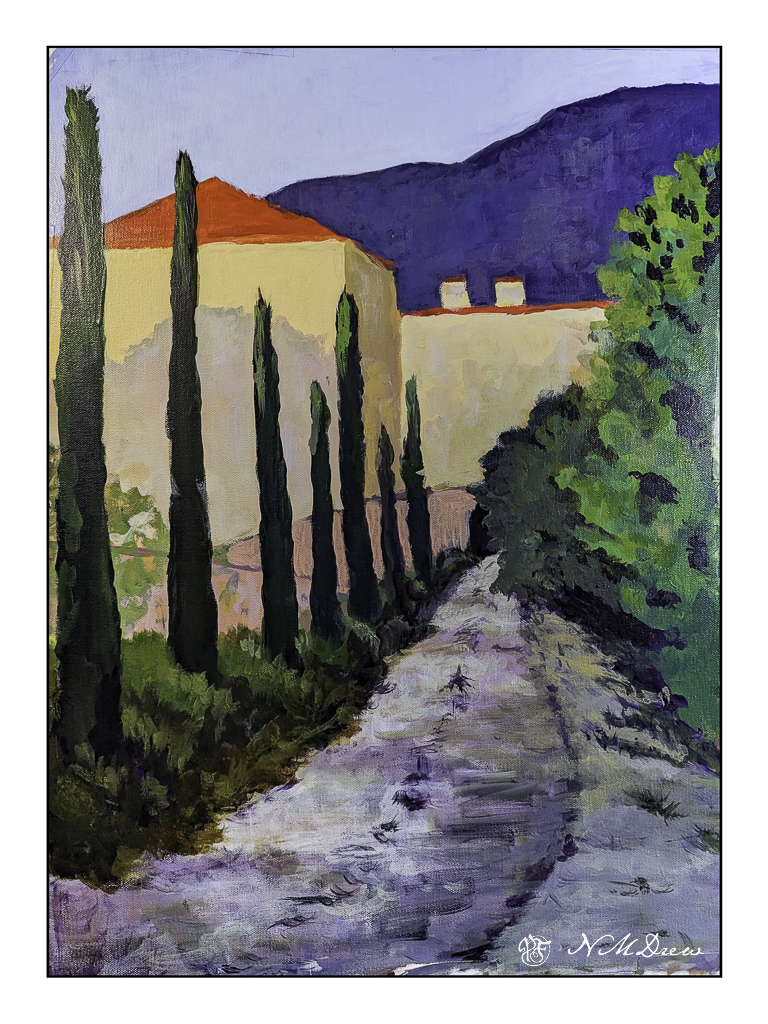
In between everything and all the organizing and deciding and packing and griping and whining and worrying and daily stuff, I did manage to start a painting. It’s on a bit of 14×18 inch Fredrix canvas, taped to coroplast, and on the easel. It has been through multiple iterations since its inception, and still has a way to go. I will finish when we return, and I am sure I will see it all with fresh eyes.

This is not a great picture – a photograph rather than a scan – but it does show where it now stands. I thought a painting of a road and building might be fun to do. I still need to put in windows and work a bit on the middle area where the two pinky curvy bits of architecture are, as well as some of the leafy trees on the left. The photo makes it a bit askew, but the roof lines are actually straighter in the painting.

I usually work in watercolor, and that is usually a more immediate event than returning to a painting daily for a few hours. In fact, it is an altogether new experience for this impatient person, and I am finding I rather like the time I have to come and go with a painting. Having it on an easel to look at all the time is also a new experience. It let’s me look at it and review it from where I sit in the studio, typing away about it or other things. I wonder how this newfound taste and appreciation for time and painting will play out on our trip.

Golden Fluid Acrylics, 14×18 Fredrix canvas.

Watercolor Kit & Other Travel Toys

Heading out for an adventure of three weeks with only a carry-on suitcase and a back pack is forcing me to pretend I am an efficient traveler. The fact is, I am not, and it is very challenging to rethink what I want to have around me when traveling. For me, having enough clean underwear is important – but perhaps more so is not getting bored. I need stuff – to read, to paint, to draw, to listen, to make, to take photos. And this means making everything small and efficiently useful.

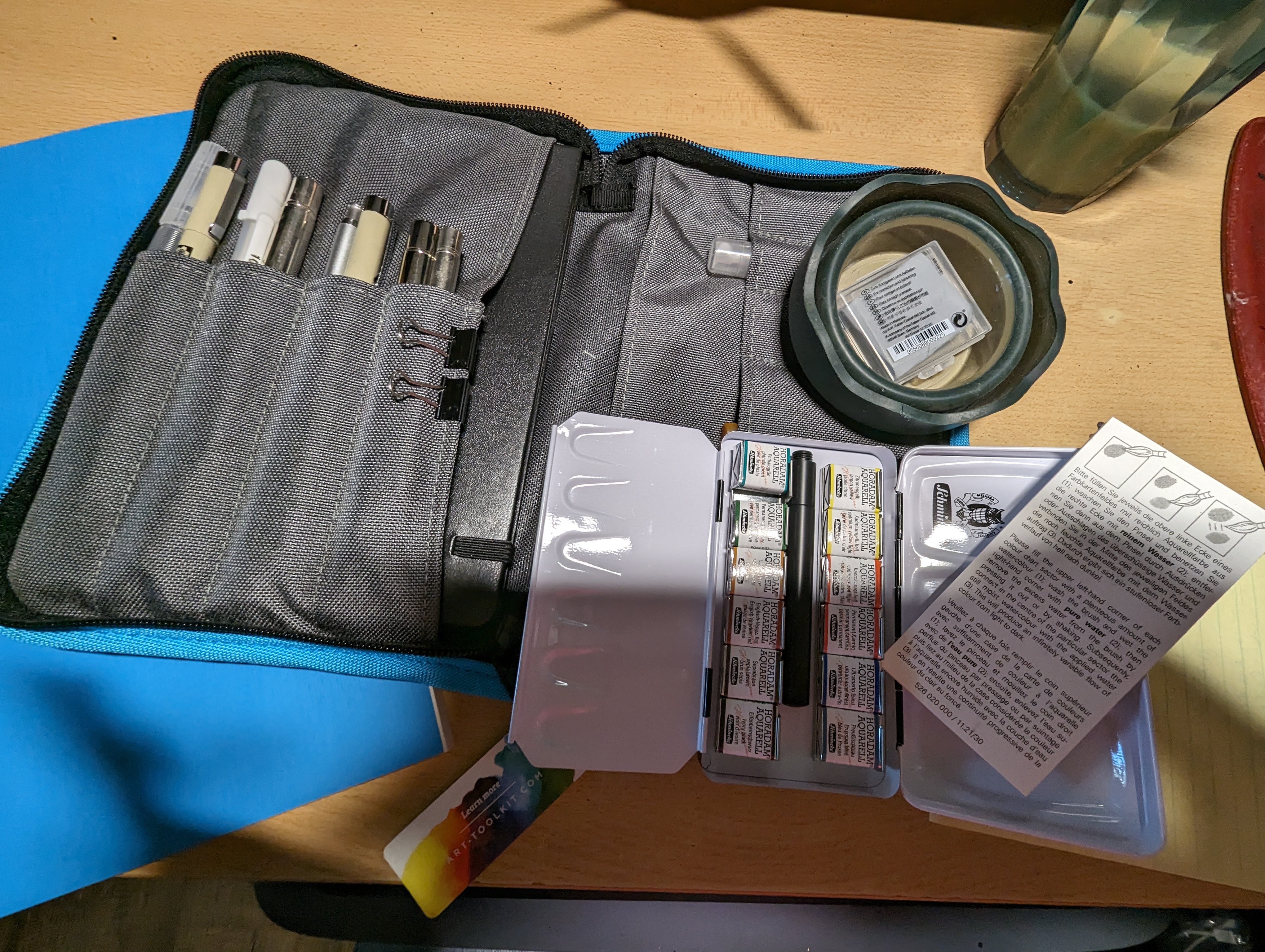
First on the agenda is my watercolor and drawing set up. In this 7×10 (or so) zip-up case by Art-Tool, I have their included Moleskine watercolor book, 12 half pan set of Schmincke watercolor paints still wrapped up, travel brushes, ink pens, mechanical pencil and lead, kneaded eraser, collapsible water cup, and a few other things. Many of them are original to the kit, but I have modified it a bit to meet my needs. It’s pretty nifty.

Next, books – audio and written. I like to hear things when I am sewing or knitting by hand. This means lightweight, small head phones and something to provide me with books. My phone can supply both! Another need / want conquered.

Camera . . . as someone used to the capabilities of a DSLR and such, a small automatic point and shoot without the option for controlling everything (should I desire such) was not something I wanted to spend money on. I spent weeks on research – I needed to be able to use manual controls all the way as well as my preferred aperture priority – and finally settled on the Canon G7X Mark II. As the Mark III had just come out, I got a good price on it, and have been using it for months. The battery life is good; I can put it a purse or pocket, and the pictures are good but flatter in appearance than either the X100V or the Nikons I like to use. Post production always remedies that.

We will be doing stops in various ports en route to our friends in the south of Spain. Looking ahead to Iceland, Ireland, and England, it appears to be cool but not cold, and with rain. Layers and a lightweight rain jacket that folds into a pouch are to be packed, but also more summery wear for the weather in the warmer areas. Luckily, we will have access to washing machines so a ton of clothing is not necessary.

I am going a bit nuts, but such is life. I have 3 days to finalize what I want to schlep, and then I drop into the abyss of international travel.


Practice

With any art or craft, familiarity with it makes it easy to do. With familiarity and understanding comes the ability to explore using the knowledge you have acquired. I am pretty comfortable with watercolors and oils, but acrylic has always been a point of frustration as it dries so quickly and, to me, doesn’t have the qualities of oil paints. Gouache can be opaque or transparent, depending on how used; acrylics can be used in the same way. The difference between artists gouache (vs acryl gouache) is that the colors underneath the other colors can be re-moistened, and used to dissolve and create other colors. Acrylics, while they can work similarly to artists gouache, once dried, are dried, and there is no going back.

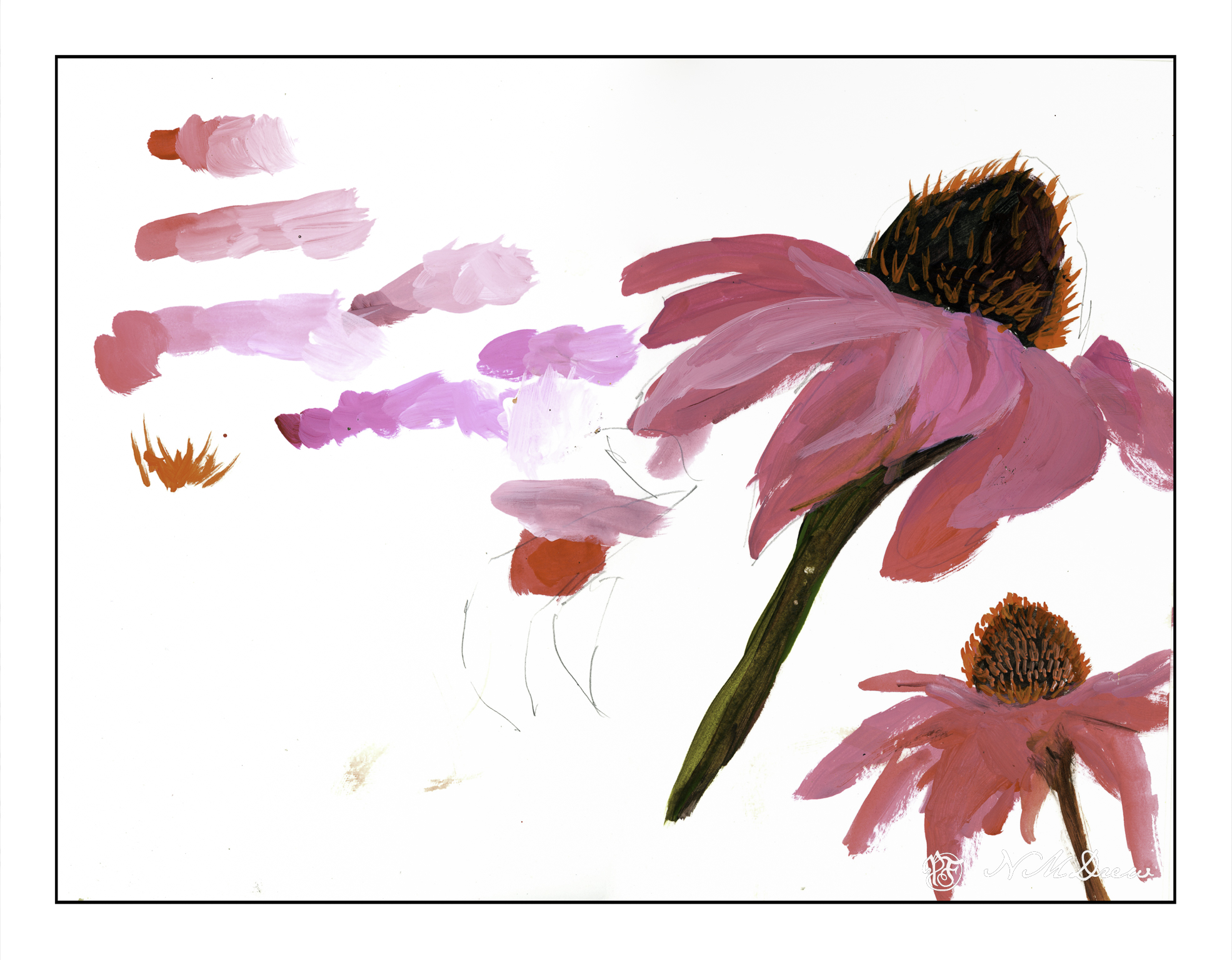
What I am trying to learn is how to use acrylics in ways that make sense to me. This is not coming easily. I like being able to sprawl my colors all over the place without drying, but this doesn’t work quite well with acrylics – unless using the heavy body paints on a sta-wet palette, the fluid acrylics I am using dry very quickly. To use them well I am trying out different ways of painting and mixing paints. Above, on the left, are colors straight out of the bottle and then mixed with white on the palette, increasing the amount of white with each brush dab. From there, I played a bit with painting cone flowers; the one on the lower right is more successful.

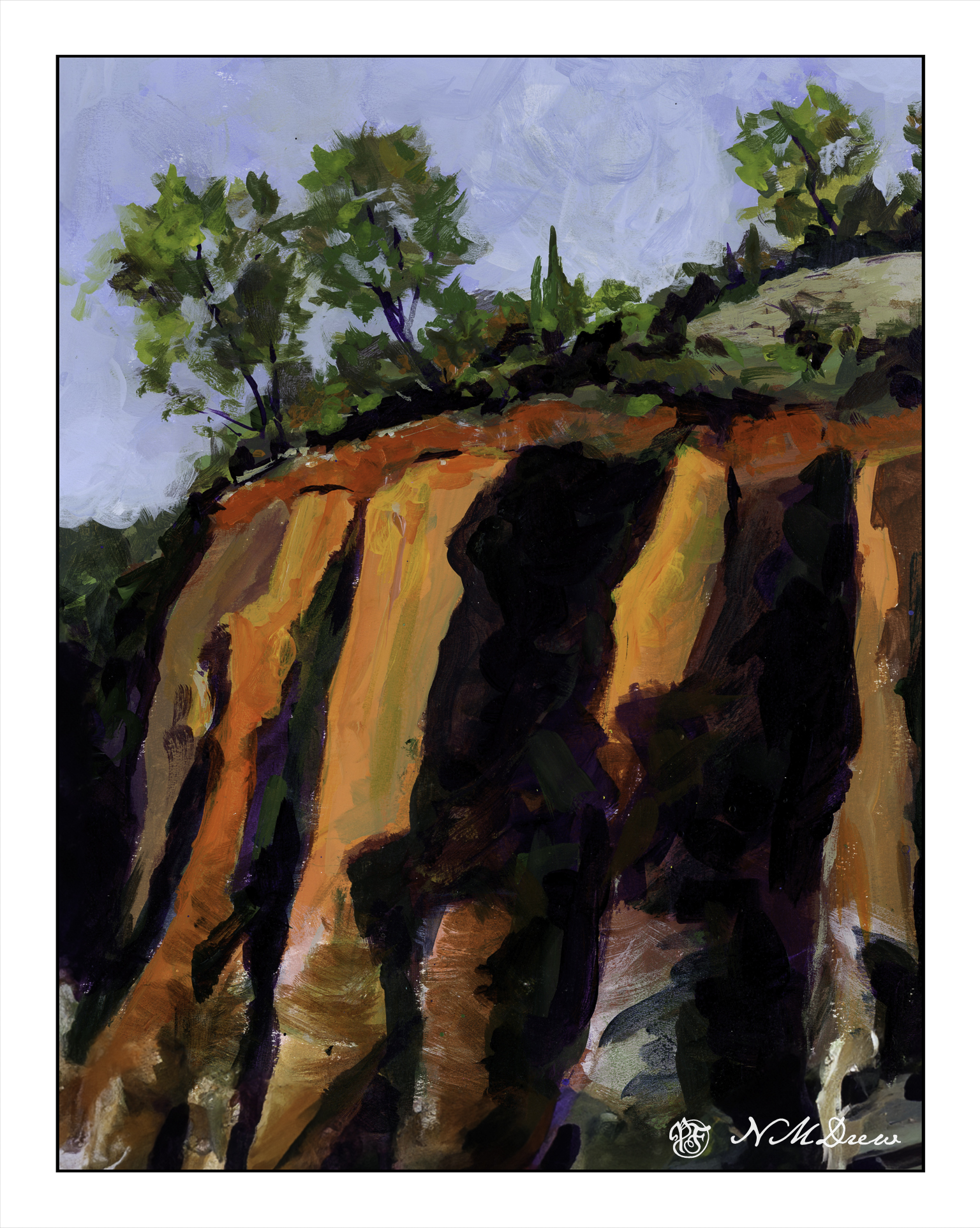
Playing is a way to explore. Above was play. Below is a “more serious” foray into painting with acrylics. I worked hard to make layers, and then return to add more color as I moved along. I just painted directly onto paper in a sketch book and practiced both painting and blending, painting directly on other areas, and bouncing around to work at making a bit of a harmonious or connected picture with similar / same colors used in various parts of the painting.

There used to be 4 trees in a row on the top of the cliffs – but then I looked at it and they were all the same shape and height. I decided to paint out the 3rd from the left. I had to paint the sky in a number of times, building up layers to hide the tree. It worked pretty well. I also played with my brush – I tend to dab, using the point of the brush – but here, especially for the tree foliage, I worked on using the sides of the brush. Additionally, I changed between very soft brushes and more firm brushes. These change how the paint moves and blends over the paper.

Practice can be fun – in any art – and by practicing and playing, new doors and experiences add to the skill set of the artist or craftsman.

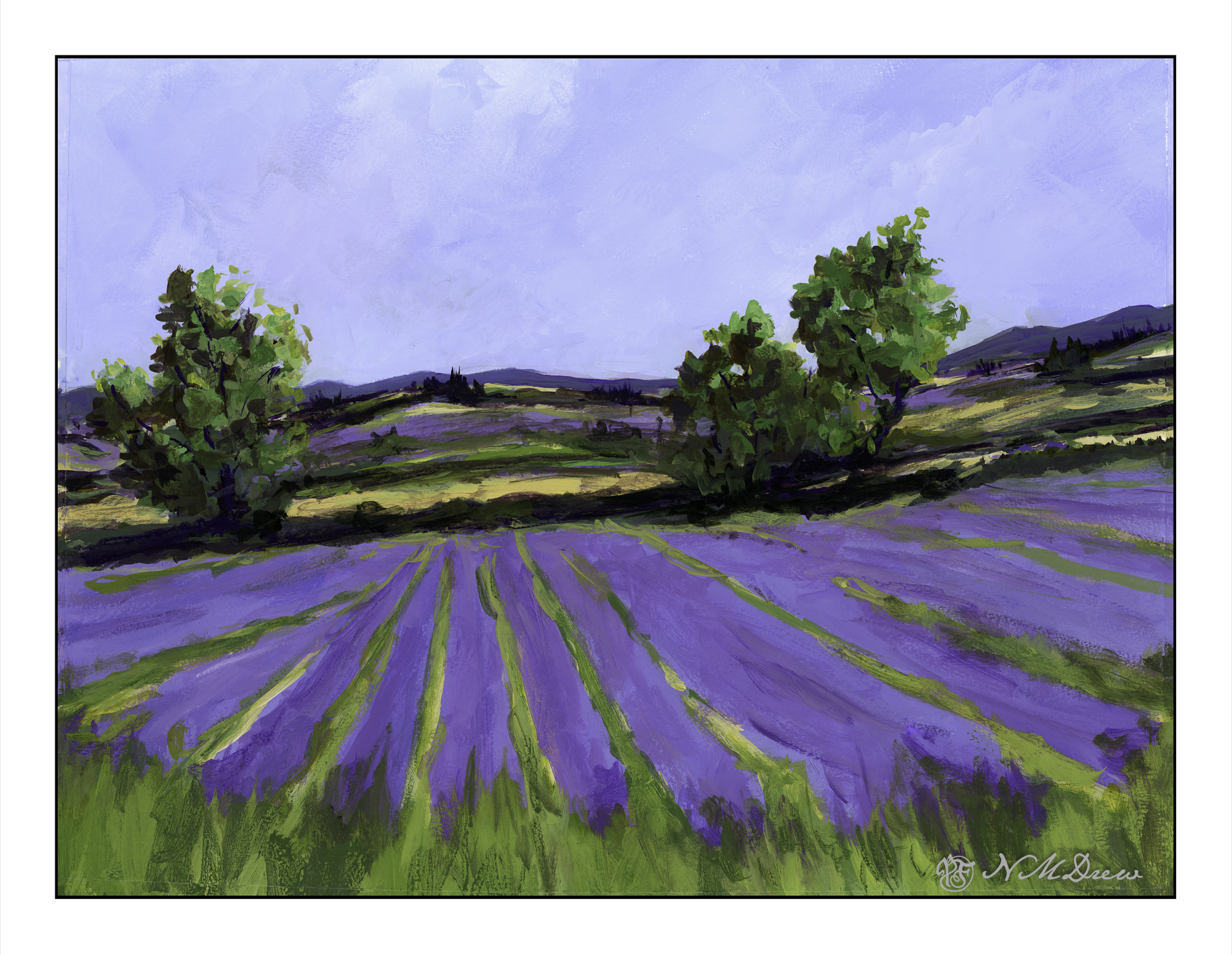
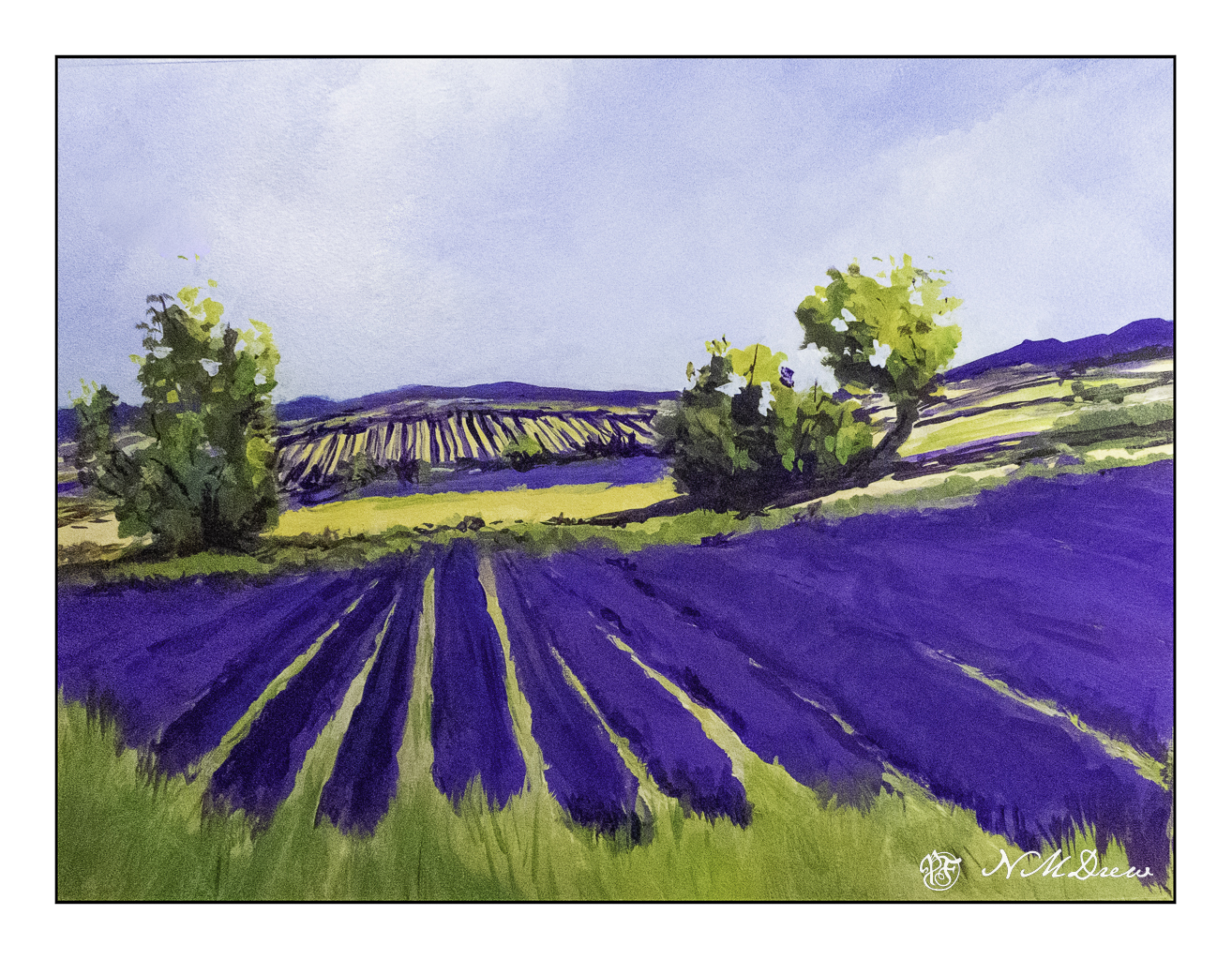
Lavender #3 – Final (For Now?)

For the last 2 or so weeks it has been appointments and appointments and ordering this or that and consolidating little things and I am so sick of it I could scream!! My lavender painting has been sitting on my easel, I see it every day, and at last I have found time to work on the painting. Finally. Oh, finally! Something fun to do.

I wanted to accomplish a few things with this painting. One was simpler, more blended brushwork throughout. I wanted to grey out the distant colors a bit for a sense of atmospheric perspective. The trees, too, need to be cleaned up a bit. I think the pale field before the second level of lavender could indent a bit more on both sides of the left hand tree. I won’t say this is a masterpiece, but it has a bit more a painterly quality in it, has a decent sense of depth, colors aren’t too overwhelming.

This is painted in Golden Fluid Acrylics. A Sta-Wet palette doesn’t keep the paints wet as they are so fluid – the heavy body acrylics work well with the Sta-Wet because they are thicker. This means working a bit differently and I have found I like them best when they are a bit dryer – great for dry brush. Too much water in the paint – or in the brush – and they can drip down on completed paintwork, or form a rather interesting craquelure.

I have been putzing on this painting for quite some time, so here is a series showing its evolution – earliest paint

15×20, Langston watercolor paper, Golden Fluid Acrylics.