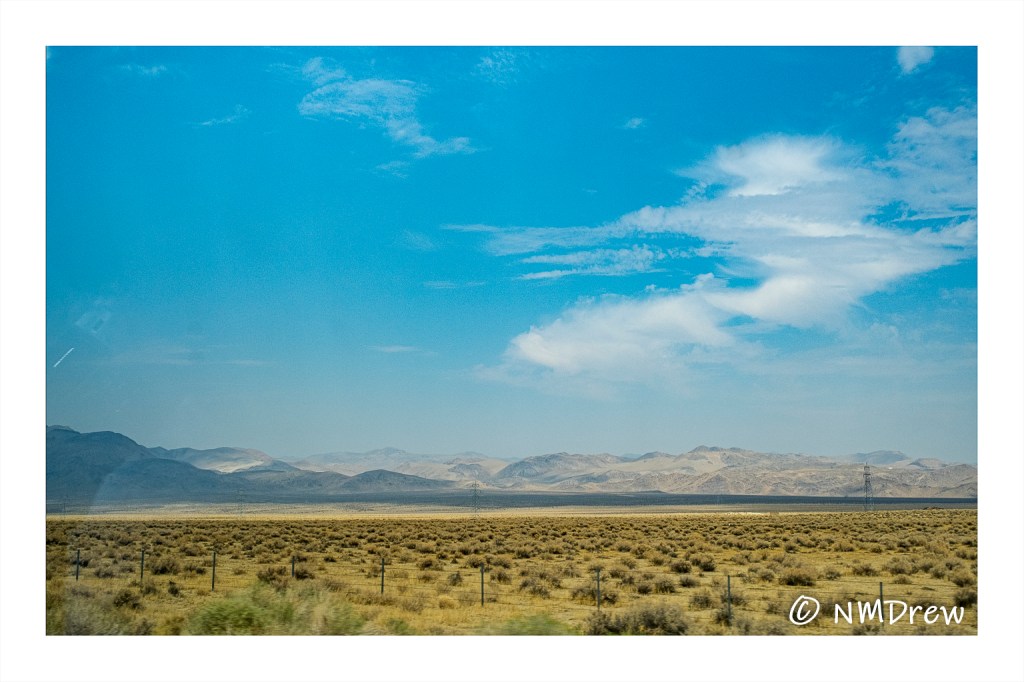
Another sketch from a photo I took, this one snapped out of the rear car window! Having a camera can get some great stuff when you don’t have time to stop every 5 minutes.
Sky Above the Owens Valley – Quill Pen and Iron Gall Ink
This was my initial sketch, done with a quill cut with a finer nib as well as done with more attention to detail. After the sketch dried for a few hours, I laid in the watercolor. Some ink was still damp even after a couple of hours drying outdoors and blotting. Below is the original photo.
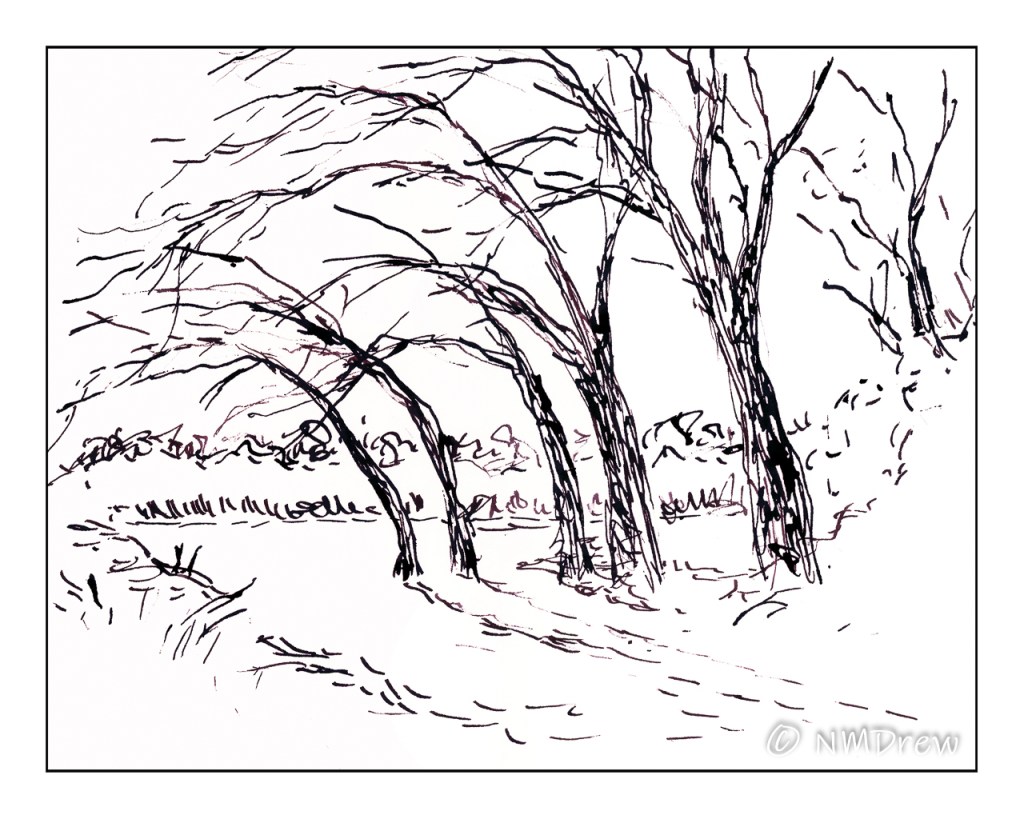
I am rather enjoying sketching as part of my morning routine. Today’s sketch is still in Independence, California. There is a trail that connects the native plant garden to a small park, Dehy Park, and I think I took this picture along the pathway. I found the repeated curved rhythm of the trees to be utterly charming – I expect the wind has a lot to do with the way the trees are bent.
Anyway, I decided to not use my Micron pens, as I have for the past three days, but to use a quill I cut myself from a turkey or goose feather and my homemade iron gall ink. First, I sketched the grove.
A Few Trees – Iron Gall Ink & Quill Pen
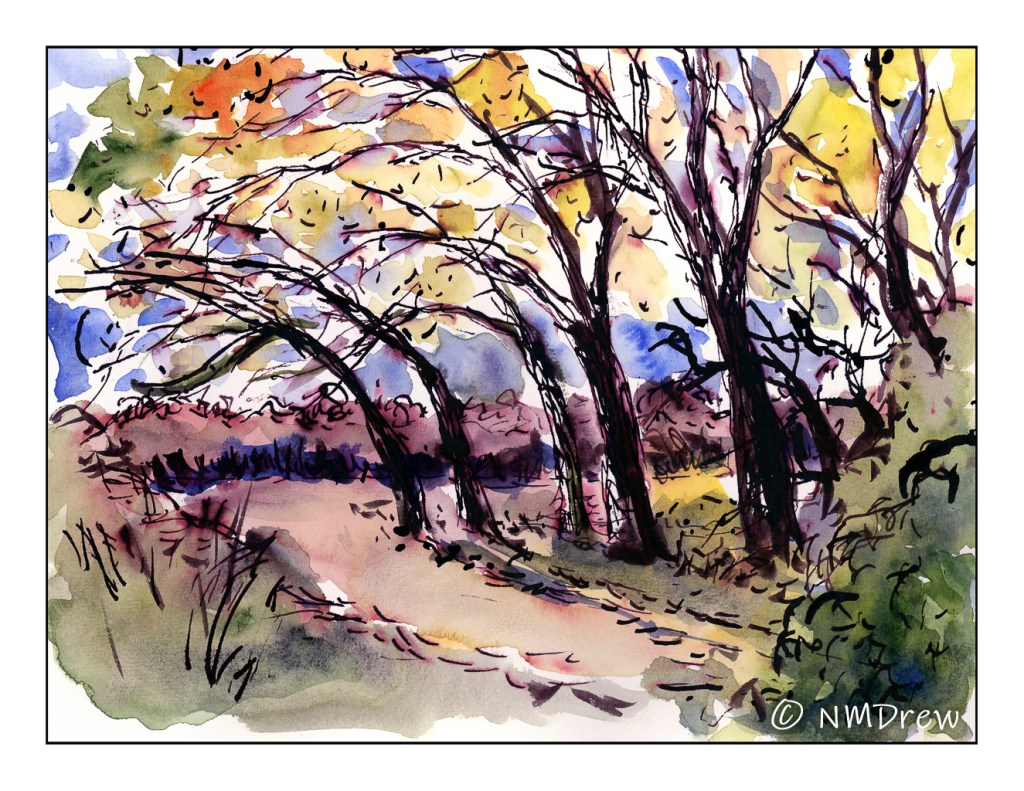
Then, I let the ink dry – or thought I did! – before adding the watercolor. Areas of ink were still wet. One of the drawbacks of iron gall ink is that it does take a bit of time to dry. The wet ink messed up some of the paints by blending in with the colors, muddying them.
Once I noticed that I decided to use dots and such with the watercolor, especially for the foliage toward the top of the trees. I dabbed the paint on, in between the black, inky branches.
I mixed colors with a water brush, stronger than the paler colors I have been using, and just applied them. The effect wasn’t too bad. In between the leaves I used blue, again, tapping the paint in, avoiding the dark of the ink.
After the paint dried, I went through a second time with the iron gall ink, both with the quill and then a defunct water brush. I think it helped out, but overall, the sketch is still quite messy, and certainly not what I intended. What I do like is the sense of dappled sunlight in the leafy canopy.
A Few Trees – Iron Gall Ink, Quill Pen, Watercolor
Takeaway points: First, the ink needs to dry before applying the watercolor paint. My quill has a wider tip on it than your standard dip pen, and thus makes bold lines. However, a bit more care could create a better combination of lines, and perhaps render the sketch more interesting. Adding brushwork and stronger lines after the first ink and paint applications helped to strengthen some areas. After I did that, I went about the morning chores while the sketchbook dried outdoors in the morning sun. I had to wait an hour at least – and then, the scan of the final sketch!
Dry Wash at Independence, CA, Botanical / Native Plant Garden
One of the nicest things about spending 2-3 nights at a place is that you get to explore. Independence, CA, is along Hwy 395 and is a town you would zip right by if your weren’t staying there. However, you really can miss a few things!
We stayed at the Winnedumah Hotel, in a room at the back. Out the door and down the road a few blocks is the local museum, and although it was closed the days we were there, we plan to go back. Outside the museum is a rather wonderful native plant garden. It faces west, so it is in the shadow of the Eastern Sierras. There is a creek running through it, complete with trickling water. Winter rains swell it and it obviously flows over its banks.
The sandy shore and rocky bottom depicted here create a dry wash. In canyon country these smooth areas are tempting for campers because the smooth soil makes pitching a tent and sleeping bag comfortable and easy, but if a rain happens upstream, a flash flood creates a swirling death trap. Even locally – where I live – people are drawn to these washes in the rainy season (if there still is one . . . ) and get washed away in the event. I had a wonderful friend who died in such a flash flood because the ground he was standing on probably got abruptly eroded from underneath. Even peaceful streams need to be treated with respect.
This is a distance shot of one of the remaining mess halls / dining halls at Manzanar, the Japanese interment camp located in the Owens Valley of California. The Eastern Sierras butt up against with a sort of barren plain between the camp and the mountains. Over 110,000 Americans were forced here during WW2.
Not a lot remains here. Barracks were many, as were latrines, laundries, manufacturing, kitchens, and a cemetery. A hospital and schools and recreation areas kept this from being a dreadful place of extermination, but it did often exterminate self-worth and communities.
Even though our trip was stopped by Covid-19, I did get a number of photos along the way. Olancha, CA, is one of those little towns without a lot of amenities, but big in different ways. Here are some – and were some – nice little restaurants that provide comfort to the hungry and a much-needed break from the car. Little dirt roads catch the eye, and trees and houses break up the flat land leading to the grandeur of the Eastern Sierra Nevadas. So, even though my trip was canceled, I d intend to create sketches of what I saw along the way . . .






 Ink, Yarn & Beer