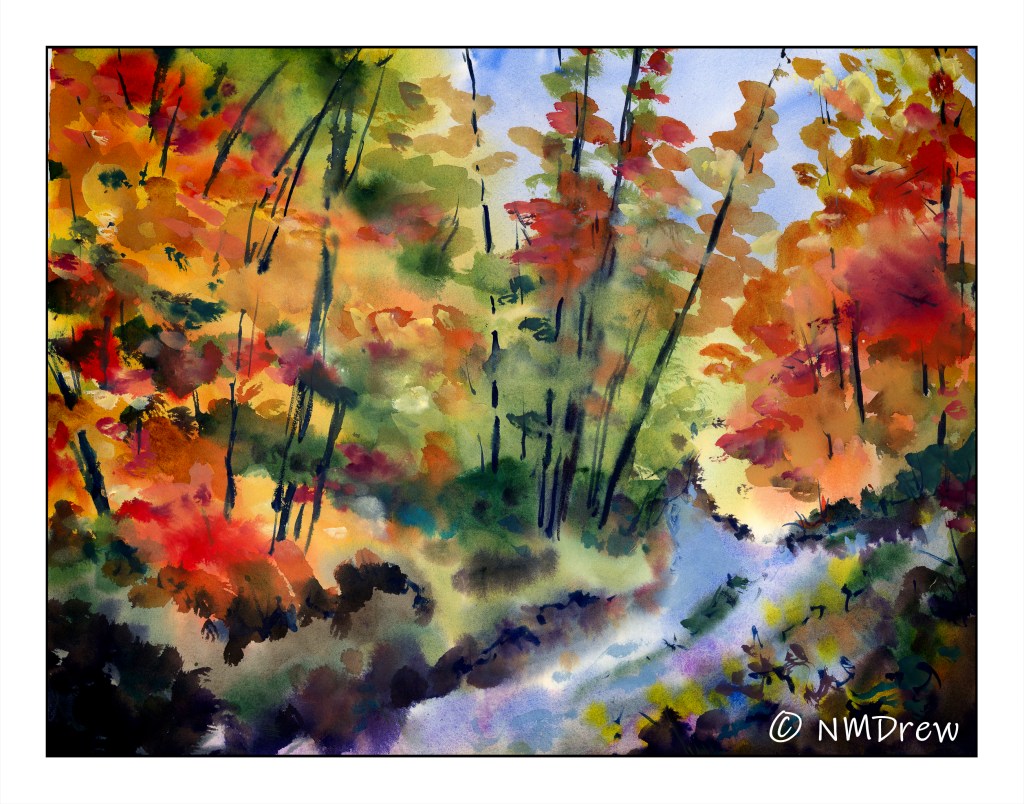
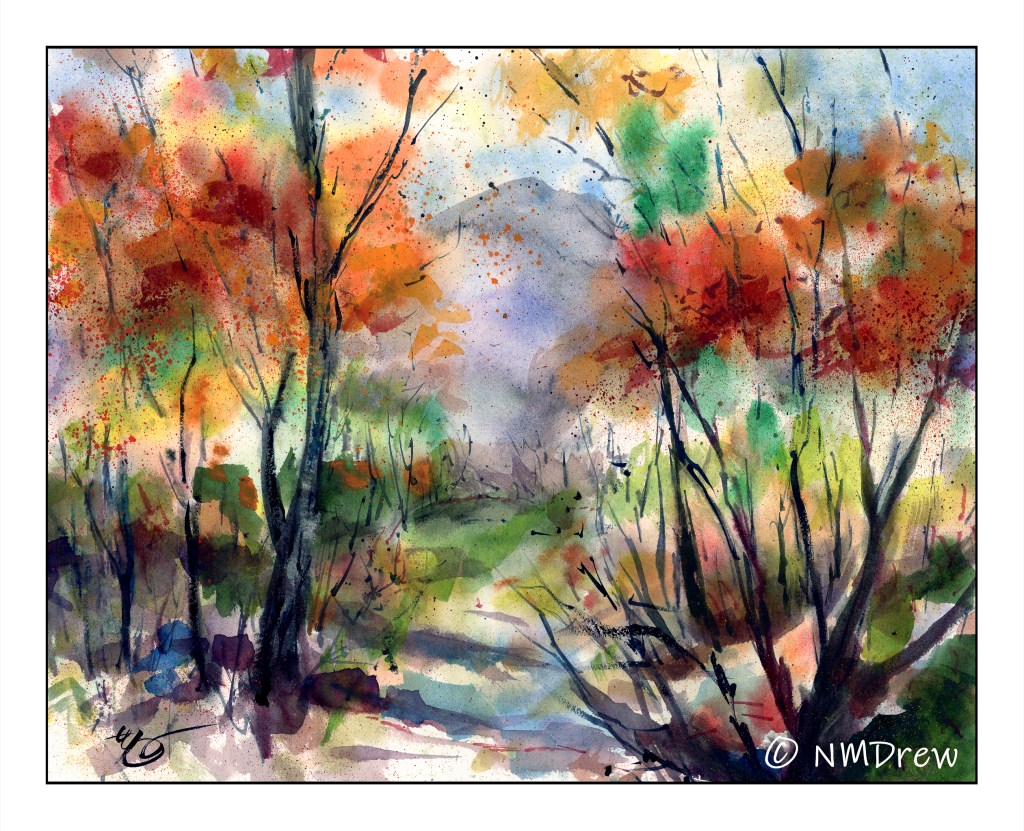
More of the splish-splash effect this morning, and I will say it is fun. This time around I added some zinc and titanium white gouache to some of the colors – something I have never done with watercolors at all. It feels rather sacrireligious.
Fraggy, this painting title is dedicated to you! I loved your comment yesterday, and it really says it all about some days in autumn. 😉
There are just times when it seems leisure doesn’t exist. That is how I have felt for nearly 6 weeks now – too many things needing attention. Little time in any day to be creative, to play, to get out and do something different. Yes, there have been breaks and time to paint, but nothing really for playtime!
For me, playtime means letting go of everything and just splashing around in the glorious mud of whatever I want to do. Today, I made that time. Watercolor was my mud.
After several days of cold and damp here in SoCal, the best kind of day arrived this morning. Cool skies, warm sun, bright light. I decided to take a piece of 16×20 CP 140# Arches watercolor paper, my spray bottle, big brushes and one of my watercolor palettes. No idea in mind, but sort of an inspiration.
There is a watercolor artist on YouTube, Sumiyo Toribe, who has a heck of a lot of fun with colors, water, and paper. Sometimes she paints big, sometimes small, sometimes on one sheet, sometimes across three sheets of 20×30 paper. There is a randomness to her work, but also a sense of composition. As well, the handling of ink and sumi-e can be seen in her work as she uses her brush in some very non-western ways. She looks like she has a lot of fun, and that is what I was looking for today.
I went outdoors onto the patio. My paper thoroughly wetted, front and back, I just began dropping yellow paint, then mixtures of yellow and orange, yellow and red, red and green, purple, blue, black, and then who knows what else. I painted wet into wet. I painted drops and blobs of color. I let the paper dry and then created glazes. Splatters, too. One glorious mess, and here you are.
No, this is not a work of art. It is a work of play and exploration. Fortunately, no muddy colors. Messy composition or lack thereof. But, to a degree, when I “thought” of a picture, I wanted summer into autumn, green into gold, shadow and light, and trees and underbrush. Everything that my SoCal suburban life lacks!
Thus, the Edge of the Seasons for your amusement. Hopefully some pleasure, too.
The studio window faces east. Every morning, if possible, I am up before sunrise, coffee in hand, reading or watching something on the computer, planning my day. I turn away from these activities to watch the sunrise.
Every morning is different. At times, I am up so early the street lamp is still on. Some mornings it is a sharp light against a dark sky. Other mornings, as of late, it is softened by the fog that has covered the valley. As the sun ascends, the fog may stay or go, and the light may be soft and golden, violet, or on a clear morning, the spectrum of colors. At times, if there are clouds, they can be lit with gold and pink.
Missing a morning’s beginnings seldom happens. To me, it is always an adventure in color and light, and this in turn makes me ponder some weird thing.
I am always glad to see the dawn – to hear the first birds – to see the birds perch on the redbud outside my window, or see the crows hopping on the eaves. It is always new and different, full of potential and hope.
This morning was no different. What was different is I went into the living room to open the shutters. A flitter to my right, and through the slats of the shutter, on the fig tree, a little bird, yellowish on the breast, was popping around, limb to leaf, eating figs or bugs. On the lawn, a crow was poking and prodding for bugs. He watched my movements a bit, as did the small bird in the tree, but neither flew away.
Mornings are, for now, eternal. When I am long gone, they will continue. Savoring the dawn is a wonderful way to begin any day.
About six weeks ago I started this painting and then all the chaos of insurance and plan choices and lost mail brought most of my creative life to a screeching halt. It was emotionally exhausting in a lot of ways, but those details really are not important today. Instead, this painting is finished at last!
Details first: acrylic on gessoed 16×20 CP Arches 140# paper. Borders of paper taped down all the way. I probably spent about 10-12 hours on this painting.
There have been multiple iterations of this painting. In the original, a tree was in the right middle front foreground. That disappeared last night. Then the road, which disappeared dead center, was reworked and made visible through the trees this morning. The suggestions of vineyards in the background disappeared, too. Too many stripes – I was looking for a zebra.
To finish the painting, I decided to work in middle of the night last night, and from 10:30 pm to 2:30 a.m. I painted out nearly everything except the blobby middle that I knew was not what I wanted. My husband, who is no art aficionado, always has good advice on painting problems. He and I agreed on the issues. So, this afternoon, I spent a few hours working and reworking it until you see the finished result above.
I have not done a lot of painting in acrylics, but each painting I do brings new experiences. I still tend to be a dabber, but am working to think about how I move the brush more, such as long horizontal or vertical strokes, or suggestions of something with just a blob (not a dab!) of color. I need to work in acrylics more to build more confidence in my brushwork.
So, here you are, on a gravel road in the backcountry, enjoy vineyards and olive groves, somewhere in a Mediterranean country on a hot day in summer.
There are times when everything seems to go south, and even when you know it will work out, it wears you out. Waiting for things to get fixed. Waiting for Monday to call customer service. Waiting to hear from customer service. All the waiting is really pretty boring and aggravating. What do you do in between?
I waited. I made phone calls. I waited for answers. In between I realized that I was making myself crazy. So, some sewing. Shopping. Cleaning out the front flower bed (half way done, but today the wind is blowing and it’s stinking hot). The side patio, for container gardening, got chopped. I filled up the 96-gallon clippings bin with all sorts of things. The patio looks naked. However, it is also ready for next spring. Bulbs are dormant, and new ones will get popped in sometime soon.
I have been making myself a nightgown out of flannel. Sounds cozy, eh? Well, mine is not sweetly flowered flannel. No, it is gaudy and has a whole bunch of sharks swimming around.
Too cute, eh? I still need to put in the placket / casing for the elastic drawstring, pick out unwanted threads, and hem it.
The post office called me twice. Problem solved. (Thank you USPS!) Insurance administrator called. Problem solved. Ummmm, what else? That’s it.
Can you believe all this took a couple of weeks to get settled down?