
Oak Gall Ink: Day 1

Yesterday’s post was about oak gall ink (which I may also refer to as “iron gall ink”), how it is made, some historical information, and what not.  Today I will tell you about what I did, accompanied by my fine photography!

The Receipt:  Take 80 g. oak galls, pulverize into fine powder, and dissolve in 300 ml. of distilled water.  Place into jar, seal, and set out in the sun for 3 days.

I weighed out 300 ml. water on my digital scale, followed by 80 g. of oak galls – which came to exactly 3 ounces!  I put the galls into my non-used coffee mill, but the outside was so tough I took them out, placed them in a baggy, and took a 3 lb. hammer to them – well, Josh did the first honors of crushing the galls, and I immortalized him.

After the crushing in the baggy, the galls were placed in the coffee mill a second time and were pulverized into a powder.

Thence, they were transferred to a pint Ball jar, water added and powdered stirred in.  I placed a thin layer of plastic wrap between the lid and contents, shook it up a bit, and took it outside to enjoy the benefits of the sun for the next three days.

Shaking will occur daily, as thought about, and on the 25th the ferrous sulfate heptahydrate will be added.  Who knows if that step will work at all!

Note:  To see the pictures larger, click on one in each group to work through a slide show.
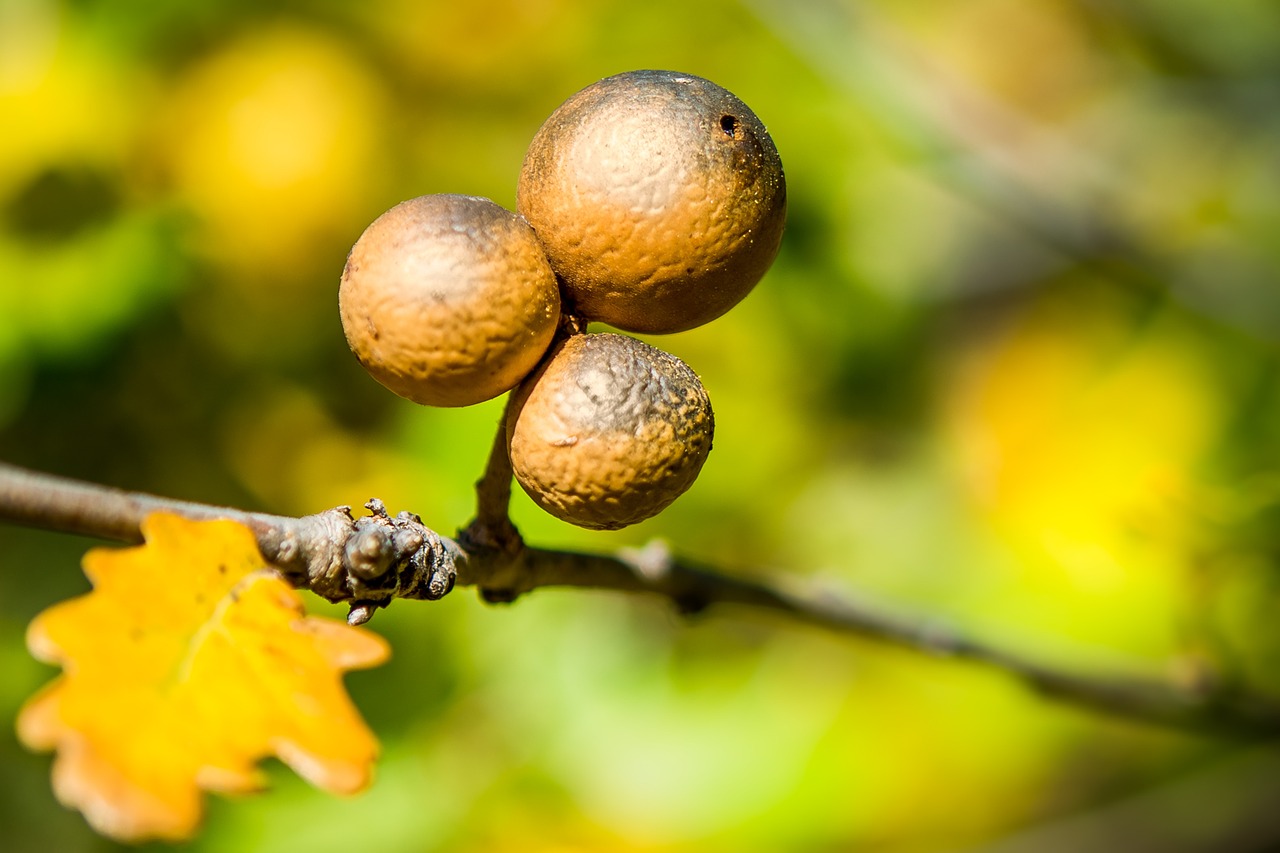
Oak Gall Ink: What To Do


If you were to google “oak gall ink” a bazillion links turn up.  Videos, message boards, recipes, historical documents are revealed to the unwary.  In particular, there are two ways in which oak gall ink – also known as “iron gall ink” – may be made.  One involves the simple crushing of oak galls and then steeping them in water (distilled is probably the best choice as  there are no chemicals to interact with the galls), and the other is a 2-month long ferment which gets (eww, gross) all moldy.  I’m not sure the latter is up to my tastes, but I will give it a shot nonetheless. Today, though, is the “short version” – perhaps a process lasting a week or less.

There are two sites which I think give a good indication as to the process I plan to use.  The first is this video from the British Library:

This next link is from the Schoenberg Institute for Manuscript Studies, out of the University of Pennsylvania Libraries.  I rather like the description, the detail, the grey kitty Chloe, and the historical evidence of a cat with inky paws on a manuscript.  Both are good reads, so take the time to travel a bit.

Receipt for Iron Gall / Oak Gall Ink

  • Oak galls:  80 g.
  • Distilled water:  300 g.
  • Ferrous Sulfate:  50 g.
  • Gum Arabic:  25 g.

Crush oak galls into small pieces or grind into powder using a spice or coffee mill.  Place into jar and cover with 300 ml. of distilled water.  Place in sunny window 3-7 days (depending on your life and schedule).  I plan to do 3 as per the recipe from the Schoenberg Institute.  After 3 days, there should be a dark murky liquid in the jar.

On Day 3, add 50 g. of Ferrous Sulfate to oak gall mixture; replace in sunny windows for another day.  On Day 4 add the Gum Arabic and leave for another day.  On Day 5, strain the liquid into a clean vessel and voila, ink!

Thoughts and Concerns

My first concern is I am using ferrous sulfate heptahydrate, which is apparently a hydrated form of ferrous sulfate that dissolves more readily in water than the normal.  My next concern is the ratio of oak galls to ferrous sulfate – it is 8:5, or much closer than the 5:1 and 3:1 ratios I have seen in other recipes.  The more acidic the ink, the more destructive to pen nibs, quills, and paper.  However, at this point, I’ll take it as the ferrous sulfate heptahydrate may not create such a strong acid.

Quill & Ink

I have always enjoyed ink and writing with pens.  Years ago – back in the days of my being just out of university – I fell in with a group of evil re-enactors.  Making things from scratch was the trend, and in that time period I learned to weave and spin and dye – the last two I still do – as well as to cut quills and the rudiments of calligraphy.  My Italic is still acceptable, and I can do a good Spencerian and Roundhand and a few others when pushed.  For some reason, it crossed my mind that I should re-learn how to cut feather quills, to write with a la Jane Austen, and from there it evolved into making oak gall ink.

And so, it has begun.  Supplies are in hand.  I have quills (turkey, not goose, but they are pinion feathers it appears) and the makings for ink:  oak galls, ferrous sulfate, and gum arabic.  Now, time to find instructions on how to cut quills (which I have) and recipes for ink.  Oak gall ink is very acidic, and thus not especially archival over the centuries – but who will give much thought to my musings in 300 years if they are still around?  Luckily, not too far from me is a feather wholesaler, and of course there are some excellent online resources; I also have a good supply of pen nibs from the last few centuries and nib holders, ranging from repousse silver to student plastic and wooden.

The fact is, I love making things and creating from scratch.  Quill cutting is an art, and one I was only beginning to master years ago.  I have never made ink, and am looking forward to it, using both “quick” methods, and “slower” ones wherein the oak galls ferment for a few to several weeks.  Meanwhile, I will look up inky recipes and begin my adventures into the 18th century . . .