Mending Your Pen

As Jane Austen wrote in Pride & Prejudice:

“I am afraid you do not like your pen. Let me mend it for you. I mend pens remarkably well.”

“Thank you – but I always mend my own.”

Austen is discussing the quill pen in particular – a pen made from the feather of a bird, usually a goose, and cut with a pen knife. The ink is most likely iron gall ink, made at home or sold in penny jars. Pre-cut quill pens could also be bought, perhaps well made or not, but certainly could be customized to one’s own liking. It is from this particular section of Pride & Prejudice that I decided I could “mend my pen” to my liking as it got worn with use.

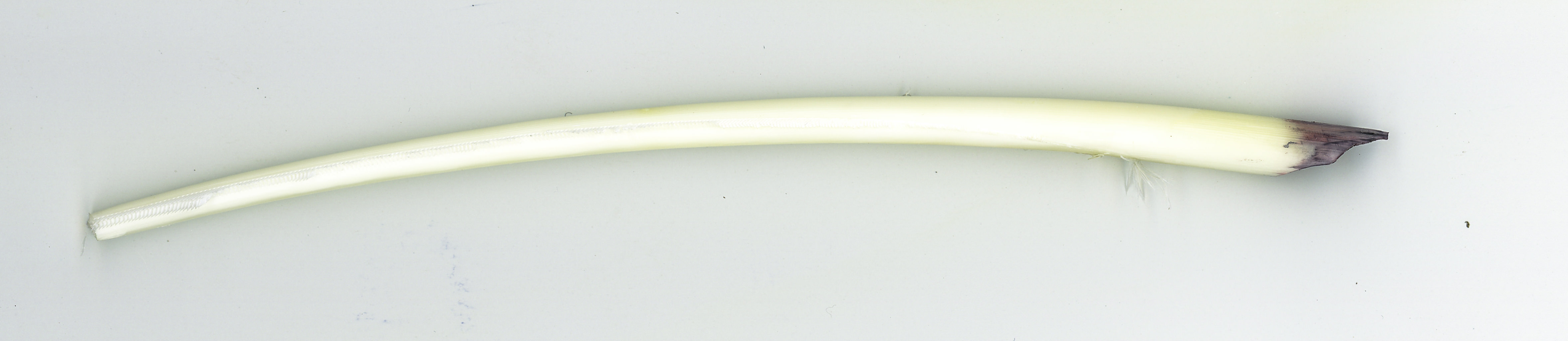
First, let us consider what writing with a quill pen entails. It means getting a feather, preferably a long feather from a goose’s wing, a first or second pinion about 14-16 inches long. From there, the feather is aged before cutting – reportedly a year – or cured with heat, or “clarified” after soaking overnight in water that might have alum added to it. Then it is trimmed with all feathery parts are removed. The end of the feather that attached to the bird is the part which becomes the nib. It’s a complex process to learn, but easy enough once you get your mind around the steps and shape you need. As always, practice makes perfect – but even an imperfectly cut quill pen can write quite well. I speak from experience.

To cut a quill, you need to soak it in water and then heat treat it to “clarify” it – making it hard enough to handle the cutting process. This video shows you this step:

YouTube, of course, has a number of videos about it. Some are good and some are absolutely ridiculous. Here is a good one – he has already clarified his feather:

And this is basically what you do all over again when you “mend your pen”!

Why mend? Why re-trim and shape a feather quill pen? For one thing, quill pens are like anything – some you really like! I have one that fits perfectly in my hand and is a daily writer. Others are not as comfortable, some quills are narrower in diameter and less comfortable; wider in diameter and uncomfortable for lack of familiarity. All can write beautifully and I, the user, simply adapt to each one. However, quills do become a bit messy if used regularly and a good mending can refresh them. As well, quill pens require rotation – the nib becomes soggy from the ink, and need to dry out. My inkwell from the early 1800s has 4 holes in it, to hold 4 pens, so I can cycle through them (not that I do!).

When I choose to mend a pen, I follow a protocol that seems to work for me. Here are the steps.

  • Test the pen by using it. What is the problem?
  • Soggy pen? Too wide? I usually begin by re-cutting the very end of the pen off to create a new writing surface. Test the pen. Problem solved? Go no further.
  • If the pen is still not writing with a clarity of your liking, sometimes you just need to shave off a bit of the top and bottom of the nib as done in the video. This can help sharpen a nib. Test again.
  • After the above trimming, you may want to make your nib a bit more narrow, so shape the sides of the pen. I do this a little at a time, carefully, and test the pen until it is to my liking.
  • Does the pen fail to carry ink beyond a few words? It could be the slit in the pen nib needs to be re-cut. When this occurs, I usually have trimmed the nib using the above steps before re-cutting the slit. The slit is important for ink flow; without it your ink can blob out all at once and that is not a nice thing to have on your paper!
  • Is your pen, after trimming, writing rough? If so, I find that 3M 2000 grit wet sand paper helps. Write on the sand paper, practicing the marks you make when using cursive.

The tools I use for making and mending my pens are a few. They include

  • Toenail trimmer
  • Quill knife – a pen knife as seen in the 2nd video
  • Xacto knife
  • Self-healing mat
  • 3M 2000 grit sand paper
  • Small tool to clean out inside of quill

Here is a good video about tools used to cut a quill, as well as cutting the quill itself:

You don’t need all these things – the differences of quill cutting varies, as you can see, from the above videos.

So, today I mended about 7 pens and cut 5 more, two of which were failures. I threw an old quill pen out as it was done in, and my mending attempts only made it worse. I saved my favorite pen and fixed a bunch and made some new ones. Not a bad few hours spent in the sunny patio! I now have 11 usable quills for my daily jottings.
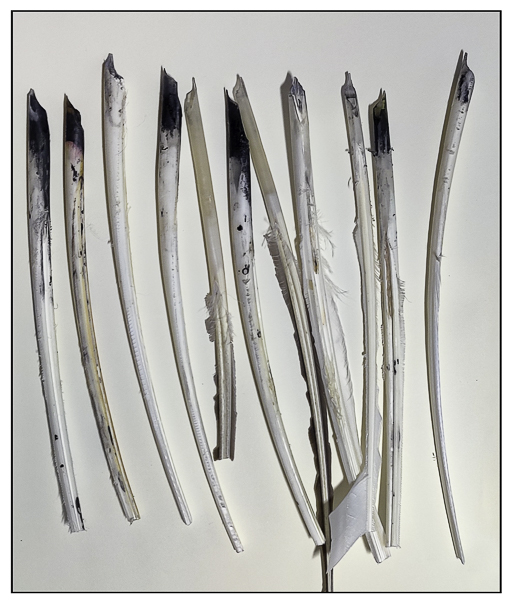
And a close up of the nibs – some are quite inky!
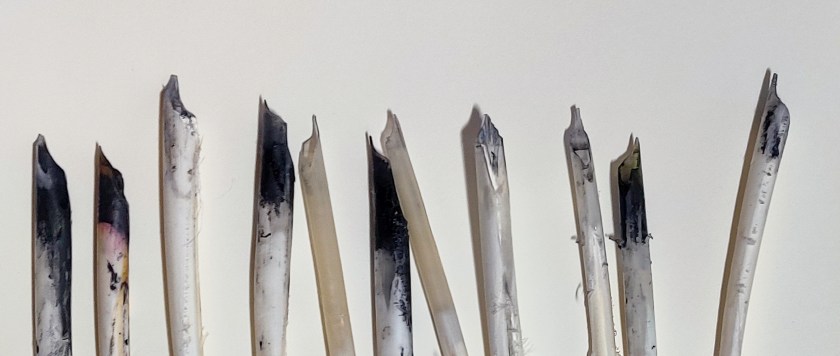
Hope this helps you realize that your old feather quill pen can still be used with a bit of TLC! If they did it in the Regency period, you can still do it in the 21st century.
A Year of Living Ycnkely

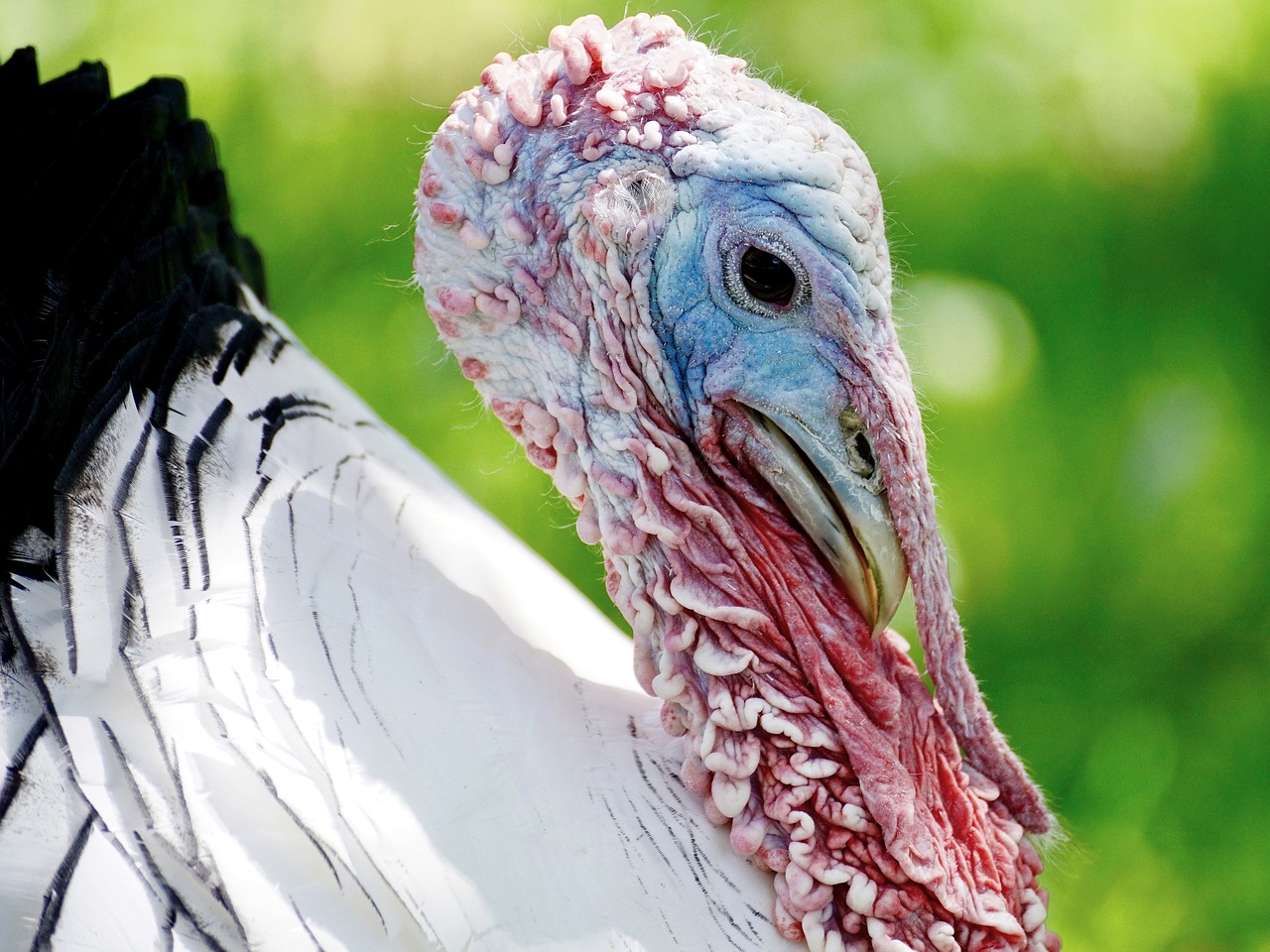
For the past year I have been keeping a journal – something I have done since I was 10 (I shred them, too!) – writing exclusively with goose / duck / turkey quill pens and iron gall ink, all made by myself.

Real quill pens don’t have all the feathery parts on them. They are removed when the quill is made. Not very pretty, but far more functional. All that fluffy stuff gets in the way when you write!

Why do this? I like the act of writing. Just paper and ink and my thoughts or lists or complaints or observations. In this time period, just the daily usage of ink and quill has shown me and taught me a lot of things, things which are perhaps lost through time and the changes in technology. The fact is, too, I like to make things that I can use, and a quill pen and iron gall ink are proving to be two favorites.

Quills gave way from common usage in the 1830s when the metal nib came into easy manufacture and availability. Why not? Easier than cutting your own quill. Iron gall ink is easy to make if you have iron galls (though any plant material with tannin in it also works), and other ingredients available. It just takes time. Interestingly, powdered iron gall inks were available to the public, and apparently in common usage during the Revolutionary War by soldiers and others on the move. The powder was in packets, and all you did was sprinkle some ink on a surface, add water or wine or beer, and with your handy quill and a bit of paper, off you wrote.

Today’s treatise is about the Yncke itself. I’ve made multiple batches and have found out a few things that may have been common knowledge back when it was the only ink commonly available.

Observations

Iron gall ink is best used in small amounts, such as in an inkwell with a lid. The ink evaporates and particulate matter settles out with time. By keeping your ink in a sealed container – I use a mason jar with a lid – you keep it relatively fresh. It won’t evaporate although settling of the materials occurs.

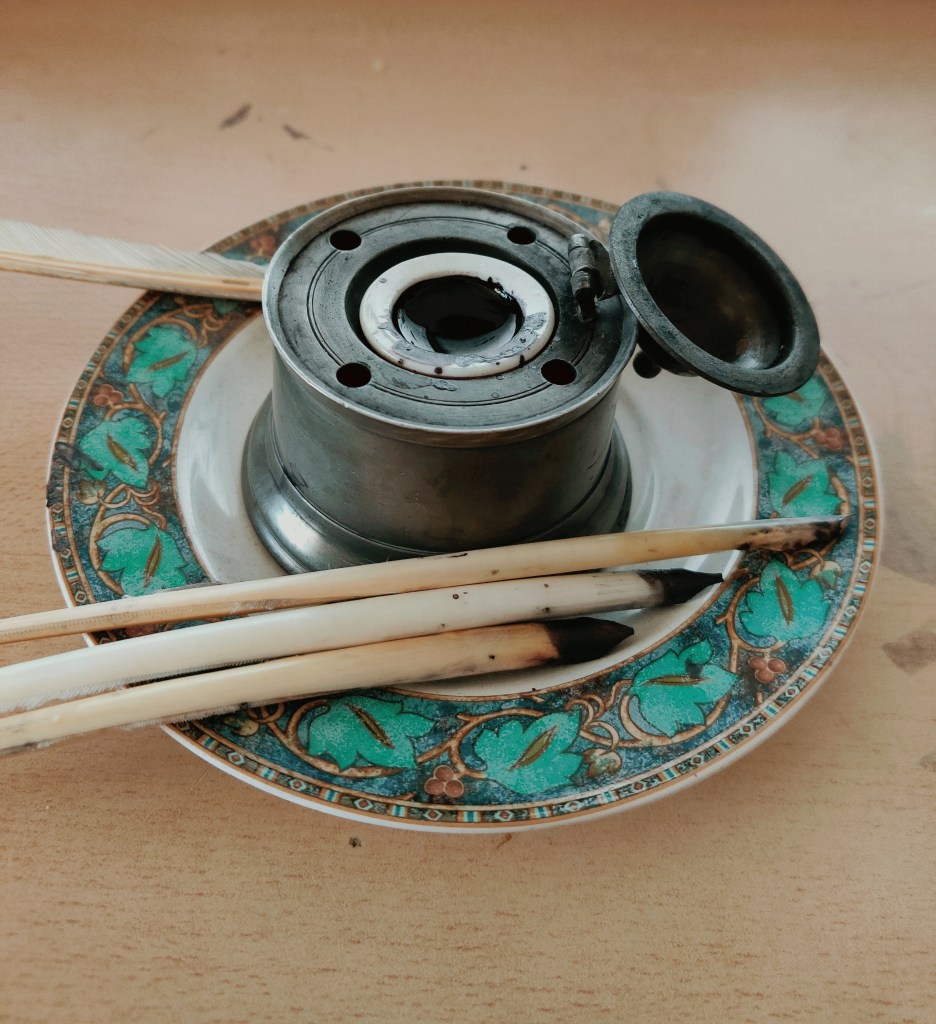
Here are my quills, ink well with porcelain insert, and saucer to catch spills. Notice the stains on my desk! I can usually remove them with some bathroom scrub that has bleach, rinsing thoroughly after scrubbing. Let the cleaner sit for a few minutes to let the bleach work, and use a bit of gentle elbow grease. This is a plastic-topped work station I have had for 25 years, and it has held up very well!

I use a pewter inkwell, reputedly from the early 1800s, with a porcelain well. I keep it on a saucer as spills from iron gall ink stain anything easily. The porcelain is easily cleaned up. I replenish my ink every two or three days – a lot gets used up! Watching it disappear is rather fun.

When I replenish my ink, my choice of adding more ink or thinning it is really my first question. Experience has shown that through evaporation the ink becomes thicker and thus does not easily flow from the pen. I add water in a small amount, but after having read that one should use vinegar or spoilt wine or beer to keep the ink’s color strong, I have tried both. My experience is too limited at this point to make a more definitive statement that either works fine.

How do I know when I need to dilute my ink? I know when I can no longer write a long line of words with a single dip of the quill. The ink begins to blob up and becomes more viscous. If I find I can only write a word or two before the ink is very pale, I know that the first problem is the ink, not the quill. Then, I add a bit of water or vinegar or wine or beer, just a bit, and try writing again. If the flow improves, you are fine. I use a plastic pipette with a squeeze bulb because I can control the addition of liquid more easily than just pouring it into the well.

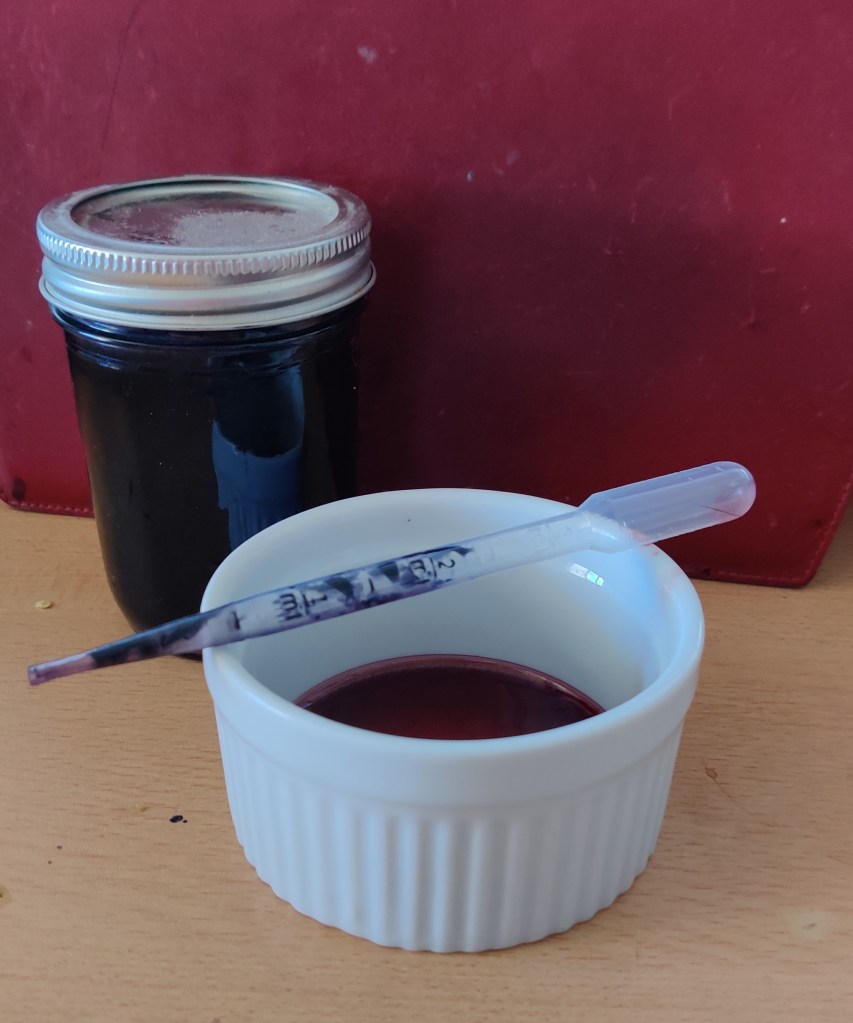
Here you will see the ink in a 1 cup canning jar with separate screw top and lid. The pipette is made of plastic and has a squeeze bulb on top. This allows for tidy delivery of either ink or thinning liquid – here, old red wine in a custard cup.

In using iron gall ink, I used to keep it in bottles with screw-on lids. Specifically, I used old fountain pen ink bottles. However, this ink is like a glue in some ways because the lids eventually stick to the bottle and become difficult to unscrew. Flying ink is not fun when you finally get that lid off! I store mine in 1 cup canning jars, the kinds with separate screw tops and lids, such as used in making jam or jelly. When I need more, if the lid is sticky, I can usually pry it off with a knife – slowly and gently! And I do it in the kitchen sink or with paper towels beneath the jar to catch any spillage. Clean any spills up immediately!!

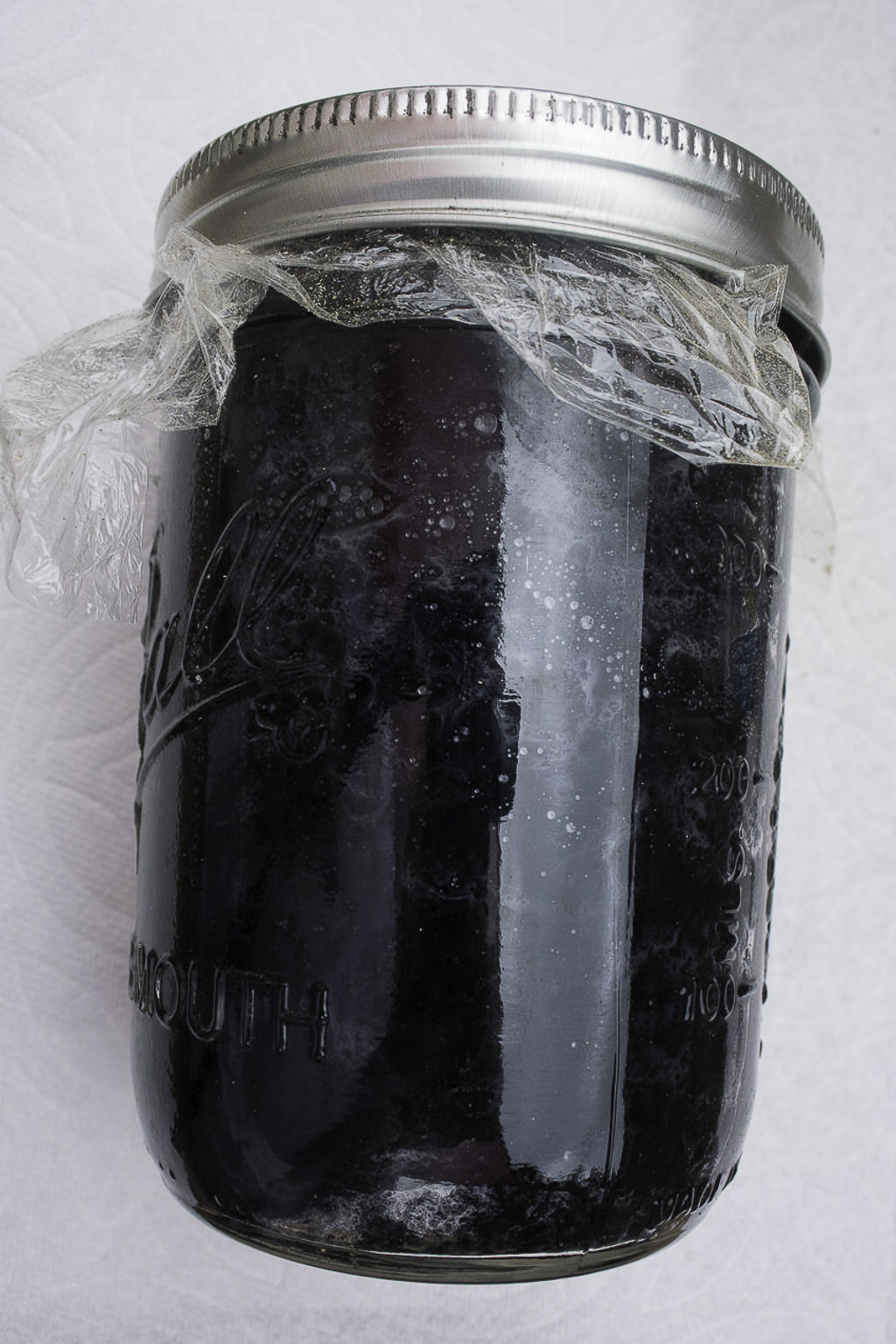
Iron gall ink can spoil. I have had batches which developed a scummy surface on it, but it doesn’t seem to affect the quality of the ink. I just shake it up and mix it in. This seems to have occurred when I used water in making the ink. This last batch I made with some old wine, and the scum did not appear. I will say, too, that I like the smell of wine when I use fresh ink! It’s a nice addition.

Making it, as I said, takes time. There a numerous recipes on the internet. You can find my own commentaries on the ink by using the search feature. The recipe I use so far is as follows, and have been pleased with it, especially when I have made it with wine:

Receipt for Iron Gall / Oak Gall Ink

  • Oak galls:  80 g.
  • Distilled water / stale wine or beer / vinegar:  300 g.
  • Ferrous Sulfate (I used ferrous sulfate heptahydrate):  50 g.
  • Gum Arabic:  25 g.

Crush oak galls into small pieces or grind into powder using a spice or coffee mill.  Place into jar and cover with 300 ml. of distilled water.  Place in sunny window 3-7 days (depending on your life and schedule).  I plan to do 3 as per the recipe from the Schoenberg Institute.  After 3 days, there should be a dark murky liquid in the jar.

On Day 3, add 50 g. of Ferrous Sulfate to oak gall mixture; replace in sunny windows for another day.  On Day 4 add the Gum Arabic and leave for another day.  On Day 5, strain the liquid into a clean vessel and voila, ink!

My Check List For Using and Maintaining Iron Gall Ink

  • Take the time to make iron gall ink. I think a week or two is best. Anticipate when you will need a new batch.
  • Store unused ink in a closed container, such as a canning jar.
  • Use a small amount of ink at a time as it easily evaporates and settles out.
  • If your ink is thick, before adding more ink to your well, dilute first with small amounts of water, vinegar, stale wine or beer. Test with your quill. A pipette works well to transfer fresh ink or dilution liquid.
  • Paper towels are excellent as blotting paper. I use toweling to blot a page before I turn it over, and I turn it over onto another sheet of toweling. Sadly, we no longer have blotters as daily items on our desks.
  • Rinse your quill when done, and blot it dry. Have at least 3-4 quills available to use as they need to dry out between uses.

So, that is it for this posting. Hopefully it is of some use to those who would like to use iron gall ink and quills on a more regular basis. If you are just beginning to use these items, be patient and kind to yourself. Learning to write with a quill pen is not easy, and learning how to replenish the ink on your pen has its own quirks. We are used to pens where re-inking is not normal, but with both quills and metallic dip pen nibs, there is a pattern and rhythm to getting the right amount of ink on your pen. Once you master it – and it shouldn’t take long – you might find yourself quite happy with your new skills!

Gum Arabic – The Last Ingredient

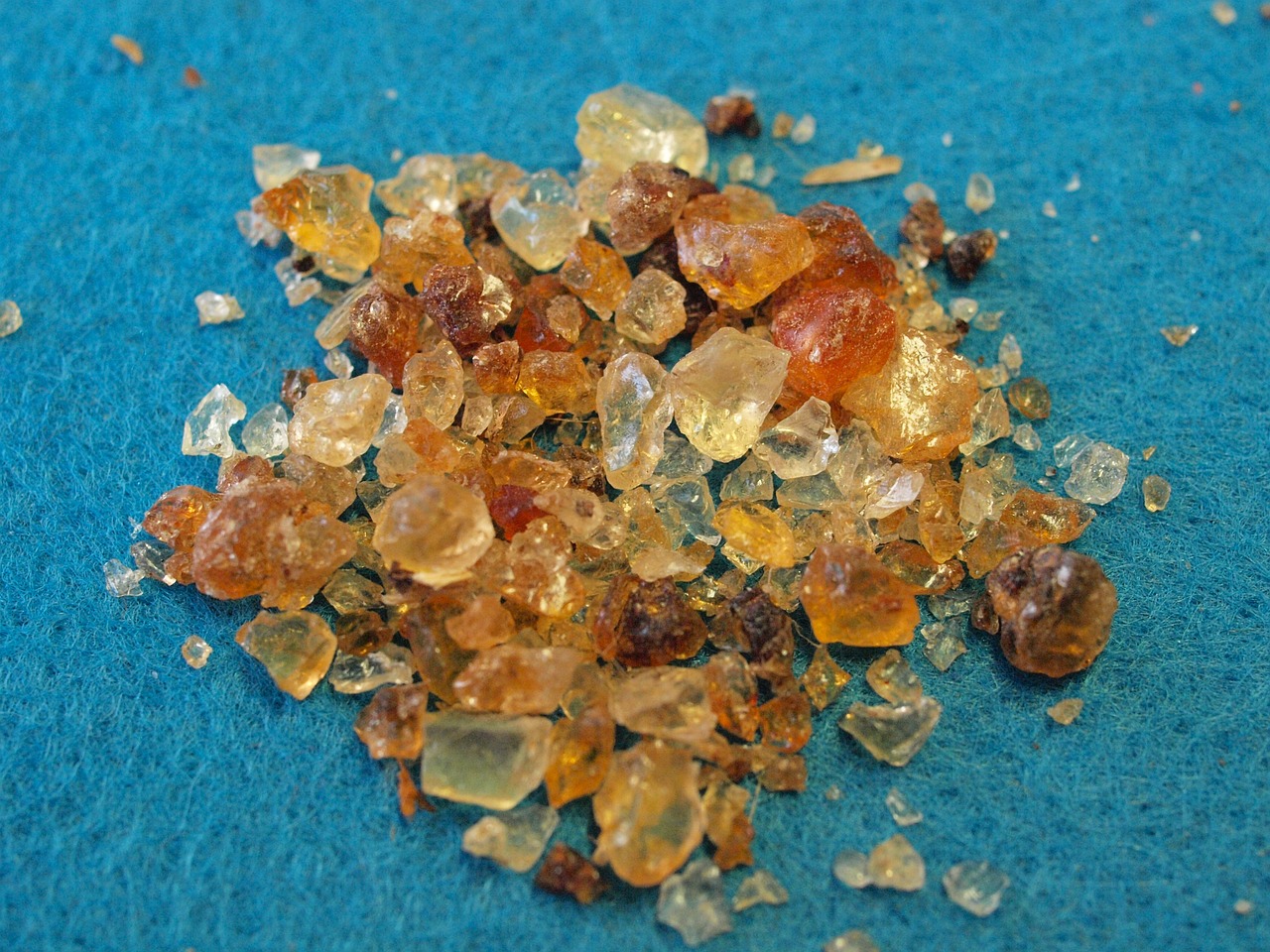
Today is the final day for adding ingredients to the iron gall ink.  I added 25g. of gum arabic to the ferrous gallate (new name for the oak gall / ferrous sulfate heptahydrate solution) to create the final product of ink. Until the gum arabic is added, the solution is really just a solution or a liquid. My gum arabic was in a powdered form, so I simply placed it on top of the liquid in the jar, and shook it a lot. Since adding it, I am continuing to shake it. The gum arabic to the left is in its most common form – hardened sap. It has a jewel-like quality, I think – a lot like amber – and besides using it in ink, it is edible and has many uses in the food industry.

Gum arabic, the hardened sap of the acacia tree, is used a binder in ink, controlling the ink’s viscosity – how the ink flows.  It adds more control into the ink’s behavior, such as eliminating or lessening feathering, bleeding or cracking when use on paper or parchment. An element of luminosity or shine is another characteristic it imparts to ink.

In addition to controlling viscosity, gum arabic helps the ink to adhere to the paper. The water in the ink evaporates, and left behind is the colored portion of the ink; it is the gum arabic which acts as a glue to stick the ink’s pigment to the paper.

An ink – or watercolor paint or gouache – needs the gum arabic to give it the right consistency or body to flow easily, but not messily, from the pen or brush. Other pigmented inks may also crack, and the addition of the gum arabic helps prevent this; I don’t believe that iron gall inks suffer from cracking.

Soon enough, the ink and quill will be put to the test of actually using it!  Stay tuned . . .


Chemistry Magick & A Quill Scraper

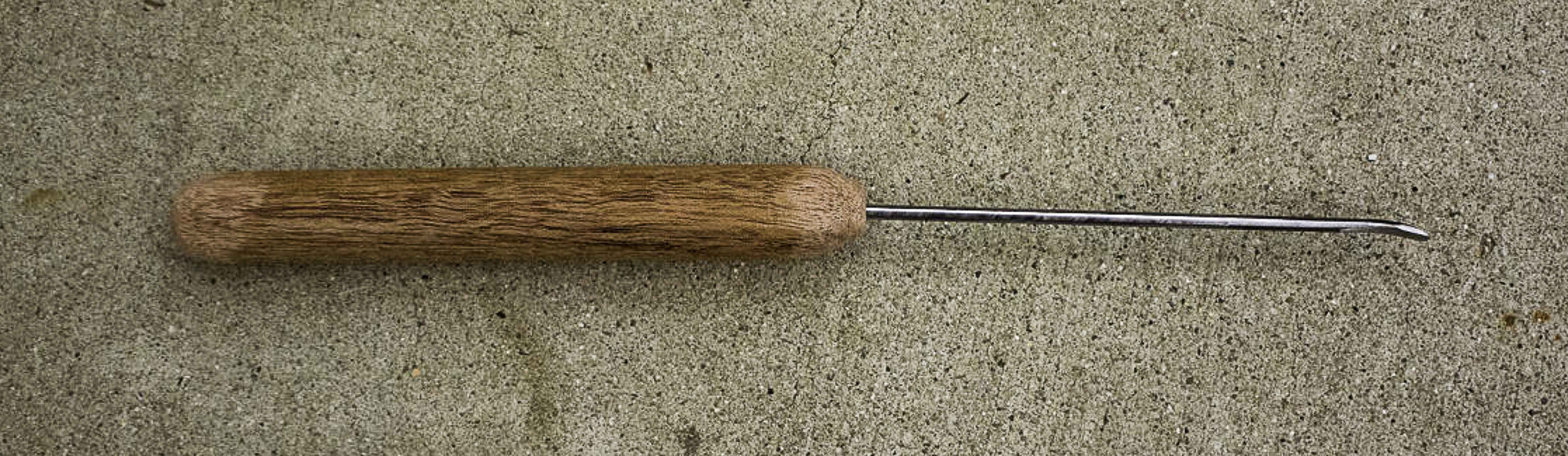
Early this morning, Josh and I went to the hardware store.  We bought supplies for Thursday’s indigo dyeing adventure and a piece of steel wire to make a quill scraper, a tool used to scrape out the membranes inside the feather’s quill, which is where it attaches to the bird.  Once home, Josh headed out to the garage, and within about 45 minutes produced a scraper, similar to the one found in yesterday’s quill cutting video with Mr. Ruud.  All told, it measures about 8″ in length and is a dandy little item.

Quill scraper made with a piece of steel wire, inserted into a wooden handle. End shaped and bent. Total length is about 8 inches / 40 cm. Works very well!

And then, a bit of housework – dusting! It’s gotta be done – a bit of lunch, a nap, and onto the magic of adding Ferrous Sulfate Heptahydrate to my slightly fermented jar of oak galls.

Ferrous Sulfate Heptahydrate was not hard to find.  I bought it from Amazon and had it within a day or so.  The jar is about 113 g. – I need 50 g. for the ink.  Thus, I weighed it out.

From here, it was time to add it to the oak gall mix, which has been out in the sometimes-sun since Saturday. I shook is multiple times everyday.

And now – oh, this was so exciting and beautiful! – the addition of the Ferrous Sulfate Heptahydrate to the oak gall mixture!

Ferrous Sulfate Heptahydrate as it settled into the oak gall and water mixture. So lovely!

And now, shaken up, the dark ink of the Iron Gall Ink!

Shaken mixture of Ferrous Sulfate Heptahydrate and Oak Galls!

And now, another 24 hours out in the sometimes-sun. Stay tuned for the addition of Gum Arabic (25 g) tomorrow!

The First Quill

While we wait for the ink to ferment, along with kimchi (more later!) and the current batch of beer, I have taken some quills to begin to re-learn how to cut them.  What an adventure it has already proven to be.

To begin with, I bought a quarter pound of white turkey feathers from a local feather company.  They are white, and what I was able to do was to look at the diameter and width of the quill part – not the feathers, as they are not important – but the thickness and length of the lower end of the feather, the part to create the nib of a quill pen.

Yesterday, I stuck the quills in a glass of water to soak overnight.  I made sure there was enough water to cover the lower end of the quill up to where the first barbs begin.  One feather had its tip intact, but the remaining four had been cut away or removed.  According to varying sites, the end should be cut away prior to soaking.  After soaking the quills, I attempted to do the following, in this order:

  • Scrape out the membrane within the quill.  I used a variety of things, some of which were more satisfactory than others – in particular, I used a couple of threading hooks for my spinning wheels.  They weren’t especially good.  Nor was a bent paper clip or seam ripper.  I have seen scraping tools fashioned out of bicycle spokes and mounted in a handle – I will try to devise one over the next few days.  The soak in the water gave the feathers a rather fowl (yes, deliberate pun!) smell – light and rather disgusting.  Perhaps they soaked too long.  The next round of quills, I will try to remove the membrane without soaking them overnight, and then move into heating them, as in Step 2 below.

  • After scraping out the membranes – none really seem to become clear as suggested by varying videos on YouTube – I hardened the quills in hot sand.  I put some fine sand into a sauce pan on the stove and heated it up.  I heard you can spit on the sand (or sprinkle some water drops if you are disinclined to spit) and if you hear a hiss, the sand is hot enough to harden the quills.  I measured the temperature of mine, aiming for 350 F, and ended up with a bit more.  From there, I moved the pot onto a trivet on the patio, and inserted sand into the quill tips and left each quill to clarify (what it is supposed to do) for about a minute.  I cycled through the quills.  At times I could hear the quills hissing in the sand – water evaporating or the sound of scorching from touching the bottom of the pan?  Three quills were scorched, and two were not.

  • After the hardening / clarifying process I looked at my quills.  They looked kind of sad and did not smell delightful.  After choosing a scorched quill, I watched this video by Dennis Ruud, a master quill cutter. 
  • While I did not follow all his steps, I did attempt to create a quill as he did – with some success.  My first quill was not at all clarified, nor was it especially good.  Still, the process of learning was most important.  The fact the quill was rather scorched and deformed meant I had to cut off a lot of the area that would become the nib.  Wah!  Still, I made the attempt – and was really rather pleased with the result.  I used different Xacto blades for the final product.

  • Finally, I stripped away all the feathers using slices from the Xacto knife as well as trimming them with scissors.  Ultimately, all I was left with was the shaft and a nib, total length about 8 inches / 20 cm.

  • And then I practiced writing . . .

The quill nib was broader than I would have preferred, but the pen held up well despite all the flaws.  The paper itself is very smooth, and having a hard finish, not especially absorbent.  As a result of both the hard finish on the paper and the broad nib, it took a bit of time for the ink to dry.  I tried script and printing using the quill turned to about 35-45 degrees to create a thick-thin element.  Still, for my very first quill in ages and ages, I was pretty darned pleased with it!