
There is a channel on YouTube called “Life in the 1800s” that brings to life the proverbial days of yore. This video, from a voice recording made by Julius Franklin Howell, gives a view of the Confederate side of the Civil War, in which he fought as a young man. As today is Thanksgiving in the US, I think about our history, real and fabricated. What we think today is not necessarily what was thought when history was being made. This was a fascinating video, an oral history, of someone who was there.
Category: Blitherings
Mending Your Pen
As Jane Austen wrote in Pride & Prejudice:
“I am afraid you do not like your pen. Let me mend it for you. I mend pens remarkably well.”
“Thank you – but I always mend my own.”
Austen is discussing the quill pen in particular – a pen made from the feather of a bird, usually a goose, and cut with a pen knife. The ink is most likely iron gall ink, made at home or sold in penny jars. Pre-cut quill pens could also be bought, perhaps well made or not, but certainly could be customized to one’s own liking. It is from this particular section of Pride & Prejudice that I decided I could “mend my pen” to my liking as it got worn with use.
First, let us consider what writing with a quill pen entails. It means getting a feather, preferably a long feather from a goose’s wing, a first or second pinion about 14-16 inches long. From there, the feather is aged before cutting – reportedly a year – or cured with heat, or “clarified” after soaking overnight in water that might have alum added to it. Then it is trimmed with all feathery parts are removed. The end of the feather that attached to the bird is the part which becomes the nib. It’s a complex process to learn, but easy enough once you get your mind around the steps and shape you need. As always, practice makes perfect – but even an imperfectly cut quill pen can write quite well. I speak from experience.
To cut a quill, you need to soak it in water and then heat treat it to “clarify” it – making it hard enough to handle the cutting process. This video shows you this step:
YouTube, of course, has a number of videos about it. Some are good and some are absolutely ridiculous. Here is a good one – he has already clarified his feather:
And this is basically what you do all over again when you “mend your pen”!
Why mend? Why re-trim and shape a feather quill pen? For one thing, quill pens are like anything – some you really like! I have one that fits perfectly in my hand and is a daily writer. Others are not as comfortable, some quills are narrower in diameter and less comfortable; wider in diameter and uncomfortable for lack of familiarity. All can write beautifully and I, the user, simply adapt to each one. However, quills do become a bit messy if used regularly and a good mending can refresh them. As well, quill pens require rotation – the nib becomes soggy from the ink, and need to dry out. My inkwell from the early 1800s has 4 holes in it, to hold 4 pens, so I can cycle through them (not that I do!).
When I choose to mend a pen, I follow a protocol that seems to work for me. Here are the steps.
- Test the pen by using it. What is the problem?
- Soggy pen? Too wide? I usually begin by re-cutting the very end of the pen off to create a new writing surface. Test the pen. Problem solved? Go no further.
- If the pen is still not writing with a clarity of your liking, sometimes you just need to shave off a bit of the top and bottom of the nib as done in the video. This can help sharpen a nib. Test again.
- After the above trimming, you may want to make your nib a bit more narrow, so shape the sides of the pen. I do this a little at a time, carefully, and test the pen until it is to my liking.
- Does the pen fail to carry ink beyond a few words? It could be the slit in the pen nib needs to be re-cut. When this occurs, I usually have trimmed the nib using the above steps before re-cutting the slit. The slit is important for ink flow; without it your ink can blob out all at once and that is not a nice thing to have on your paper!
- Is your pen, after trimming, writing rough? If so, I find that 3M 2000 grit wet sand paper helps. Write on the sand paper, practicing the marks you make when using cursive.
The tools I use for making and mending my pens are a few. They include
- Toenail trimmer
- Quill knife – a pen knife as seen in the 2nd video
- Xacto knife
- Self-healing mat
- 3M 2000 grit sand paper
- Small tool to clean out inside of quill
Here is a good video about tools used to cut a quill, as well as cutting the quill itself:
You don’t need all these things – the differences of quill cutting varies, as you can see, from the above videos.
So, today I mended about 7 pens and cut 5 more, two of which were failures. I threw an old quill pen out as it was done in, and my mending attempts only made it worse. I saved my favorite pen and fixed a bunch and made some new ones. Not a bad few hours spent in the sunny patio! I now have 11 usable quills for my daily jottings.
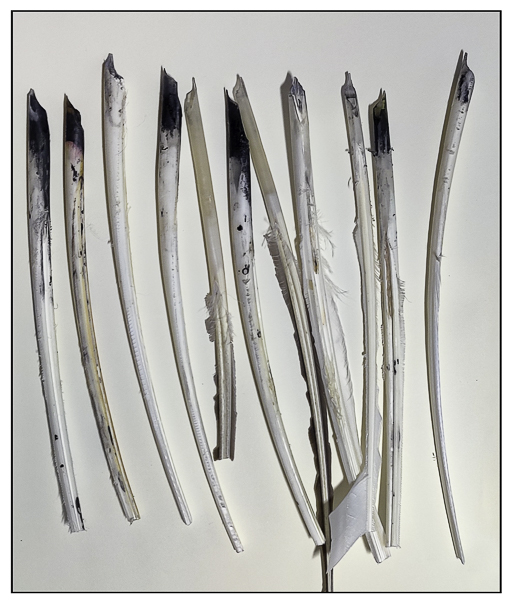
And a close up of the nibs – some are quite inky!
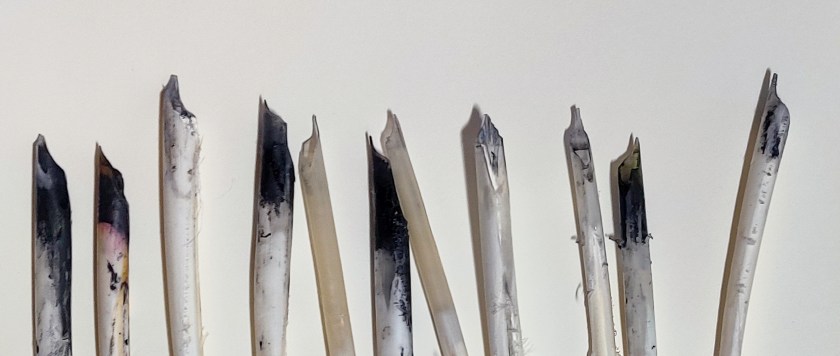
Hope this helps you realize that your old feather quill pen can still be used with a bit of TLC! If they did it in the Regency period, you can still do it in the 21st century.
The Passing of the Queen

I am very sad to hear that Queen Elizabeth II is no longer amongst us. In our turbulent world she has been a steady hand. No life is perfect and hers has had its share of upheaval and craziness, but in face of it all, she has remained dignified and human despite the responsibility of her role. I admire her a great deal, as a woman, as a leader. In today’s world, I only wish there were more like her with vision beyond their own immediate agendas.
Rest in peace.
Quiet Quitting

“Quiet Quitting” is the new term for losing the enthusiasm to dedicate your life, your free time, and your soul to your job. “Nothing new” is what you will read if you search the term, and that is true. People have been doing this forever. It really is a practical way to get your life back and not starve to death or live on charity.
I think everyone who has ever held a job has quietly quit one job or another. Causes can range from harsh management and a sense of not being appreciated to just boredom and being stuck in a position. For many people, those around them can make or break a job. When the people fade and fail, then enthusiasm wanes. Other times, the excitement and interest in a job changes when the job changes. Duty calls, though, and we often slog on although we are not especially happy with the ongoing situation.
Changing a job can help this, bring in new faces, more money, a new environment. Sometimes this change alone can help a person renew, and leaving a toxic environment for one (hopefully not toxic) with a better atmosphere. Our work is often tightly bound up with a sense of self and self-worth, but work also helps us hide from other responsibilities or problems we just don’t want to face.
One thing is just yourself. You can hide from yourself if you are always working. What happens when you suddenly have to face yourself and learn who you are, who you have become? It can be exciting, or depressing, or confusing, or any other number of things. You can also hide from people around you, such as your kids or wife or husband or other family members, friends, and neighbors.
Ultimately we need to look at ourselves and find values and reasons within our daily lives beyond the job – or return to the job to continue hiding.
“Quiet Quitting” doesn’t just happen at work. It happens in marriages, friendships, and all relationships. People change, people get tired of patterns and abuse or neglect, and it seems the older we get the less patience we have for life’s crap. The idealism and hope of youth vanish as we see the world change and we learn more of reality. Life pulls no punches, and some of us are in easier situations than others, but we still all have to deal with life and its disappointments.
I think this may be when the quiet quitting can begin. Disappointment after disappointment, ongoing environmental degradation, polarizing politics, wars, inflation, income problems, etc., can cause many of us to retreat. We can also lash out at those around us when upset rather than looking to a loved one for support. As well, we also need to look within for a way to move beyond our own sorrow or displeasure with the way our lives are going or the way the world is moving beyond our control.
I am retired – I have time for myself, perhaps too much of it. I have time to look at the world around me and not be pleased. I see people I care about far more differently than I did before I had all this time to think. I have time to ponder. All of this does at times make me want to walk away from everyone and everything. Hobbies and interests are one way to hide from all this, but what is the value if there is no value within? And this is when acknowledgment of dark thoughts needs to become the vehicle for change and renewal.
Quiet quitting can be a form of restoration of the self and the soul. I don’t think it is an easy process to find new things which give value and meaning to one’s existence, but life is all about growth and change, at all ages and phases in life. Life does punch you in the face a lot! Roll with the punches or fight back? Adapt? Change direction? Flounder and wander around in the dark, seeking the answers from various sources?
Hmmmmm.

The Love Song of J. Alfred Prufrock
S’io credesse che mia risposta fosse
A persona che mai tornasse al mondo,
Questa fiamma staria senza piu scosse.
Ma perciocche giammai di questo fondo
Non torno vivo alcun, s’i’odo il vero,
Senza tema d’infamia ti rispondo.Let us go then, you and I,
When the evening is spread out against the sky
Like a patient etherized upon a table;
Let us go, through certain half-deserted streets,
The muttering retreats
Of restless nights in one-night cheap hotels
And sawdust restaurants with oyster-shells:
Streets that follow like a tedious argument
Of insidious intent
To lead you to an overwhelming question…
Oh, do not ask, “What is it?”
Let us go and make our visit.In the room the women come and go
Talking of Michelangelo.The yellow fog that rubs its back upon the window-panes,
The yellow smoke that rubs its muzzle on the window-panes
Licked its tongue into the corners of the evening,
Lingered upon the pools that stand in drains,
Let fall upon its back the soot that falls from chimneys,
Slipped by the terrace, made a sudden leap,
And seeing that it was a soft October night,
Curled once about the house, and fell asleep.And indeed there will be time
For the yellow smoke that slides along the street,
Rubbing its back upon the window-panes;
There will be time, there will be time
To prepare a face to meet the faces that you meet;
There will be time to murder and create,
And time for all the works and days of hands
That lift and drop a question on your plate;
Time for you and time for me,
And time yet for a hundred indecisions,
And for a hundred visions and revisions,
Before the taking of a toast and tea.In the room the women come and go
Talking of Michelangelo.And indeed there will be time
To wonder, “Do I dare?” and, “Do I dare?”
Time to turn back and descend the stair,
With a bald spot in the middle of my hair—
[They will say: “How his hair is growing thin!”]
My morning coat, my collar mounting firmly to the chin,
My necktie rich and modest, but asserted by a simple pin—
[They will say: “But how his arms and legs are thin!”]
Do I dare
Disturb the universe?
In a minute there is time
For decisions and revisions which a minute will reverse.For I have known them all already, known them all—
Have known the evenings, mornings, afternoons,
I have measured out my life with coffee spoons;
I know the voices dying with a dying fall
Beneath the music from a farther room.
So how should I presume?And I have known the eyes already, known them all—
The eyes that fix you in a formulated phrase,
And when I am formulated, sprawling on a pin,
When I am pinned and wriggling on the wall,
Then how should I begin
To spit out all the butt-ends of my days and ways?
And how should I presume?And I have known the arms already, known them all—
Arms that are braceleted and white and bare
[But in the lamplight, downed with light brown hair!]
Is it perfume from a dress
That makes me so digress?
Arms that lie along a table, or wrap about a shawl.
And should I then presume?
And how should I begin?. . . . .
Shall I say, I have gone at dusk through narrow streets
And watched the smoke that rises from the pipes
Of lonely men in shirt-sleeves, leaning out of windows? …I should have been a pair of ragged claws
Scuttling across the floors of silent seas.. . . . .
And the afternoon, the evening, sleeps so peacefully!
Smoothed by long fingers,
Asleep… tired… or it malingers,
Stretched on the floor, here beside you and me.
Should I, after tea and cakes and ices,
Have the strength to force the moment to its crisis?
But though I have wept and fasted, wept and prayed,
Though I have seen my head [grown slightly bald] brought in upon a platter,
I am no prophet—and here’s no great matter;
I have seen the moment of my greatness flicker,
And I have seen the eternal Footman hold my coat, and snicker,
And in short, I was afraid.And would it have been worth it, after all,
After the cups, the marmalade, the tea,
Among the porcelain, among some talk of you and me,
Would it have been worth while,
To have bitten off the matter with a smile,
To have squeezed the universe into a ball
To roll it toward some overwhelming question,
To say: “I am Lazarus, come from the dead,
Come back to tell you all, I shall tell you all”—
If one, settling a pillow by her head,
Should say: “That is not what I meant at all.
That is not it, at all.”And would it have been worth it, after all,
Would it have been worth while,
After the sunsets and the dooryards and the sprinkled streets,
After the novels, after the teacups, after the skirts that trail along the floor—
And this, and so much more?—
It is impossible to say just what I mean!
But as if a magic lantern threw the nerves in patterns on a screen:
Would it have been worth while
If one, settling a pillow or throwing off a shawl,
And turning toward the window, should say:
“That is not it at all,
That is not what I meant, at all.”. . . . .
No! I am not Prince Hamlet, nor was meant to be;
Am an attendant lord, one that will do
To swell a progress, start a scene or two,
Advise the prince; no doubt, an easy tool,
Deferential, glad to be of use,
Politic, cautious, and meticulous;
Full of high sentence, but a bit obtuse;
At times, indeed, almost ridiculous—
Almost, at times, the Fool.I grow old… I grow old…
I shall wear the bottoms of my trousers rolled.Shall I part my hair behind? Do I dare to eat a peach?
I shall wear white flannel trousers, and walk upon the beach.
I have heard the mermaids singing, each to each.I do not think that they will sing to me.
I have seen them riding seaward on the waves
Combing the white hair of the waves blown back
When the wind blows the water white and black.We have lingered in the chambers of the sea
T.S. Eliot
By sea-girls wreathed with seaweed red and brown
Till human voices wake us, and we drown.
Work to Do
This is really a result of the road trip – more of that in other postings! – a lot of slides being scanned by yours truly in two different systems, with two different results. These slides are from ca. 1951-1960 and were taken in Illinois, in Chicago and the rural area where I grew up. For some reason after that the only family pictures we have are school pictures, and they are not really exciting to look at.
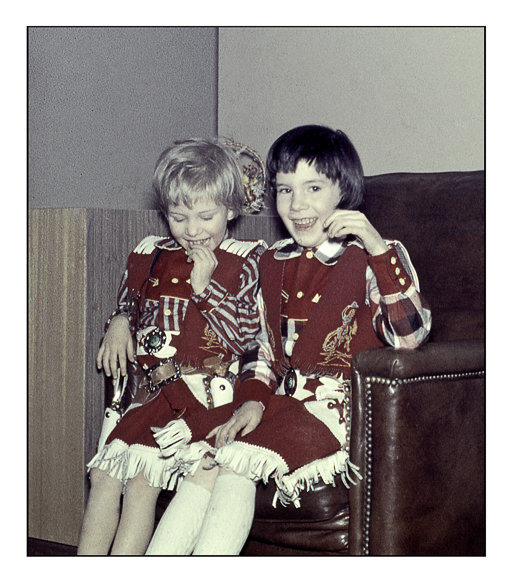
The slides were taken with both Kodachrome and Ansochrome. Both have deteriorated, lost color, collected dust and threads. Cleaning them up is not easy, but software – the right software – helps in that regard. Above is a slide I cleaned up and cropped using the Epson V600 flatbed scanner, Lightroom, Photoshop, and On1 Photo Raw. Dust removal with the Epson software was not really great so I spent a lot of time erasing the debris on the slide. You can see the original slide below.
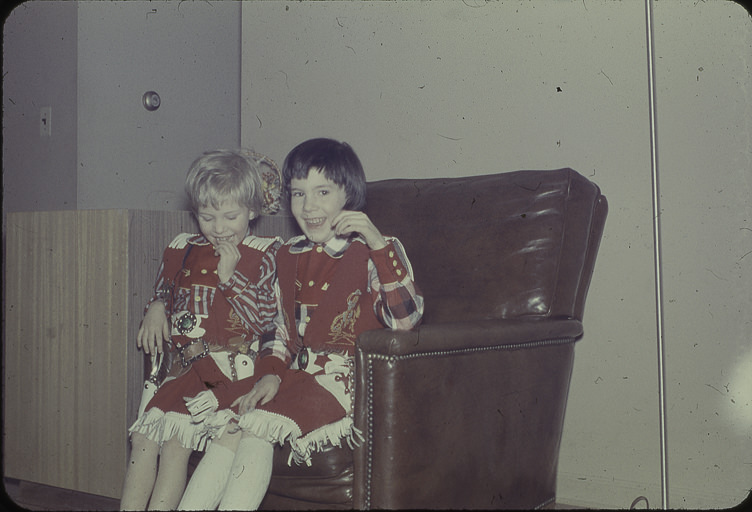
I have no idea what kind of camera my parents used in those days, but I am sure it is a 35mm camera as this is a Kodachrome. This next image is from an Ansochrome slide of yours truly and our dog Siwy (pronounced shee-veh, or as we said, shee-vee). I used SilverFast 8.8 and my PrimeFilm XA Super Edition to scan the slide.
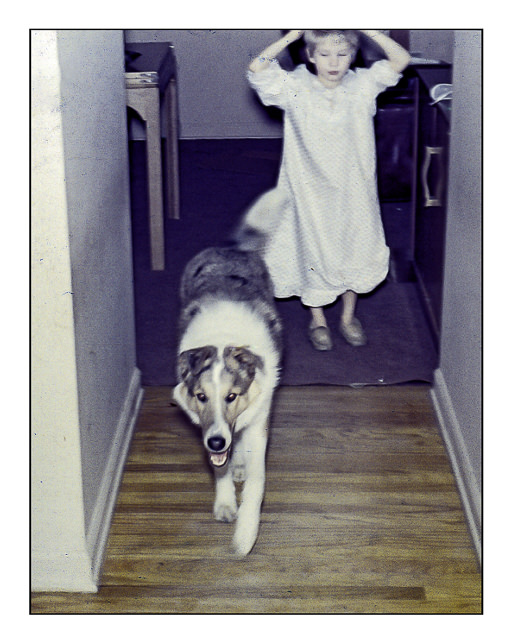
Silverfast has a really good dust and dirt removal in its SE software – you can get this for free with a lot of new scanners. A lot of people think it is hard to use – maybe if you don’t want to play a bit – but I have been really pleased with it. There were still areas after the dust / dirt removal I needed to clean up, such as areas where the slide had deteriorated. Sharpness, too, was difficult to work with. Below is the original scan of the slide so you can see the difference.
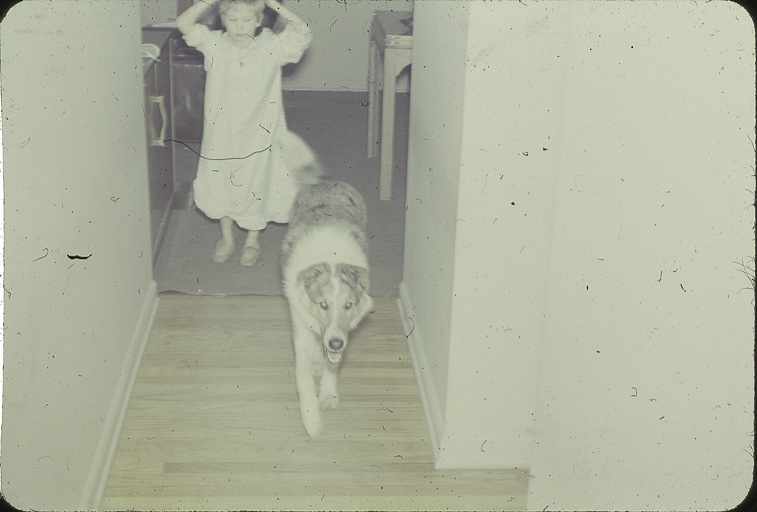
The combo of SilverFast and PrimeFilm scanner create a relatively clean scan – I wanted you to see all the dirt! Finally, I did the color upgrade / modification in On1 Photo Raw using a preset I made.
Our family doesn’t have a lot of photos and little knowledge of family history. My mother’s family were immigrants and their family vanished after WW2. We never had much contact with my father’s family for all sorts of reasons. When we go, our branch of the family tree disappears. Editing and recording these slides is for my pleasure and that of my sibs – if they think it is of any interest.
Am I living in the past and not looking to the present and future? Am I getting mawkish and sentimental? It’s hard to tell. History has always fascinated me, so perhaps our little bit of history and that of the world is impetus enough. Of course, editing photos is a bit of fun, too, so why not?
 Ink, Yarn & Beer