
Author: -N-
Local Talent, ii
Last night’s workshop was presented by Tom Gamache and Van Webster. This was the least photographic workshop about photography I have ever seen!
Oh, yes, there were photos, but the key was what makes up a photograph. This means the history of painting was pulled in, with landscape paintings from the Renaissance and later being used as examples for composition, light, and action. While this may be obvious to a landscape artist, it was rather an eye-opener to hear someone say what I have thought – like the little girl in The Emperor’s New Clothes, I needed someone else to point things out to me that I already knew.
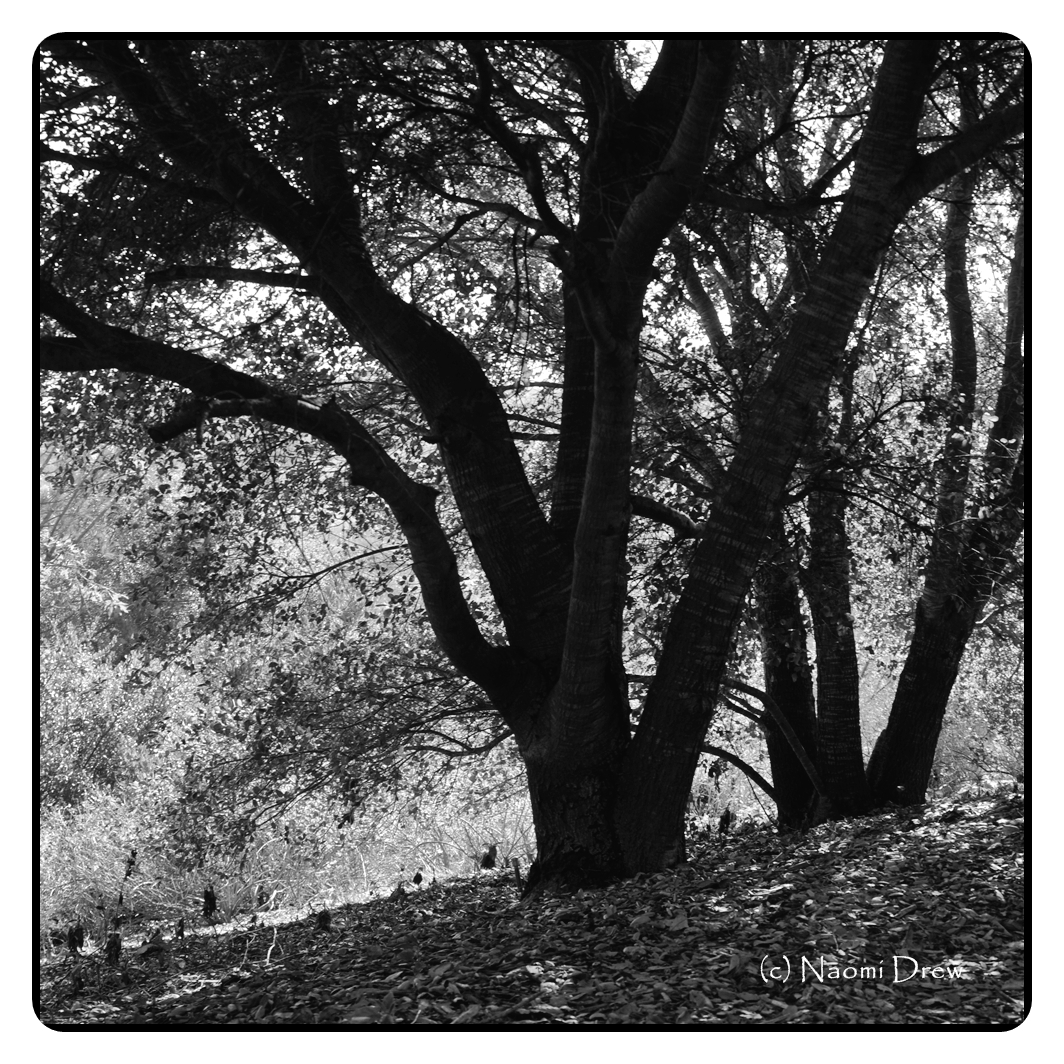
The value of this is revisitation to the elements which create drama or visual excitement in a painting. Triangular shapes. Repeated patterns. Contrast in color. Nuance of light. Light on dark. Dark on light. S curves. Z curves. Diagonals. Soft versus hard. Graphic versus romantic. Close focus. Distant focus. Foreground. Background.
One thing that stood out was pointing out that art is planned. Thinking about it, it is. The artist pulls together what they know from experience and theory, and create something. While the results may not be exactly as anticipated, the elements of composition and light and contrast are often considered before work is begun. This means preliminary drawing, value studies, whatever. In short, a bit of conscientious effort before will pay off later – and art emerges, not a lucky accident.
Definitely a thought-provoking workshop.
Local Talent, i
I joined our local photography club awhile ago. For $30.00 a year I’ve made a very wise investment. The monthly meetings all have contests, with critiques by professionals. Workshops have included framing and mounting of photos, studies in composition, and so on. Tonight is another workshop, but as I forgot what the topic is, I decided to look up the instructor . . . and when it did, it all came back. Landscape! And looking at this guy’s stuff online, all I could do was say “wow!” and think how lucky we are to have members like this . . .
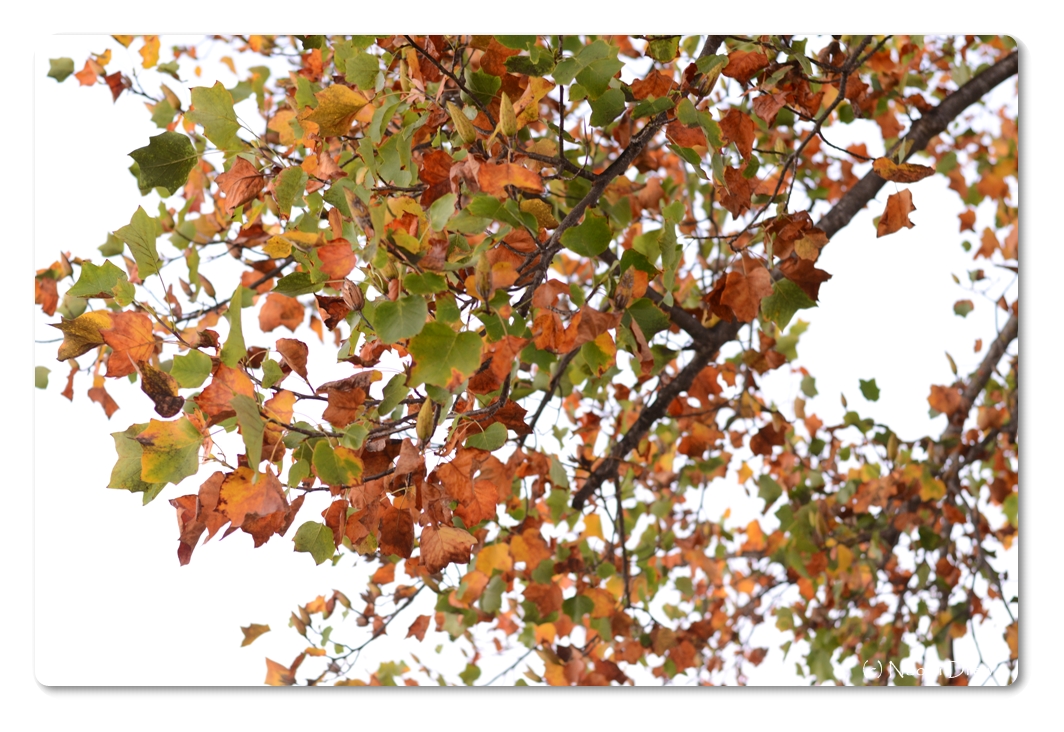
Come into the light, Luke . . .
The other day I picked up a book on black and white photography, specifically John Batdorff’s Black and White: From Snapshot to Great Shot. He mentions using available light. With this in mind, and rather restless as I wait for the afternoon to pass before heading out to a swank party, I wandered around and came across my husband’s shoes on the table. He just polished them.
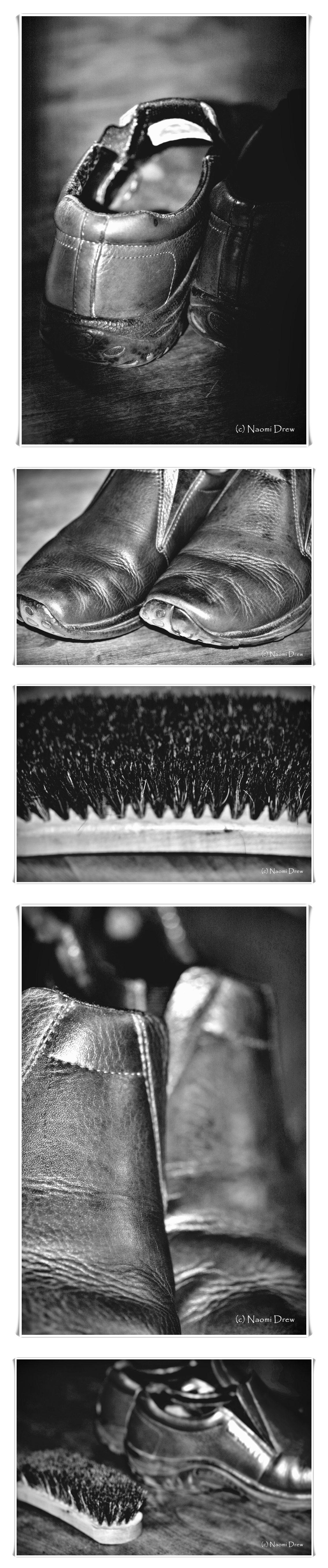
I used available light, and augmented a bit with some post-processing and on-camera pop-up flash for a few pictures.
As they say, work with what you got.
Tumalo Creek
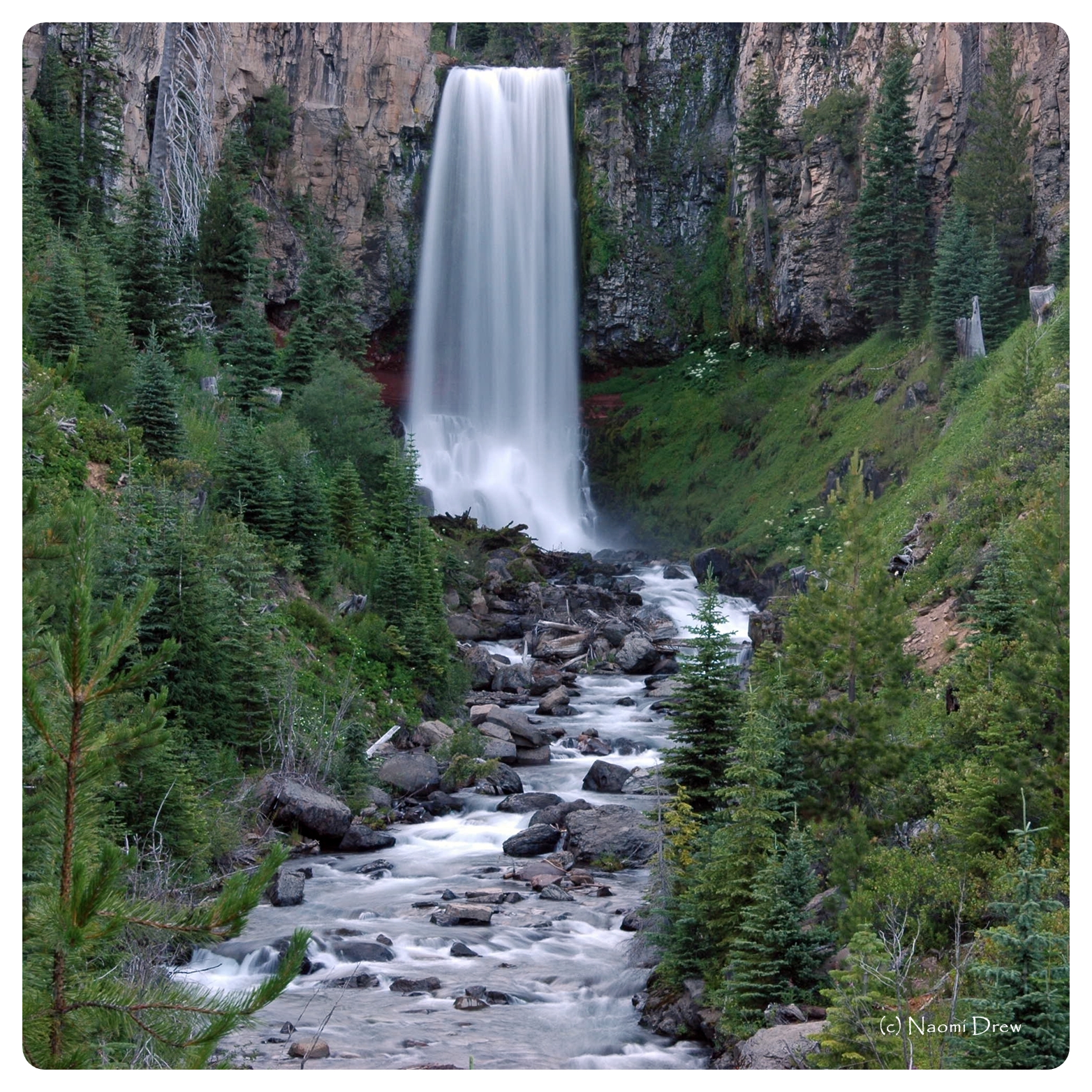 Outside of Bend, Oregon, is Tumalo Creek and Falls. We went there on our last night in Oregon, before heading home. It was a spontaneous trip, so I just threw the camera bag in the car, not taking a tripod. I should have as the light was fading quite rapidly. Everything I did was handheld, or precariously propped up on a railing.
There is always something about blurred water in photography that attracts me. I can hear the water by looking at it. This blur, in contrast to sharp silhouettes of trees or plants against the water, is always an eye-catcher.
None of these pictures particularly pleased me. I was using the Tokina 11-16, which is a very wide-angled lens. These are far harder to use well than what you might think. Composition is really difficult. At the falls, it was particularly difficult because of the perspective and falling light. There were a couple of other photographers there – with tripods! – who probably did a much better job than I did.
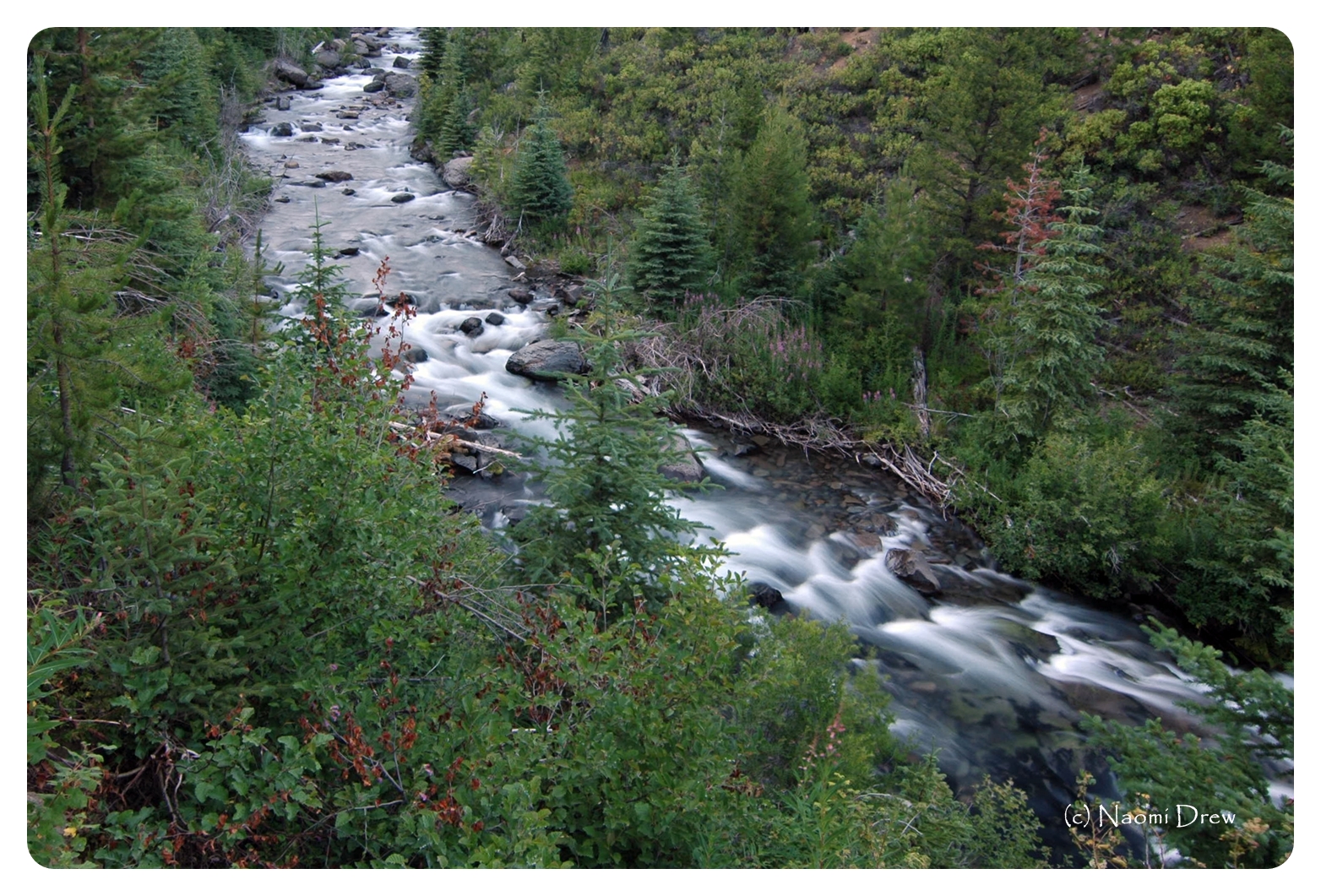
Pulling these out, a couple of months after our trip, I did a bit of cropping and other post-processing, but mostly I was considering the composition, and how a poorly composed picture may be improved by judicious cropping. Not so sure if it worked, but what I did learn was a little more about composition! Cropping something into a square is far more challenging than a rectangle . . .

 Ink, Yarn & Beer