
I do all I can to keep my face off the internet – but I guess a shadow is okay!

I do all I can to keep my face off the internet – but I guess a shadow is okay!
Because The Factory Dress is based on 1920s dress designs, I plan to use either my treadle machine or my 1920 hand crank machine. Both would be appropriate for the time period. Even if electrified, they would be fine, unless you didn’t have electricity. I’ll hand sew when necessary.
I think it would be fun to give some background on both machines. The Free No. 5 is not famous, but the Singer 66 is. If you go to eBay and search “The Free Sewing Machine” you will find a lot of them for sale. Anyway, a treadle machine allows you to use both hands as you sew. With a hand crank machine, the right hand provides the power, not your feet. Today, we will explore a bit about the The Free No. 5 treadle machine.
The Free No. 5 Treadle Sewing Machine
The Free No. 5 is a knock-off of a Singer 127 vibrating shuttle machine. It is a full-sized machine, having an 8″ harp and a vibrating shuttle mechanism. ISMACS has a number of brief articles about the No. 5 and other models made by Free.
This video shows you most of the basic functions of The Free No. 5, even though the blurb under the YouTube video says it is NOT a No. 5, for all intents and purposes, it is. The model “No. 5” is not painted on the head, but the decal pattern is the same ans the No. 5, the sewing cabinet is the same, and so on. If you watch the video, listen to the sound of the machine as it sews – I love it!
I bought my No. 5 about 20 years ago from a gentleman in Billings, Montana. He shipped it freight and it arrived on my doorstep in pristine condition. It was beautiful, and still is. Being new to vintage machines, I did not realize it had a long bobbin. In fact, it was the only long bobbin machine I had ever seen. I thought all sewing machine bobbins were round!! Well, eventually they evolved into roundness, but here I was, perplexed and frustrated. Thanks to the internet, and especially YouTube, I finally learned how to use the vibrating shuttle successfully. Interestingly, one of my closest friends told me she had grown up sewing on this same machine, but the Singer 27 version!
The story behind my No. 5 is, to me, so interesting. This man buys and sells household goods as a living, and this household was a prize. The story itself seems rather incredible. He found a household for sale, upstairs, downstairs, and in the basement. The house was ca. 1920 or earlier, but had been seriously remodeled to the point that new flooring was put in, a trap door about 3’x3′ constructed over the former opening to the basement, and forgotten. Only a skinny person could manage the staircase. In he went to find not only my machine, vintage and pristine and barely used, but also antique Stickley furniture in the same condition. How do you get such items out of a 3’x3′ opening? You take it apart and carry it up the stairs. The story, he said, was this machine was bought for the former owner who hated sewing – into the basement it went. And there it stayed until the 1990s.
My machine has proprietary attachments, but it does take a 15×1 sewing needle – at least there I didn’t get a lemon. I have a bunch of attachments, too, and original long bobbins. The original bobbins are longer than the new ones being made and are quite nice to use. Despite the length differences, the new ones work fine with a few tricks.
To be continued . . . .
Here we go: a Simplicity advertising video from 1948! It’s even older than me, which is saying something. Definitely it shows its time, but in some ways it is rather fine vintage. The acting is corny, but despite that, there are some really good little sewing tidbits on using a pattern and constructing a garment.
The sewing machine is, I think, a Featherweight 221 in a card table. The telephone is an oldy, too; I have one very similar to it, adapted for the plug-ins, now useless in the age of VOIP. I miss having it around! It always worked, especially when the electricity went out.
If you look, there is a wealth of knowledge here, as well as some pretty cool vintage things for us 72 years later. Funny to think they were very modern then! Anyway, the importance and value of hand stitching and basting, how to sew darts (top to bottom) using tailor tack markings, and if you look closely, using a thimble when sewing by hand, give you an idea of the value of such knowledge. It reminded me of some sewing tricks I’ve forgotten from good ole Home Ec.
I have never learned to use a thimble comfortably – most of us these days are probably in the same position. I do have a metal clamp-on thimble (not painful, just adjusts to your finger size) and a leather one. I prefer these thimbles to the traditionally-shaped ones.
Now . . . . which machine?
A couple of months ago I posted the live link to the webcam of the eagle’s nest in Decorah, Iowa. At that point,the eaglets were tottering around and just a few days out of the egg. Today, they are grown into young eagles as big as their parents. Still dependent on their parents for food, they are now practicing flying by flapping and flapping their wings.
Today, one is able to get a bit airborne. The other is not far behind. A third, though, has me a bit worried – it likes to stay lying down for the most part it seems, even though it does get up to walk around the nest. Since I can’t tell them apart, it may be a different one that stays lying down while the others wander and flap.
Eventually, the eaglets will fly to a branch. And then another, and then soar away. I am not sure at what age they become fully independent, but it is always exciting to watch them grow and flap and fly every year.
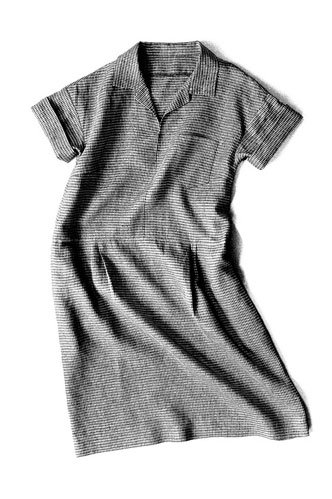
I thought I was going to hand sew a flapper-style drop-waist dress. The sewing gods are in disagreement, saying yes to the 1920s and no to the flappering.
Several years ago I bought a pattern called The Factory Dress by Merchant and Mills, a British enterprise with designs I really like. There is an elegance to them in their designs that is understated, yet practical, like good-sized pockets! The fabric I chose for this dress is a cotton weave from Japan in a darkish color with white woven rectangles. (I’ll photograph this later.) I cut the whole thing out this afternoon. The question is, should I hand sew it like I was planning, or should I sew it by machine? Something to brood about overnight, as well as whether I should line at least the skirt.
You can find this image on their website, along with some variations. Google “the factory dress” and you will fine even more!
 Ink, Yarn & Beer