Swamp

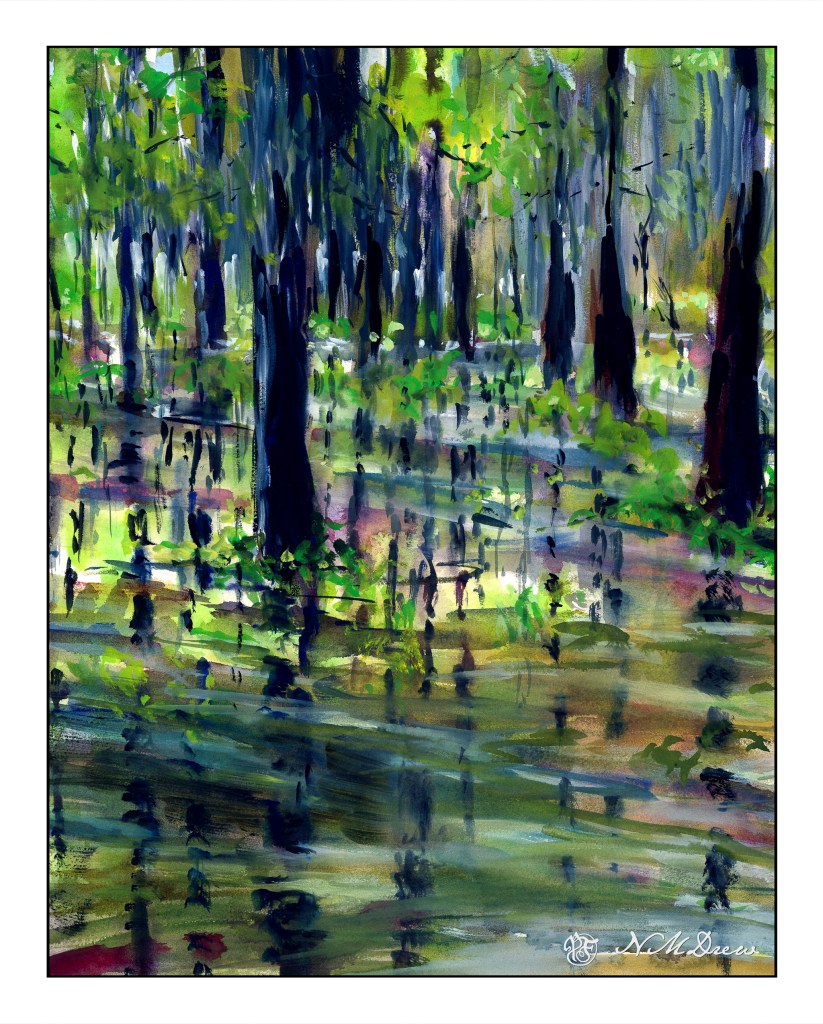
Swamps are amazing ecosystems. They are forested wetlands and often serve as a barrier between a large body of water – such as an ocean – and the land. Many of the Southern states are home to a number of swamps, such as the Everglades and the Atchafalaya Basin. Unfortunately, we have lost a lot of what they once covered through changing the land with drainage, building of levees, and such. The value of these wetlands has been seen with the massive flooding and storm surges during hurricanes when waves travel miles inland, across former swamps now denuded of trees and other plants. Heavy damage to the land occurs, with homes lost, pig slop and sheep dips overflowing into water sources. With the land clearing, wildlife diversity is also lost. The swamps provide a wall between the sea and the higher, drier land, as well as add to the overall health of the planet and wildlife diversity.

Here, an impression of a swamp in Louisiana, specifically the Atchafalaya. Once more, I worked wet-into-wet. And, I added gouache, which I am beginning to find is a nice mix with watercolor. The gouache works especially well over the transparent pigments, giving solidity and depth where needed. Arches 140# CP, 16×20 paper was used.

The Atchafalaya Basin, or swamp, is the largest swamp in the US. It is home to bald cypress. over 200 species of animals, marshland, grasses, and a resting place for migratory birds. In the 1700s, after le Grand Derangement, the French settlers of “Acadia were forcefully resettled elsewhere. Many landed in Louisiana, creating a cultural enclave of Cajuns, Creoles, assimilating English-speaking peoples who married them, and now, Cajun music is to be heard worldwide. Acadian became Cajun – and if you know your French, you’ll see the linguistic change.

So, in doing all this wet-into-wet, I am having a lot of fun, loosening up, and by bringing in gouache, I am adding a different element to my painting. Combining them is worthwhile as there are qualities in each that add much to a painting.

This painting pleases me enough perchance to be framed and hung up!

Wetlands

Another wet-into-wet painting, but this time with more challenges and a longer painting period. As before, 140# Arches CP paper.

The goal of this painting was to get away from trees and aim for seeing how using a very wet piece of paper could be worked for skies and water along with plant life, from rushes and grasses to distant trees. The style itself lends itself more to softness in general, but with judicious brushwork and glazes, more defined areas were achieved. I also used white gouache to represent a tasseled top to the tall reeds (or whatever) in the middle right of the painting; I realized I might have achieved an airier effect by splattering some frisket in the areas I wanted white.

I painted the majority of the picture last night, working glazes over areas more defined to blend them in more harmoniously. Dry brush was used for the the foreground and in areas where a rough edge was needed to show plants.

I don’t think this painting is as good as the one I did previously. The contrast is not good enough to convey distance – too strong of colors were used to paint the reeds and trees in the horizon. I do like the colors and softness, though. Another point of focus was to create a point of focus! I tried to use birds, warm colors in the center of the painting, a bit of a vignette around the edges, and other visual tricks to lead the eye somewhere. Again, I don’t think I had much success. As well, the sky and land do not seem to match.

I did accomplish a few things I set out to do – wet-into-wet with some control for sky and plants and water. Doing it is a lesson in itself, and each painting teaches something. I worked on the painting last night and then refined it this morning. I had more patience than I usually demonstrate when painting in watercolor. Why is that? Is it because watercolor is wet and watery and seems to demand a bit of speed?

Anyway, more to come, more to learn.

Early Morning

Another wet, wet painting in watercolor.

Here, I wet the paper, and then began putting in areas of color, beginning with the sky in the central part of the painting, and then blobbing down the foliage in the foreground and the distance. The line of the slope was separated from the horizon beyond. As things dried, I blobbed on more colors, and continued to work wet-into-wet as the paper dried. In the end, I was able to draw the trunks of the distant trees without their blurring using diluted colors of the darker tree trunks.

It’s really hard to describe how to do a painting like this. In doing these kinds of paintings I am finding it is necessary to have a sense of the composition itself – lights, darks, soft shapes, hard edges. It is also necessary to think about negative and positive space while painting, as well as the overall effect desired. I worked light to dark, and strove to keep the earliest colors as separate as possible from others. In the end, I used glazes to unify areas with color as well as worked with thick paint and a very dry brush for some detail.

140# CP Arches, 16×20. It took about 3 hours to work on, using time in between to dry the paper with a blow dryer or let the water get absorbed into the paper so softer edges could be achieved.

Of the 3 “splish splash” paintings I have done, this one is my favorite. This technique works very well for areas with a lot of foliage, but what about ocean scenes, skies, and so on? That is next on my agenda for this method.

This was a lot of fun – I hope you like it!

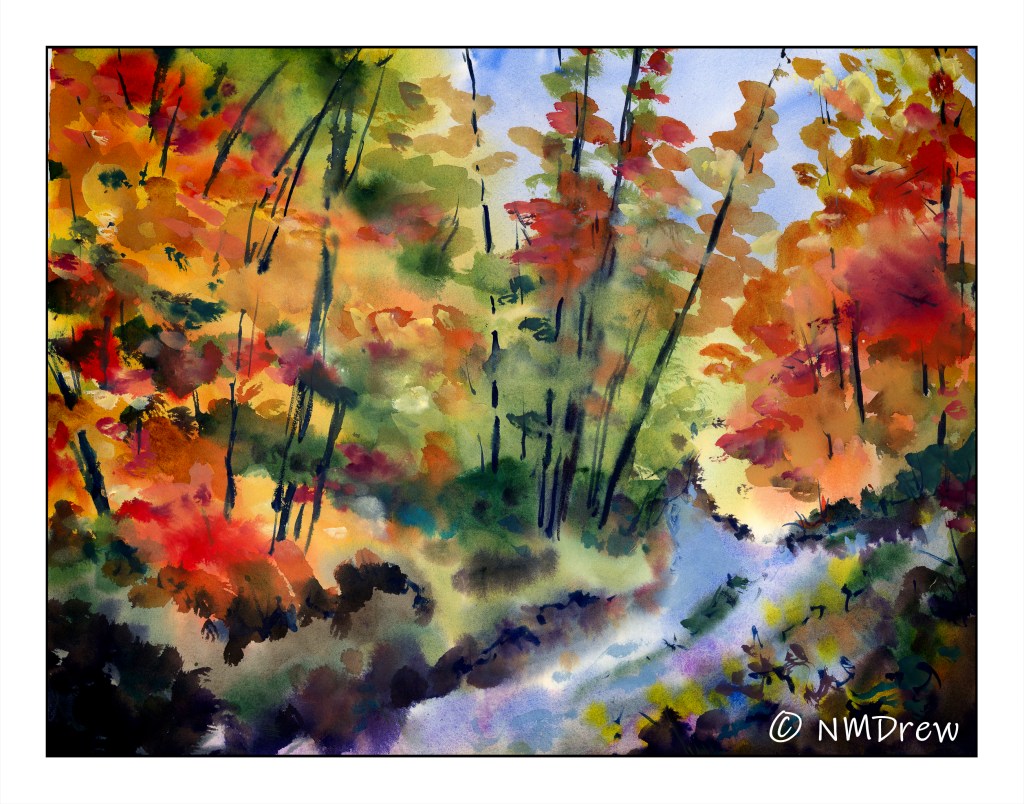
Autumn Explosion

More of the splish-splash effect this morning, and I will say it is fun. This time around I added some zinc and titanium white gouache to some of the colors – something I have never done with watercolors at all. It feels rather sacrireligious.

Fraggy, this painting title is dedicated to you! I loved your comment yesterday, and it really says it all about some days in autumn. 😉