
Once more, a class by Shari Blaukopf, “Sketching Boats: Simple Solutions for a Complex Scene,” has changed my approach to subject matter in watercolor and other media. I think this class amazed me the most in how it affected my own painting. As Shari writes:
I love painting boats, but this course is not really about that. It’s about simplifying a complex scene. So, while boats and their reflections are our ostensible subject, I’ll be sharing my tips and techniques for making visual sense from any scene of complexity.
Complex scenes – other than landscapes – overwhelm me when it comes to painting. I just have no idea where to begin. Looking at a bazillion things cluttering up the subject matter and deciding what to do is sometimes so much that it is better to walk away and try something simpler. For me, buildings are often the culprit, and this means city scenes go unpainted. Certainly scenes of harbors and boats and marinas are even more complex as boats sit on the water and are all about the same height – masts being the main difference in a marina full of sailboats. However, this class broke it down quite nicely, and while I am not especially enamored with the results, I am really happy with what I learned from this class and the general success of the painting.
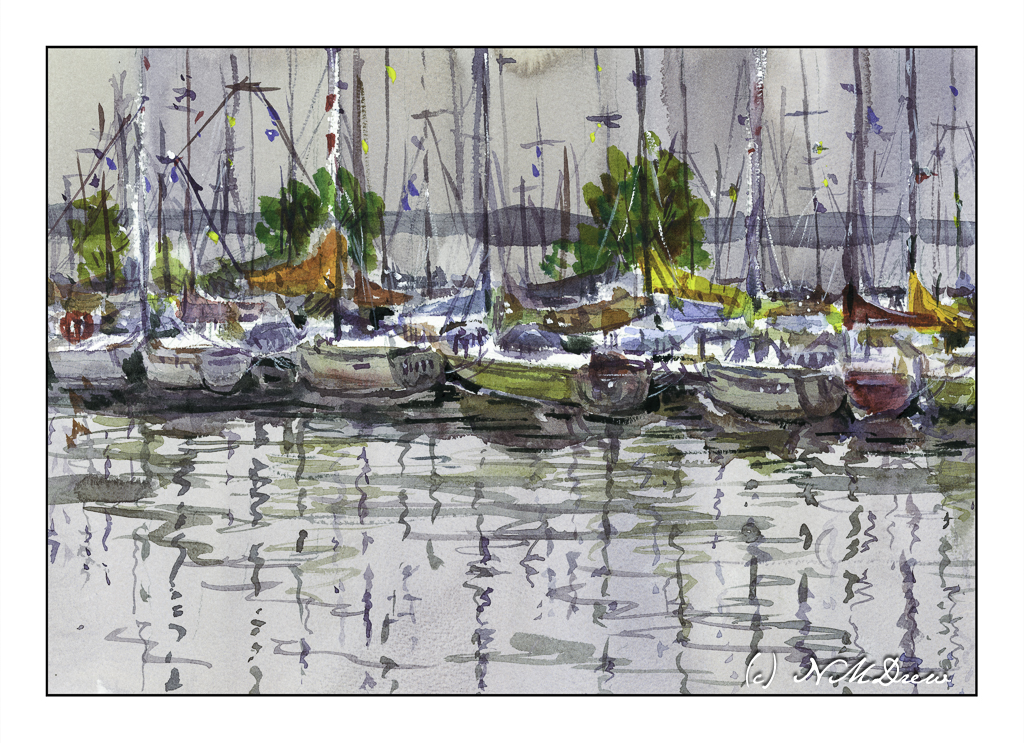
Essentially, the process is very logical and simple. The scene is drawn in pencil. The horizon line is determined, and then the drawing is begun. The boats, as they are the main subject, are drawn on an even level – they all are pulled up against a dock and the water is the surface. There are no hills or valleys. The boats closest to the viewer are drawn in detail, and the rest are suggested with shapes and lines, with their “oh, that’s a boat” qualities indicated when painted.
The sky and the forefront water first were painted along with the land in the distance behind the boats. Areas for larger masts, the white ones, are left unpainted. Then the detailed boats were generally limned in with color. Masts and reflections are indicated in this early period. From there, the painter works back toward the more distant boats and such. Eventually, details are added and final, tiny touches with color and white gouache complete the painting.
In summary: the simplest areas are completed first. The complex areas where detail counts is narrowed down to the first row of boats. Large to small. General to specific.
Writing this does absolutely no justice to Shari’s wonderful short course. I recommend it for watercolorists and any painter intimidated by complex scenes. Her breakdown of a complex scene is very simple – but I personally would never have thought about painting this way!
I was floored by my results – I did not expect to be able to do this painting at all.
Watercolor, short course by Shari Blaukopf, Arches Rough 140# paper, 10×14.
 Ink, Yarn & Beer
I think it’s an excellent painting Naomi! Well done indeed!
Thanks, Fraggy! I am surprised by it myself – may do another boat scene . . .
It’s another wonderful example of how relatively simple lines, shapes, and colours can render a very complex scene instantly recognizable. It’s testament to your skill as an artist.
Thanks, FishyFish! I think I am just a decent copyist! Hopefully the lessons will prove useful elsewhere.
I continually return to this painting because of its beauty. The water is gorgeous!
Thanks, Tagpipspearrl!