
Focus stacking – also called focal stacking, photo stacking, and who knows what else – is taking a series of images of one object and focusing at a slightly different distance from the previous photo. From there, you merge all the images to create one highly detailed image.
I’ve done this before using a manually focused set up, but after looking things up, it turns out the Nikon Z6ii has a built in focus stacking set up where everything is automated. It doesn’t take very long. I decided to try it out, following instructions on YouTube. They were easy to follow. My parameters, if you are interested, were as follows: 100 images, set apart by “1” in the Nikon menu, and an interval of “1”. What all this means, no idea, but I did it, and in a few minutes I had 100 images. My lens is 50mm at f/8.
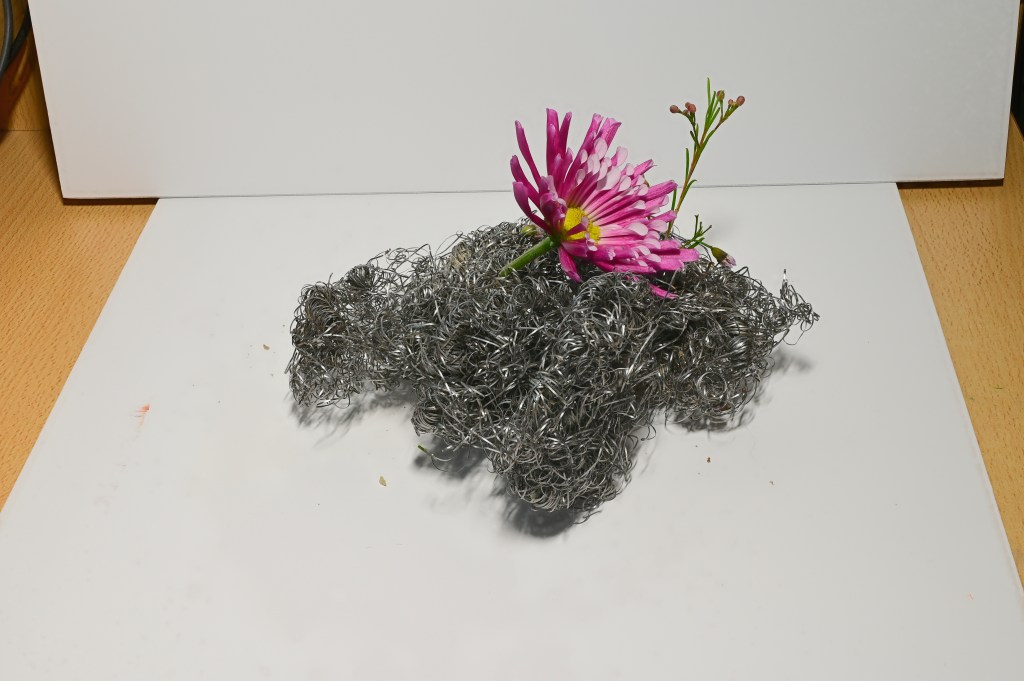
Zinnia & Steel Wool
This is what the original stacks looked like after using Zerene software. Zerene is a software I have used years ago, and it works great. It takes a bit of time, but I think a dedicated program helps a lot. Photoshop does focus stacking as well, and so does another program, Helicon, but this requires an annual license or a lifetime license, and comes with various grades of licensure. For me, Zerene is just perfect for what I want to do.
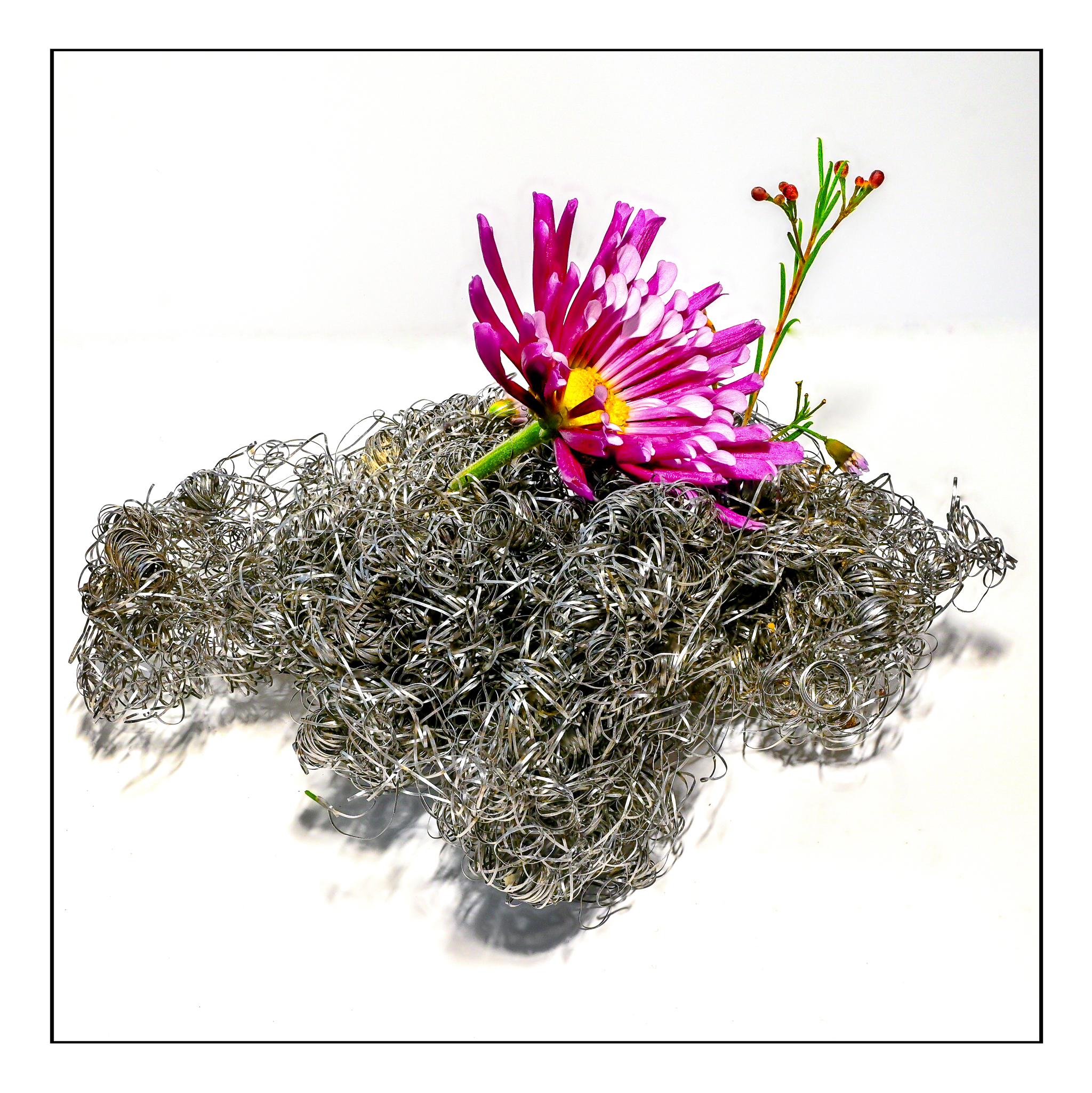
First of all, if you want more detail of the above picture, click on it and enlarge as big as you can get it. You will find the little hairs on the zinnia stem as well as flaws in the photo stacking, but it is worth looking at methinks.
Obviously I did a bit of post production! I had to use the spot fix in LR and On1 to get rid of the line where the 2 pieces of foam board met up. I also had to get rid of spots and splodges. I increased the exposure a bit, upped the whites, blah, blah, blah. Let’s just say it took some time, but made me think that perhaps investing in a light box might be a good idea. I tried to make this look as nice as possible without going nuts and getting picky to the point I was ready for the zoo.
Kris over at Wicked Dark Photography does a lot of outdoor focus stacking of small things, like moss or mushrooms, and her lovely work made me realize there is a lot more potential here than getting nice photos of things to sell on eBay. Kris’s work as a photographer just really appeals to me as she knows a lot about nature, enjoys trees and water and even spiders (which I like outdoors and not enlarged!) and small plants. I look forward to her weekly posts as she is often out on an adventure with which I can travel along, especially on her videos.
 Ink, Yarn & Beer
Nice pic with lots of clear detail! Judy
Thanks, Judy! Focus stacking is really fun. I should have used my macro lens perhaps, but for this attempt, it was still a good lens to use.
Great image! I’ve never tried focus stacking. Traditionally it’s so much work, and I’m lazy! I should check to see if my camera will do it automatically. I like the way the steel wool looks when you zoom in.
Thanks, Anne! Give it a shot – so to speak – it is really kind of fun, with or without the automation. Before I did it with automation, I would put my tripod on a camera, make sure my focus was good, and then starting before the object I would shift the focus area and snap a picture. Camera shake is important to consider, so I would use a delayed timer of 5-10 seconds since I didn’t have a cable. F/8 works well as it is sharp in most cameras and has enough DOF for image overlap. YouTube has videos on how to focus stack in PS, so if you have the latter, off you go if you want to!
Thanks -N!
Awww, thanks and nice stack! Such a treat of texture and color – quite unexpected. And 100 shots?! Phew. I don’t think I’ve ever done one that big. You’re really pushing the tech and it worked great.
Thanks, Kris! I always overdo things . . . but here, was not sure what could work so figured the best is to max it out and then work backwards. Automation is definitely your friend here – other stacks I have done manually probably had less.