
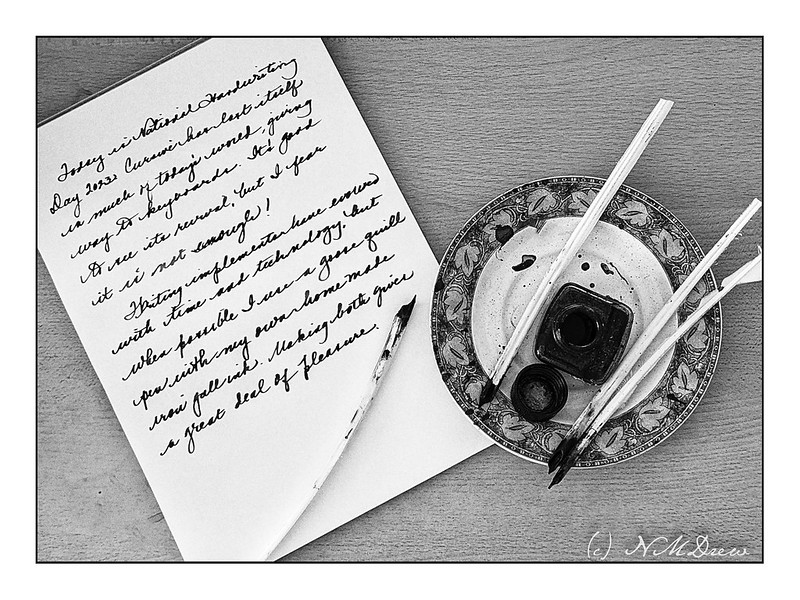
Handwriting has gone the way of the dodo, and cursive even more so. When I was teaching, it really surprised me to find students who were barely able to hold a pen or pencil, much less form readable printing or cursive. Apparently kids are forbidden to use cursive in hand-written work these days because they just can’t do it neatly. And while I disliked practicing handwriting, today I will say that I am so appreciative of the fact that it was part of my public school curriculum on a daily basis for grades 1-8. Today? Well, keyboarding is taught, and learning to touch type in high school has really paid off, but I still turn to pen and ink and paper, and on a daily basis I prefer quills I have cut myself, and iron gall ink I make as well.
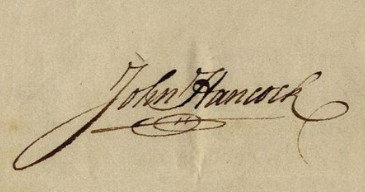
Here in the US, National Handwriting Day has apparently been a thing since 1977. Choosing January 23 is because the first person to sign the Declaration of Independence was John Hancock, whose signature is famous for its beauty. The expression of “put your John Hancock here” or anything similar is a way of saying “sign on the dotted line.”
Times change and we need to adapt, but there are times when I think modern technology and the wonders of the computer age mean we lose what we use to have. In a way, the book Fahrenheit 451 makes a point for preserving older technologies, and having people memorize whole novels is much like the oral traditions of countries where not everyone could write. Working together, old and new can preserve our history – and what we consider to be a daily thing (i.e. writing a letter on paper!) can vanish. Digital archives preserve such knowledge, but to acquire this knowledge again means actual, physical experience.
If you look at my little blurb in the photo, you can see my handwriting is okay, but I don’t always make my letters correctly and have to backtrack over them. When I was in school, if I had to turn in a handwritten essay, such mistakes would bring down my grade. And if I made them – well, I just started over.
So, cheers to National Handwriting Day. Reading cursive and handwriting is important and the best way to learn is to be taught at an early age. Apparently students not taught handwriting and cursive lose out on far more than just an ability to pick up a pen or pencil and communicate on paper.
Come to think of it, do kids even pass notes in class? Or do they text and hope they don’t get busted for using a phone in class?

 Ink, Yarn & Beer
I learned cursive at school too, but don’t use it now. For a few years I did calligraphy too, it’s nice to have lovely writing. Of course I just scrawl the shopping list nowadays, sigh.
My handwriting was never that good, but it was readable. When they proposed to not teach cursive in school, I heard that a student said, “Then how will I be able to read the Declaration of Independence.” I don’t know if anyone actually said that, but it’s true. Sometimes yielding to technology is not a good thing!
I still use cursive when I write!
I love to write by hand, and I have a nice hand. Regardless, 90% of my words are typed.
My early-Gen-Z sons can’t read my cursive. I don’t love that.
The point about the Declaration of Independence is a good one. So many historical items are handwritten letters and documents. Reading them will become like learning another language!
I agree, Kathy. Makes me feel sorry for kids – it will be harder as they get older, too. It is so automatic for us!
That”s too bad for your kids, Jim. I keep thinking if I had kids today, one thing I would make sure they learned was to write cursive. But then think about this – their teachers might not be able to read it!
I like to use cursive, too, when I write. I would rather use a written list than one on the phone. Good to know, Merilee!
I agree with you, Anne. We need to write by hand. What happens it you can only keyboard an SOS when you crash land on a desert island???? 😉 Don’t yield to technology! Fight the fight for cursive!
Yeah, Fraggy, I think you probably just scrawl a shopping list in a beautiful calligraphic hand. Lovely handwriting is something that I think most people can learn, but they just need to be given the time to practice it. What I find so interesting are the different ways cursive is taught worldwide – some with a decided right slant, such as in the US and in England, too, when Roundhand was taught. France and Germany have more upright cursive, and doesn’t England teach a more vertical one these days? I would rather write shopping lists by hand, so . . .
I have no idea what they teach here anymore, judging by my grandkids writing it isn’t any sort of cursive!
Hey, Fraggy – I read, and perhaps misread, that English / British schools went from a right-slanting cursive to a more vertical, upright one, making printed letters easier to connect. The cursive I learned is akin to the Roundhand of the late 1700s / early 1800s in England, and part of it was the Palmer Method as taught in the US in the 20th century – a frills-free simple, concise, clean hand for business.